
The Breeders are working on it together
Kim Deal and Josephine Wiggs talk to Paste about touring with Olivia Rodrigo, how concert audiences have changed, and trying out the band’s new, unreleased material on the road.
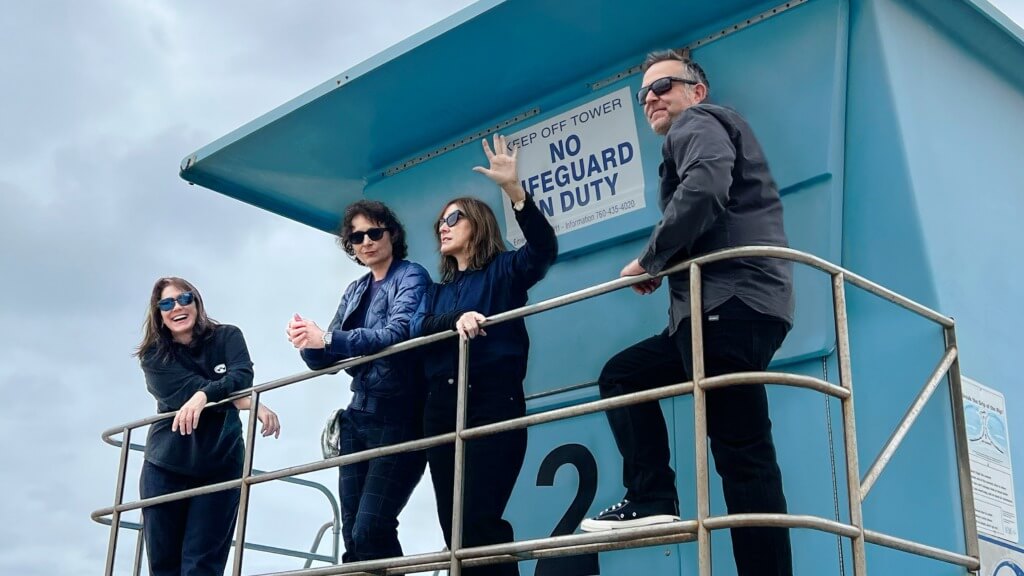
Photo by K. Rector
I heard “Cannonball” for the first time when I was fourteen. I didn’t know who Kim Deal was, and I didn’t know where her wheezy, distorted vocalizations ended and the equally distorted guitars began. I was a Pixies fan but I didn’t know that “I’ll be your whatever you want” was a kiss-off toward their frontman, Black Francis—Deal’s non-apology for being a breakout star instead of an obedient sidekick. All I knew was that listening to “Cannonball” felt like being hit by a train from inside my head. And I was hit all over again at The Fillmore in Philadelphia this past weekend, when Deal’s metallicized howls met the mic, melding with the hiss of Jim Macpherson’s snare and the rabbity thumps of Jospehine Wiggs’s bass. I let my voice drown in the noise of the rest of the enraptured crowd shouting back at them: “I’m the last splash!” In my headphones, “Cannonball” tore through my teenage brain; played live, years and years later, it swallowed up the whole room.
It’s a polite crowd at The Fillmore, appreciative but never as wild as the ones the Breeders had back in the nineties. “I remember audiences back in the day being really out of control,” Wiggs says when I hop on a Zoom call with her and Deal a week before their Philly concert. “The audiences themselves were a spectacle, to be honest, in terms of their enthusiasm and vigor.”
“It was the style at the time,” Deal continues, in perfect Grandpa Simpson cadence, “to jump onstage. And then I’d notice there was a line to get onstage. And the crowdsurfing! People were annoyed because Doc Martens would hit their faces, so that’s why they’d yank the boots off and throw ’em on the stage.” At one show in Barcelona, the Breeders were forced to stop playing and end the set early because the club promoters were worried the floor would cave in from all the jumping: “They took us downstairs to the basement and they showed us that the ceiling and poles were cracking,” Deal remembers.
That kind of thing doesn’t happen much anymore. Beloved as the Breeders still are after thirty-plus years, a hiatus, and several lineup changes, their audiences have calmed down a bit, preferring to express their appreciation in subtler ways. As the emphasis has shifted from bands to soloists and the “indie rock household name” has become a diminishing category—and as acts like the Breeders have risen to occasional arena rock status as a legacy band—the crowds drawn tend to be considerably less rowdy than the ones they used to play to. That doesn’t mean, though, that the Dayton four-piece has gotten any less relevant; merely that their fans might be a bit less vocal. An interviewer recently asked Wiggs if she knew how excited people were to see the Breeders live. “And I said, ‘Well, no.’”
This is, in part, because the crowds themselves have changed—in demographic, yes, but also in expressiveness. The days of floor-caving and boot-throwing are long gone. “When you see audiences now, they’re not like that,” Wiggs says. “I think what’s happening is that people’s enjoyment is interior.” She theorizes that the omnipresence of phones is one reason audiences have become less expressive: when most so much entertainment is solitary and face-to-screen, people are more likely to internalize their enjoyment.
I wonder if it has something to do with my generation’s self-consciousness—how we’ve grown accustomed to someone recording us, giving each of us a perpetual security camera in our heads. During the Breeders’ rousing performance of “Hellbound,” I find myself questioning whether, in tempering our reactions to live music, we’ve also diminished our capacity for collective catharsis. We’re under no obligation to put on a show in response to one (usually it’s better if we don’t), but have we made the conversation more one-sided than it’s supposed to be? On a more practical note, the Breeders are now playing bigger venues with stricter security where activities like jumping onstage won’t fly, so audience members know better than to try it. Or, maybe, the fans have just gotten older and settled down.
Well, not all the fans. Two years ago, Olivia Rodrigo invited the Breeders to open shows on the GUTS tour, citing them as an influence for her nineties alt-rock inflected tunes, and introducing the Deals’ band to a new generation of listeners. It comes in waves, Kim tells me, and that “the Breeders have a different cycle of resurgences than the Pixies.” At least when I was young, and under the tutelage of the cool adults in my life who recognized my appetite for loud, freaky guitar music, Pixies were the canon. But, as these mentors would tell me, if you really wanted to be in the know, you listened to the Breeders. Now, not a day goes by where I don’t receive a press email with “FFO: The Breeders” in the subject line.
Later this summer, the Breeders will reunite with Rodrigo to play Daisy Chain Fields, her Lilith Fair-inspired music festival featuring an all-female lineup, with proceeds benefiting various feminist nonprofits. Wiggs admits that she and the rest of the band were pretty shocked when Rodrigo invited them on tour. They didn’t know much about the former Disney kid-turned-popstar, but a certain subset of Rodrigo’s audiences definitely knew about them. “Quite a number of people at those shows had come with their parental units,” Wiggs tells me. “You could see the parents really digging our show and singing along and knowing all the words.”
We can only hope that somewhere out there are some middle schoolers who became diehard Breeders fans after watching them open for Rodrigo. I think once again of my younger self and all the brightness and defiance she gleaned from “Cannonball”—not a “power ballad” in the traditional sense of the term, but both of its individual parts sparking from loose loud-and-quiet ends between its minimal, “fuck-it-all” lyrics, so much wanting and caring in the subtext of a song whose text suggested otherwise.
To say “Cannonball” tells a story is a stretch, but it lays out a map of clues from Deal’s frustration with her second-string status in the Pixies to her then-newfound bandleader status. Though the Breeders began as an escape plan led by Deal, it was never meant to be The Kim Deal Show—she didn’t want to leave one creatively stifling group just to replicate that dynamic in her new band. The process has always been a collaborative one, with all members holding one another to an interdependent standard, one that leaves room for spontaneity. Three decades down the line, that still hasn’t changed.
Asking how the band has managed to stay so in sync with one another after all these years (and over such a great distance) feels like asking a lifelong couple what the secret is to a happy marriage and predictably, getting no one straight response. Wiggs offers a practical answer: “One of the reasons I remain underemployed is in order to have the flexibility to respond to the text that says ‘you have to come here NOW.”
Wiggs and Deal have an affectionate, needling rapport—Deal with her cheerful Midwestern candor, poking fun at Wiggs, who catches all Deal’s jests with a dry and droll British wit. Within the first three minutes of our Zoom call, Deal sarcastically gushes about how much Wiggs, The Breeders’ odd Brit out, loves Dayton—hometown of Kim Deal, her twin sister Kelley, and drummer Macpherson. (At the show, Deal makes sure to asterisk her introduction of “We’re from Dayton, Ohio!” by clarifying immediately afterward that Josephine is not.) “A lot of times I’m like, she’s so hoity-toity and London and all that,” Kim tells me. “But you know what? She was from Biggleswade!”
Wiggs, her voice betraying no trace of exertion or protest, responds, “But it’s forty-five minutes away from the capital of the country!”
“We’re forty-five minutes away from Cincinnati!” Deal counters.
Kim Deal’s real-life twin is in the band, but in Kelley’s absence, it’s Kim and Josephine who rag on each other like sisters. The two go on another digression not long after, when Wiggs reveals her lifelong distaste for holidays, much to Deal’s dismay: “You don’t love Valentine’s Day, Josephine? Easter? Does the U.K have an Easter Bunny?”
Deal and Wiggs’ silly-one/stoic-one dynamic is practically the same onstage as it is in conversation. “We have an English person in the band, so that means we’re classy. And we can do Beatles songs!” Deal says onstage at The Fillmore, gesturing across the stage to where Wiggs is posted up next to a taxidermied crow perched atop the amp. In her all-black outfit, Wiggs matches her beloved stuffed mascot. Deal sports a bright blue Jaws sweatshirt, and she’s not kidding about the Beatles songs—their live rendition of Pod’s “Happiness Is A Warm Gun” cover cracks open each air molecule. It sounds as suffocating and electrifying as it did the day Steve Albini captured it in the studio.
Wiggs’ basslines are the firm foundations on which Deal and co. can play. A track like “Cannonball” shoots off every which way, but it’s that bassline that holds it together at the center. Wiggs tells me that her YouTube algorithm recently fed her a Super 8 video of The Breeders playing a show in Olympia, Washington, circa ’92, which included an early, lyricless version of “Cannonball” without “all the stops and starts.” It’s almost impossible to imagine—“Cannonball” is all its stops and starts, not the same song if it’s not being jerked around in one direction or another. Still, Wiggs remarks that she was impressed at how fully-formed even that embryonic version of the Breeders’ most iconic song was. The vision was there from the beginning. Each rough draft contains the essence of the final form, the process of revision and refinement is a scavenger hunt to find it.
Or as Wiggs puts it: “We have to go out and tour, we have to go out and play these songs in front of people so that we know how we feel about them, so if there’s a dead spot in a song, get rid of those four bars! You don’t know how it’s going to land,” she says. She’s got this amusing habit of raising her voice on specific words for emphasis, like when she tells me: “In order to really hone a song and make it be the best it can be, it’s really important to play it live before you record it, so that you can WRING OUT ALL THE DEAD SPOTS and the STUPID THINGS that only work in the studio but will NEVER WORK AGAIN!”
“It’s weird ’cause some stuff sounds good recorded, but when played live it’s just meh,” Deal adds. “Or it’s the opposite.” She also reveals that, on this tour, the band will try out some new material—unreleased, unrecorded, unfinished songs that they’ve never played live before, “like it was back in the old days.” A few of them make it into the Philly setlist, and they sound as spotlight-ready as the ones the Breeders have been playing for decades. The standout comes during the encore, a slow-rattling scorcher by the name of “Alien Eyes.” Its “stops and starts” are similar to the ones on “Cannonball,” but “Alien Eyes” is altogether something weirder and darker and more molten. Macpherson’s pebbly drumming is painfully restrained, which only makes Deal’s thick, jagged riffs hotter to the touch. Few words are discernible beyond the chorus, during which Deal sometimes commands and other times pleads: “Don’t look at me with your alien eyes!” Her words fall out in thick slabs.
Even more impressive than the relative polish of the new songs is the malleability of the old ones, which maintain their intuitive, often improvisational feel even after thirty-plus years of practice. As the Breeders’ faithful rhythm section, Wiggs and Macpherson dig in and refuse to let go on “Off You;” on “Divine Hammer,” they give the people something to dance to. Deal sounds as daydreamy as ever when she sings “Drivin’ On 9”—the favorite Breeders song of the two girls in front of me, who tell me before the set that they’re gonna “freak out” when The Breeders play it, and make good on that promise. Kelley Deal cries out “Step aside, sis!” before taking over the mic to sing “I Just Wanna Get Along.” (Kim once joked about the track’s origins: “Mom said I had to let Kelley sing this one.”)
Both Kim Deal and Jospehine Wiggs have put out solo records in the past few years. Wiggs’ instrumental album, We Fall, came out in 2019, a major change of pace from her work with the Breeders: “Even though I really like being in charge and making the decisions I want to make, it can also be really difficult because there’s no one to bounce ideas off of, there isn’t a feedback loop there in the way there is when you’re working with other people.”
Deal had a similar experience recording her 2024 solo album, Nobody Loves You More, a record she envisioned clearly from the start and recruited a revolving-door array of session players to bring to life—a starkly different recording experience from building an album as a member of a band. “I go where I want while I’m still on the planet,” she sings on “Disobedience,” the grandest, most declarative ballad on a record full of big swings of the orchestral and electronic varieties. It’s got Deal’s characteristic lyrical minimalism, but much like “Cannonball,” its bombastic and immediate instrumental arrangement affirms the ambition that the lyrics only begin to reveal; unlike “Cannonball,” nothing on “Disobedience” is shrouded in disaffection. It’s blatantly, unabashedly sincere. She describes herself as “white hot” and “wide-eyed”—four decades and two all-timer bands into her music career, she’s still in awe, still hungry for all she’s yet to learn. “With [Nobody Loves You More] I kinda had how I knew the songs were gonna go, and I got really good players to record them,” Deal says. “But with [the Breeders], I don’t know how it’s gonna be. We’re working on it together.”
Onstage with the Breeders, Deal launches into each song like she’s pulling a sword from the stone. When she plays the opening chord, signaling the rest of the band to fall in, Deal looks as if she’s just discovered that if she strikes the strings in a particular way, music will come out, and every time it happens, it’s the coolest thing she’s ever seen. There’s not a single moment where Kim Deal doesn’t look like she’s having the time of her life.
Grace Robins-Somerville is a writer from Brooklyn. Her work has appeared in Pitchfork, Stereogum, The Alternative, ANTICS, Marvin, Swim Into The Sound, and her “mostly about music” newsletter, Our Band Could Be Your Wife.
 Keep scrolling for more great stories.