
Tori Amos spins a compelling but uneven allegory on In Times of Dragons
On her eighteenth studio album, Amos is reflective, angry, self-referential, and sorrowful, but never subtle. The results are often effective, but sometimes cumbersome.

Our strange times. I’ll be the first to find this phrase a nasty and rather indifferent indictment of our present moment; it carries to me all the laziness that often precedes, and persists through, catastrophe. Indiscriminate drone strikes and state-supported genocide? Our strange times. The Pope making an anti-AI statement? Our strange times. Files on Jeffrey Epstein being drip-fed to us by the Department of Justice like singles off a new album? Our strange times. The Knicks overturning a twenty-nine-point deficit and scoring their winning point in the last 1.2 seconds of an NBA Finals game? Our strange times! It’s a catch-all, a sort of shrug that we can deploy as a get-out-of-jail-free card if we so choose; it bears no opinion apart from one that we can all agree on: that life has changed, quickly and astronomically, and things that we used to think would never happen have happened. This strikes me as a basic, boring observation, so it’s refreshing when artists do away with veiled statements and say what they mean.
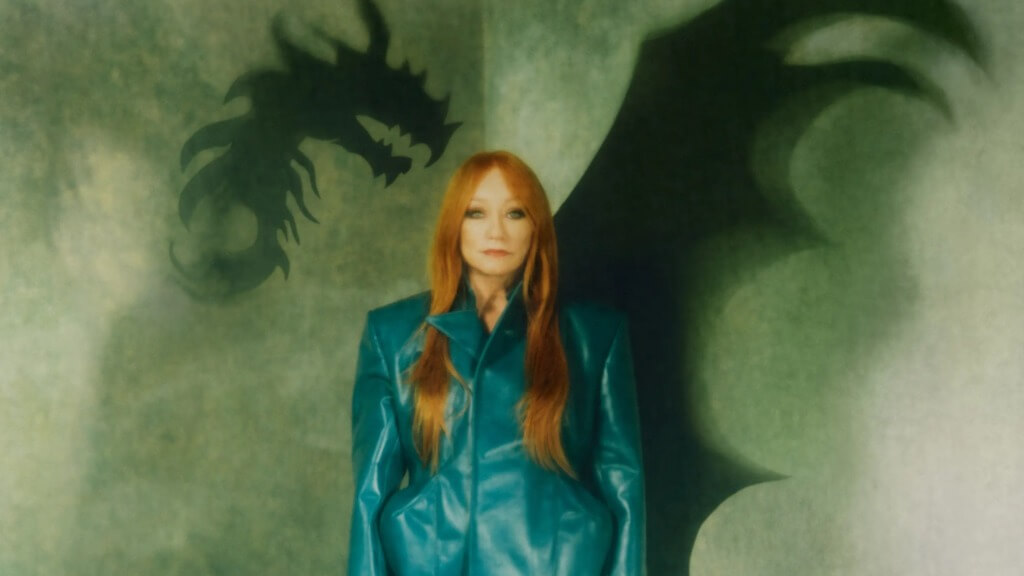
On In Times of Dragons, as on many of her preceding albums, Tori Amos makes sure to do exactly that. This, her eighteenth studio album, delves once more into the narrative elements that offer her music such color and character, and Amos writes of encounters with all manner of characters with great acuity. There are the antagonists, of course: the Lizard Demons, representative of Western society’s billionaire class. Then, the allies that our character comes across: a rotation of witches, gods, and priestesses that are familiar from Amos’ previous work.
But the most crucial opponent whom Amos wrestles with is herself. When she appeals for help in defeating the Lizard Demons on album closer “23 Peaks,” she does so with an air of penitence, as a villain looking to be pardoned. Far from a hero battling against her dragon of a husband, she too is a “half-dragon, half-woman thing”; she needs their help, she says, to change “back into the woman / I want to be.” “Could you take this burden from me?” she asks them. The burden is not society’s sins, nor those of her billionaire husband, but her own. We are all, Amos suggests, sinners and sinned against; complicit in the times we live in, architects of the destruction we are wreaking on our environment, our democracy, our culture, ourselves.
It is an assertion that elevates the often-simplistic allegory running through In Times of Dragons. Amos says what she means. Her bluntness is a tonic when so many of her peers remain reluctant to speak at all. But specificity does not always equate to nuance. In Times of Dragons is rooted in a world littered with bad actors, billionaires, and oil barons, but Amos’ reactions to it often feel cumbersome, too laden with what we already know. “Stronger Together” is a particularly cloying assertion of solidarity that feels relentlessly optimistic. Even “in menacing times / stripped of rights,” Amos suggests, with uncharacteristic naïvety, “we found we could tackle it / and we could talk about it… and we could together.”
Occasionally, these affirmations come with a lick of humor, as on the jaunty “Fanny Faudrey,” which gets away with the heavy touch of its lyrics (a plea to the eponymous “Fanny the Feminist” of days gone by to “just keep teaching me”) by setting them to a catchy, folksy fragment of melody. Often, though, they feel labored. At her best, during the extraordinary three-album run of Little Earthquakes, Under the Pink, and Boys for Pele, Amos was doing what others weren’t and couldn’t do: constructing sprawling fantasies that were beautiful and ugly, forceful and precise because of their nuance, not in spite of it. She didn’t pull her punches, but those punches were weird, specific images that stuck in your mind: of cornflake girls, star fuckers, cats named Easter, the Antichrist yelling in the kitchen. On In Times of Dragons, they feel disappointingly broad or literal: it is “the patriarchy” that silences women, “ICE” that runs riot in Minnesota. Nuance is lacking, and it is needed; not to obscure Amos’ meaning, but to enrich it.
Still, In Times of Dragons is an engrossing listen, and many of its tracks show glimmers of Amos at her best. As always, it is her dexterity and intelligence at the piano that mark out these songs. “Provincetown” is an undeniable return to form, a deceivingly warm-sounding piano that loops in on itself, giving the track a feeling of momentum as Amos describes her journey “goin’ up to Provincetown”; the beautifully delicate whir of a harpsichord, floating above Matt Chamberlain’s lively, precise drumming. Similarly, tracks like “St. Teresa” and “Song of Sorrow” ooze and brood. The former features a synthesizer that casts a shadow over Amos’ lower register, pushing her voice to the edges of the track. The latter uses orchestral instruments to great effect. John Philip Shenale’s arrangements deepen and complicate Amos’ piano line. Her voicings on her Bösendorfer are evocative and intelligent as ever; they make much of In Times of Dragons a pleasure to listen to, even if the overall landscape they paint can err towards uniformity.
In Times of Dragons is an album of fits and starts. Its highs are as dizzying as any in Amos’ back catalog, and her voice—now with a touch of weariness to it—is as affecting as ever. Where the record falters is in its reluctance to move past first-order readings of the world it confronts. The allegory she has built is big and bold, but it’s painted only in primary colors. What a shame for an artist with such a varied palette at her disposal. [Universal/Fontana]
Mariam Abdel-Razek is a writer and critic based in London. Her writing has previously appeared in The Line of Best Fit, The Tonearm, and Varsity.
 Keep scrolling for more great stories.