
Trans Music Archive is documenting a renaissance
Q&A: Co-founders Ariel Loh and Rowan McDonald discuss physical media, artist partnerships, and supporting trans musicians making art under technofascism.
Photos by Day Rose Lane, courtesy of Trans Music Archive

Trans Music Archive (TMA) is barely a year old, but in a short, and often downright dismal, span of time, they’ve made some incredible things happen. The passion project of producer and sound engineer Ariel Loh and software developer Rowan McDonald, TMA is a nonprofit record label and physical archive devoted to compiling and preserving the works of trans musicians in analog formats, namely, vinyl.
We’re living in a time where censorship is on the rise and developments in tech threaten to infringe on people’s privacy and intellectual property; trans people are particularly vulnerable to these perils. TMA’s mission encourages divestment from predatory streaming platforms that push AI music, underpay artists, and provide only the illusion of discovery. Their vinyl-focused, small-batch approach to distribution and preservation favors the tactile and the personal. If streaming alienates artists from listeners, vinyl reminds us of the humanity and labor that goes into creating not just a work of music, but a physical art object.
Central to TMA’s mission is sharing and celebrating trans artists—often influential in retrospect but sidelined in their time—and getting them paid. While the digital world can be quite hostile to trans artists (and the trans community at large), TMA offers refuge in analog. Founded as a historical preservation project, TMA has implemented programming that’s geared toward trans musicians, including mentorships, artist residencies, and workshops, giving trans musicians resources and studio time that’s often inaccessible. They’ve hosted listening sessions and concerts at venues across New York City and Los Angeles. Last year, Loh made history as the first trans Asian-American woman to win a Grammy, producing Iman Jordan’s pro-Palestine anthem “Deliver,” which won Best Song For Social Change.
Loh and McDonald hope to open a brick-and-mortar location where they can house the archive, sell records, and host events. But for now, the Trans Music Archive lives in a Ridgewood apartment, tucked away in a large vinyl collection. The morning before Record Store Day, I paid them a visit to chat about physical media, artist partnerships, and providing material support to trans musicians making art under technofascism. The following interview has been edited for length and clarity.
******
Paste Magazine: Let’s start from the beginning. What was the impetus for creating this organization?
Ariel Loh: [Trans Music Archive] started in March 2025. We were at a Red Hot panel with Ceyenne Doroshow, Imara Jones, and L’Rain. They had a really lovely conversation about all sorts of things but specifically it was like… Trump just took office again and it was very like, “What do we do as artists in this state?” and the importance of artists recording what’s happening through analog means in an increasingly technofascist state.
Rowan McDonald: Imara said, “Nothing on [your phone] is your friend. It will not protect you. It endangers you.” There’s actually this video of us after the panel where you can sort of see this light go on in Ariel’s mind. We went to the bar afterwards and she was like, “We should be pressing vinyl for trans musicians.” And then I sort of had the idea of adding the historical archive part of that to the project to create this forwards-and-backwards-looking project of preserving trans music.
AL: To back it up even further, when I was living in LA from 2020 to 2024, I was hosting this queer producers and songwriters music-share called Show and Tell—works in progress, people get feedback and stuff. One of the artists I met there was Iman Jordan, who we went on to get the Grammy with a year later, which is crazy. During that time I was wanting to do some non-profit queer record label-type thing but just couldn’t figure out what the model was that made sense—that felt needed I guess.
Specifically, with the idea of a record label or non-profit record label, if we’re doing digital distribution, we’re still having to, like, own or license rights from artists and we have to maintain that. Our whole thing is: we don’t want to meddle in the rights of artists. We want to make sure they have 100% control. I had those seeds planted in my head. It didn’t quite work out, so I kind of shelved it. But when we were at this panel, it just clicked.
I want to talk about the rights and ownership aspect of this. Is that why you filed for non-profit status?
AL: We want to be able to have the artists have their own rights, so we don’t really do digital distribution at all. We’re just licensing the rights to print 100, 250 copies on vinyl. And then that’s not like a 10-year or lifetime term. Once we sell out these records, we’re done.
RM: But also, something important to our financial model is that we never want artists to owe us money. So from the first record we sell, we keep the production cost so we can recycle it into the next project and the artist gets all the profits. There’s no traditional model where we’re trying to recoup before the artist makes anything. The nonprofit and donor model helps us be able to work that way.
AL: And it’s nice too, because it really gives us this partnership with all the artists we’re working with. It’s not like a traditional label, which is extractive and like a bank loan ultimately. Even if they are really collaborative with the artists, it’s still like, “We’re loaning you this money and you owe it back.”
How does the Trans Music Archive model work in terms of rights and licensing and royalties when you’re working with signed artists and including their labels in the partnership?
RM: So, because we’re a nonprofit with a historical archive aspect—and because we only do vinyl—labels are actually, surprisingly, willing to work with us. One, we’re typically working with artists who would not have vinyl otherwise, so the label isn’t interested in putting this money out. And two, most labels see this project and want to support it. Even labels whose artists we aren’t working with have donated records to our archive. We’ve got a lot of support; it isn’t competitive with them at all. About half the records we’ve put out have no label associated with them. [If they do], we just co-brand and, often, those labels are extremely happy for us to keep the cost of production and for 100% of the profits to go to the artist.
AL: Sometimes they’ll take their cut that they have pre-agreed-upon, in terms of their share of masters and royalties. But our goal is, really, to help artists have this other means of income through their music. We’re trying to instill the value of music again, because it’s so devalued.
What do you think is driving this fairly niche but still very present analog music renaissance in the streaming age?
RM: There’s definitely a significant backlash against this future imagined by big tech—that includes streaming platforms and AI music, where audiences and artists don’t want the future that’s being described and built towards. I feel like people increasingly want to divest from the models that are out there. Vinyl has really stood the test of time. It’s been increasing in sales every year for the last 15 years or so. There’s a broader trend as well that we’re picking up on, which may have something to do with tech platforms as well as people’s listening preferences.
AL: Gen-Z has a really large market share of those record sales, so it’s encouraging to know that younger people are buying into the format. Vinyl is so cool because a lot of people have vinyl records from their grandparents or whatever. This music has lived many lives for many different people. It could be passed on into the future. It’s both this ancient technology but also so future-proof, because it’s a physical disc.
[Ariel, Rowan, and I take a quick break to go look at the actual archive, which currently lives in their home record collection, occupying a few shelves in the middle of it. They tell me about their planned upcoming releases for later this year, which are currently unannounced, so stay tuned for updates.]
The first record you released and added to the archive was Um, Jennifer?’s debut album from last year. How did you decide on that as the first one?
AL: We’re just huge fans. I worked on the record with them. I engineered half of the songs, which was awesome for me. I began transitioning almost 2.5 years ago and, at the time, I was introduced to [Fig Regan and Eli Scarpati from] Um, Jennifer? We were just chatting a lot, and then they came out to LA and we worked on their debut record together. And it was really my first trans recording experience. They’ve always been really inspiring. Their music is so fun and so real, but also not pessimistic or overly self-loathing or anything. They’re just very authentic in this way that, if you know Fig and Eli, it just comes through. We were just like, “This is the perfect band to launch this project with.”
What was your production background like at the time?
AL: I’ve been producing and engineering and mixing stuff professionally for ten, almost 12 years now? When I started working with Um, Jenninfer? at my little studio in LA, I had this little backhouse set up—just producing a lot of indie bands; I’ve always been working with smaller indie acts. I’ve had success working with this artist Yoke Lore—we had a record go gold and platinum, and I was really proud of that because of it being independent. We didn’t have a major label backing us, this was recorded in a living room off DeKalb and Woodward. I’ve done some film composing as well. My career is pretty all over the place, to be honest.
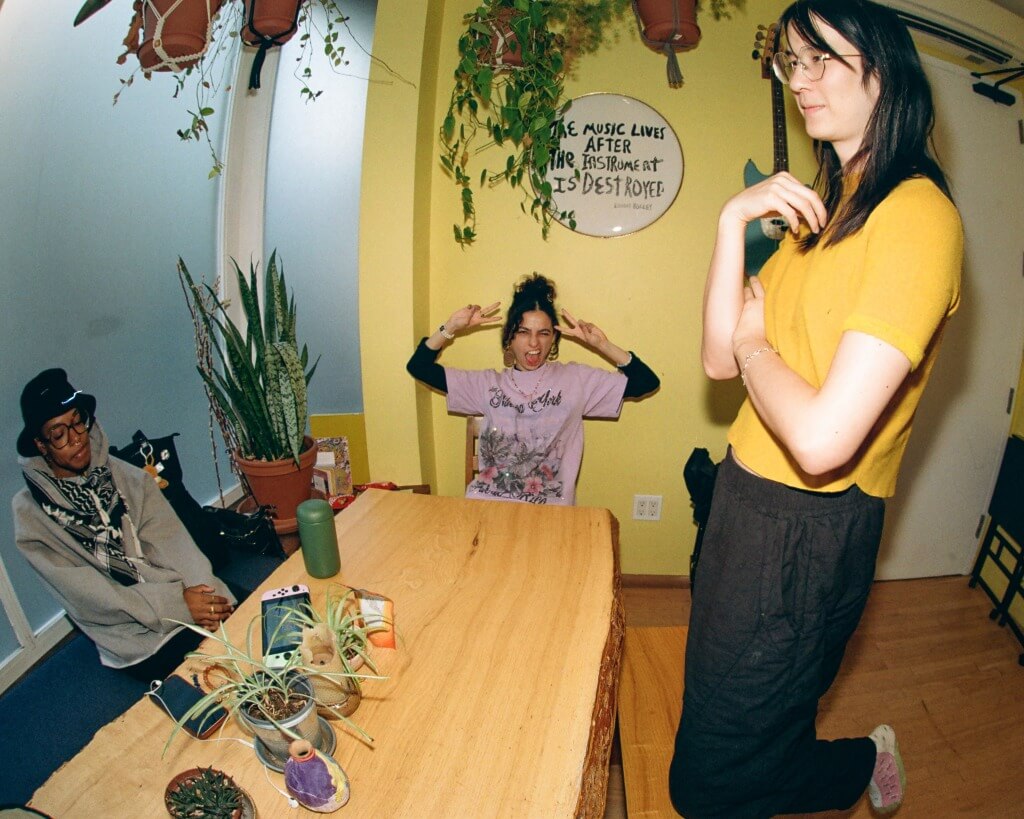
Film composing—is that how you know OHYUNG? (Trans Music Archive released OHYUNG’s album IOWA on vinyl earlier this year)
AL: A little bit. I got put in touch with OHYUNG early on by a friend of a friend. She needed help doing some vocal editing and Auto-Tuning on a track for her first full-length album, and then we reconnected when we both moved back to New York. We’re great friends now. I worked with her on some of her film scores, doing some mixing. And then we released her last record for TMA.
This feels like a good segue into some location-specific stuff. How did you end up partnering with Figure 8 Studios?
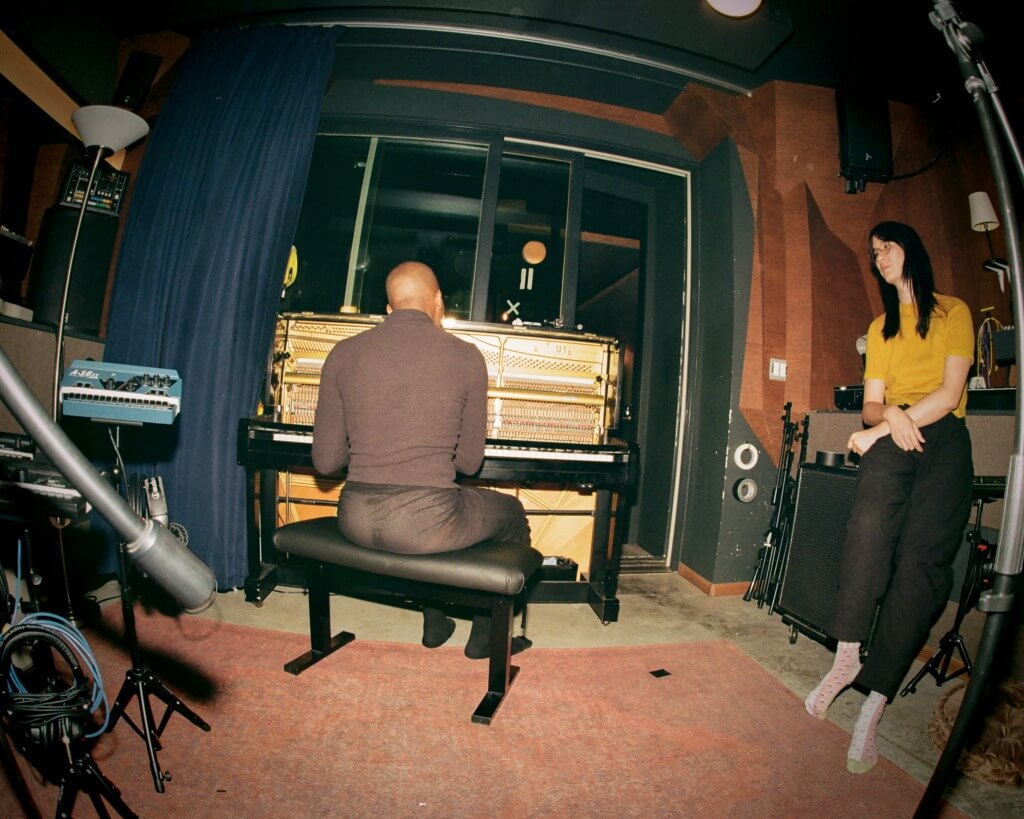
AL: Figure 8 was a really amazing opportunity that kind of just fell into our laps and created this side-quest outside of our original archive and record pressing initiatives. I was approached by my friend Sarah Galdes—who’s an amazing drummer, tours with Julien Baker and TORRES. She works at Figure 8 and is friends with Shahzad [Ismaily], the owner. They have a residency program at Figure 8 normally, but they wanted to do one for trans artists. But they were like, “None of us are trans, and most of the trans artists we know are already well into their careers.” I said, “We’d love to partner with you on this, if you’re willing to provide studio time. We can build the application process and oversee the whole thing and make sure the artists have a really good recording experience.”
RM: We also contributed a grant on top of it, because we wanted to make it more accessible for artists who couldn’t afford to take a week off work.
AL: A lot of times residency programs are like, “Do you have the privilege to go upstate for a month?”
RM: We ended up getting 325 applications. Almost everybody [who applied] was on the eastern seaboard, because we aren’t providing housing. Most people were from New York or Philly. I actually built this software—which is my background—to help us look at applications one by one and score them based on criteria that we came up with, associated with the questions we were asking: Is this artist really suitable for this space? In Figure 8’s case, the suitability was like, “Is it meaningful for them to have a space where they can record acoustic instruments?” We eliminated people who just make music on their computers.
AL: Do you wanna talk about the Vintage Synthesizer Museum?
I also wanted to ask about the Vintage Synthesizer Museum!
RM: We can double back to that—that feels like the other direction. Like, can you really get the most out of this room of analog synthesizers? Anyway, there’s some subjective musical criteria, and we also really care about where people are in their career. This isn’t really an educational opportunity, so somebody who’s never released any music is probably not appropriate for this.
You probably also don’t want people who are too far into their career already, who don’t need this as much.
RM: Yeah, exactly. If you’ve released four albums with a label, you probably have access to a studio.
AL: The last one is recording experience. Outside of the knowhow of gear, there’s studio etiquette, studio flow, knowing how to maximize your time. One of our residents, Lambkin, was so on top of it. She had a schedule and agenda for every day, knew exactly what songs and what parts they were doing.
What kinds of questions did you include on the application?
RM: We asked for two songs, a bio, the project they’re looking to record, and recording experience and background. [Rowan shows me the application form and a few submissions from shortlisted applicants.]
This is such a concise and easy to follow application. It’s refreshing to see stuff like this, because it can be such a weird rigamarole to get any kind of arts funding. This feels really straightforward.
AL: It was basically just a form on our page, like a Google Form. It wasn’t “it needs to be 500 words and these requirements.” We don’t want to make it difficult for people to apply.
I’d love to return to your partnership with the VSM.
AL: So the Vintage Synth Museum is a really great space in Highland Park in LA. It’s this big room with the most insane synth collection. Someone who’s into synths would really nerd out in it. We visited last time we were in town and were basically able to fund a residency [there] for three days for two artists. It’s happening in May. We’re actually about to announce the recipients. The two artists we selected this round are both electronic artists. [One is] Brown Angel from the Bay Area—a really great DJ who’s been playing around the LGBT scene for a long time and has played Outside Lands. They have this really cool synth Cumbia record that they wanna make. The other artist is called folie, from Chicago. folie is great—kind of EDM, SOPHIE-like music. Very cool, abstract, industrial sounds. They were both really strong applicants. We wanted to choose two people who were kind of different in style. They’re both at a really cool point in their careers.
I also wanted to talk about how you came to partner with School of Song and Arca.
AL: I’ve been familiar with School of Song for a while from having some friends who’ve taught it. I saw them announce Arca for their next workshop, and I thought I’d reach out to them. Again, another side-quest. I was like, “I feel like we could get free seats for trans folks.” They sponsored four slots. It’s a win-win for everyone. It’s a win for the recipients who got the scholarships, it’s a win for School of Song, it’s a win for Arca, and it’s a win for us.
Is there a potential opportunity for the artists who participate in these workshops and residencies to have you press their records?
AL: Because we’re still so new, we haven’t quite gotten there yet. TMA is only a year old, and we’re eagerly awaiting the completion of the Lambkin and Las Mariquitas records from our first residency at Figure 8. We would love to press those, it’s just a matter of getting them through the mastering process. They were able to do the bulk of their production and recording at the residency, but they have that last bit of post-production. As we all know, finishing is the hardest part. We would love to press their music on vinyl, I think that’s part of the goal. I don’t know that we would be able to press everyone’s music on vinyl that we work with through all of our programs. But we try to keep in mind the desire to diversify our resources so we can support as many people as we can, effectively and efficiently.
RM: Typically, the artists who are in the residency programs are exactly the kind of people we wanna make records for, so it lines up really nicely. It hasn’t happened yet, and it’s not in a contract or anything, but obviously we’re becoming aware of these artists through this.
That’s also kind of another plus, that the two of you get to find new music and new artists to be fans of.
AL: We really stay in touch with a lot of the folks who apply who [don’t get chosen]. The music scene is rich here [in New York], but there’s still so much we’re not tapped into on a regular basis. It’s like, “Wow, this person in Seattle is doing some really cool shit.”
RM: We didn’t think about it last time, but we might do some kind of highlight reel with the top applicants… with their permission. Just like, “This is some amazing music that’s out there.” They all deserve to win. It was really hard to pick just one.
AL: The hardest part about the residency is having to let a bunch of trans folks down that didn’t get it. I wish we could have unlimited resources and provide a lot more.
What does your fundraising process look like?
AL: We’ve been privately funded thus far. In the first year, we put in a bit of our own money to get the Um, Jennifer? album out—basically just being like, “Let’s put this out as proof of concept for our organization.” From there, we had a bunch of friends and family funding that’s given us a pretty decent budget. We ultimately don’t spend much money.
RM: We don’t pay ourselves. We’re pretty lean. Several of the records have sold out, so they do recycle themselves, mostly. With other programs, like the residency programs, we don’t recoup the money, but we do have funds to do them.
AL: As we move into our second year, I want to find other places to fundraise—both through traditional grants, maybe through the city or state, and private donors. I think there are a lot of people who are really well-off who want to give their money away to things like this. There’s a lot of music lovers—folks who are hi-fi audiophiles and have spent $20,000 on their listening setup, you know? They’re great people for us to attract as donors. I think part of the [mission of] the Trans Music Archive is to build this coalition of all these trans scenes—this trans renaissance we’re going through with music and art. If you’re a music lover, you should pay attention to what we’re doing—not just what TMA is doing, but what trans folks are doing. We’re at the forefront of making the coolest shit, and this is a great place for you to discover really great music. Outside of identity, even.
Under the second Trump administration, there’s been a real push to remove the language of diversity and inclusion from nonprofit missions and grant applications. There’s even been severe cracking down on what kinds of organizations can get funding or nonprofit status. As the founders and operators of a trans arts nonprofit, has this affected your opportunities, your funding, or the way that you conduct business?
RM: We were actually really uncertain if we were gonna be able to get nonprofit status, because certain categories have been removed from nonprofit eligibility. I’d like to think that some administrator had a little stroke of rebellion stamping our application. [Laughs] I don’t know how we got it through. We really weren’t sure.
AL: “Trans” is the first word in our name. We were thrilled when we got our status.
RM: In a better time, we would have access to more federal funds and whatnot. We’re lucky to be surrounded by people who do want to support trans music. Values-aligned donors really do recognize that this is a time when people need that support, given that the traditional avenues of support are not available.
AL: But I guess we never lost the opportunity for funds like that.
RM: Because we started after that.
AL: We’re just like, “This is what’s normal, there are no grants for us.”
RM: I do think that, maybe because those grants are less available for trans artists, being a person offering those opportunities in this time, it brings more attention?
This project is really the first of its kind. There’s never been an archive specifically devoted to physical recordings of music made by trans artists. Were there other existing archival projects that you looked to as a model for TMA?
RM: There’s lots of wonderful LGBT archives that archive physical materials, like the Lesbian Herstory archives, to name one locally. There was an interesting conversation we had with [John Carlin], the founder of Red Hot—a sister organization. They were our fiscal sponsor briefly while we were waiting for nonprofit status, which means that we were allowed to take donations through them. [Carlin] talked about how Red Hot as an organization was founded as a nonprofit. But, also, they have this for-profit company that feeds Red Hot. He offered us some criticism of our model: “Why can’t you just be a for-profit company?” And, ultimately, it has to do with where we’re finding our funding and who wants tax write-offs. The model Red Hot uses—selling music to do activism—is related to our model, even if selling music is part of its own aim. Ultimately, Red Hot is asking the artist to create music to sell to benefit another cause, Act Up. We are selling music and giving the money to the artists who made the music. We are still inspired by a lot of the work they do.
I wanted to return to the pressing and distribution process. Is there a specific vinyl pressing plant that you work with?
AL: We’ve been going through a few different plants, trying to find the right partner. It’s really tricky, because we are doing smaller runs. We started with 70, then 100, then 250. Now we’re trying to find the sweet spot with quality, price, and production time. Different artists have different needs. Our goal is to try and find an amount that feels like it’s achievable to sell 80% of or sell out. Our stated goal is to sell out within six months and get our cost of production investment back, so we could pass it on to the next artists. Right now, we’ve been working with Physical Music Products in Nashville, as well as Precision Pressing in Canada..
RM: For the first two records, we had a model where we gave the artists the records to sell. We had a good faith [agreement]: if, and when, you sell these, you can repay us the cost of production. If not, no worries. But after that we realized that artists don’t want to do fulfillment, and we wanted to ensure quality fulfillment for all of our artists and our audience. So we started doing fulfillment [ourselves] from the third record on. We have a web store and we ship out orders on behalf of the artists and then pay them monthly. In terms of getting records into stores, we’re independently emailing places and taking records over. We’ve gotten records into two stores in the past week: Vinyl Veritas in Dumbo and Yu and Me Books in Chinatown. We will definitely see more of that. So it’s growing and evolving.
Have you ever thought about doing CD or cassette releases as well?
AL: Right now, we’re just really focused on vinyl—partly because of the production. Vinyl is pretty prohibitively expensive for independent artists to acquire and produce. With CD and tape production, it’s a lot more accessible. I don’t wanna diminish it, becuase it’s still money that the artist has to put out for it. I think the archive has some CDs and tapes, and we’ll probably expand to collecting more of that.
RM: There are just so many barriers to producing a vinyl record, right? It has to be mastered in a specific way, which often means taking the last master, undoing it a bit, and then remastering it. You have to know which plants can get you a good rate for what kind of music it is. Different pressing methods are better for different music. You have to create additional artwork for it and understand that whole process, anyway.
AL: It’s a pretty intimidating process for independent artists. We’ve gotten a lot of feedback from the artists just being really grateful for us guiding them through the process of figuring out the artwork, the back cover, the center labels, and putting the packaging together.
There’s a really broad diversity of sound and genre within your catalog. How do you ensure that there’s a wide representation of types of music and types of artists? Are there certain misconceptions—like, “This is what ‘trans music’ sounds like, this is what trans music scenes look like.” How are you disrupting that?
AL: I think, from an outsider’s perspective, there is this idea or stereotype about the kind of music that trans folks make. There’s not that many huge major label artists who are trans. I think people cast their own view on it.
RM: I overheard somebody across our booth at Pioneer Works be like, “Trans Music Archive? That’s probably mostly screaming.” [Laughs] But one of the things that’s been so amazing about this project has been just sharing with the world that trans people are making music in every genre and every scene. Our choices of artists in the first year, and going into the second year, have been to demonstrate that trans music is in every single genre across the board, and we look like all different types of musicians.
What was your Grammys experience like?
AL: It was crazy. We got this award for Best Song for Change, which is an honorary award. So, we were told ahead of time that we’d be receiving it. It was really intense for me, because it was early in my transition—a really big stage for me to be present and be seen and give a speech. I was trying to just make the most out of that platform. There was a “Protect Trans Kids” phone case that I held up for the three seconds we were on the telecast. I don’t know, there’s two sides to it. It’s very cool to be seen and acknowledged in that field and that space. The other side of it, though, is seeing the music industry machine in full force. We were seated in the tables up front. During commercial breaks, it felt like a high school cafeteria, you know? There’s so many famous people—people trying to network or chat up this person or that person.
RM: There’s two minutes of commercials. And during those two minutes, everybody gets up and tries to network and take photos and get all these meetings with everybody else. And they’re all very fancy people. They’re all swarming around to get their moment with each other.
AL: Lady Gaga had her speech about trans folks, which I know was also criticized by other trans folks within the community. Visibility is not enough without protections and all that, but we were one of a few, if not the only trans folks [sitting at] the main tables. I don’t know if Kim Petras was there or not. When Lady Gaga did that speech, it was really intense for us. We went up to her and just thanked her and got a hug from her. It was really nice. But the whole Grammy experience gave me this purpose or drive, ambition. The Song for Change award feels like a prompt, you know? It was like, “Okay, what are you gonna do with this now?”
Grace Robins-Somerville is a writer from Brooklyn. Her work has appeared in Pitchfork, Stereogum, The Alternative, ANTICS, Marvin, Swim Into The Sound and her “mostly about music” newsletter, Our Band Could Be Your Wife.
 Keep scrolling for more great stories.