
The Fool, The Hermit, & The Twisted Teens
Blame the Clown and Florida Water Blues are full of no-bullshit, tight-as-a-tick songs packed with hooks and furious yawps. The complicated part is figuring out the tarot-speaking, dream-stealing mystics who made them.
Photos by Bobbi Rich
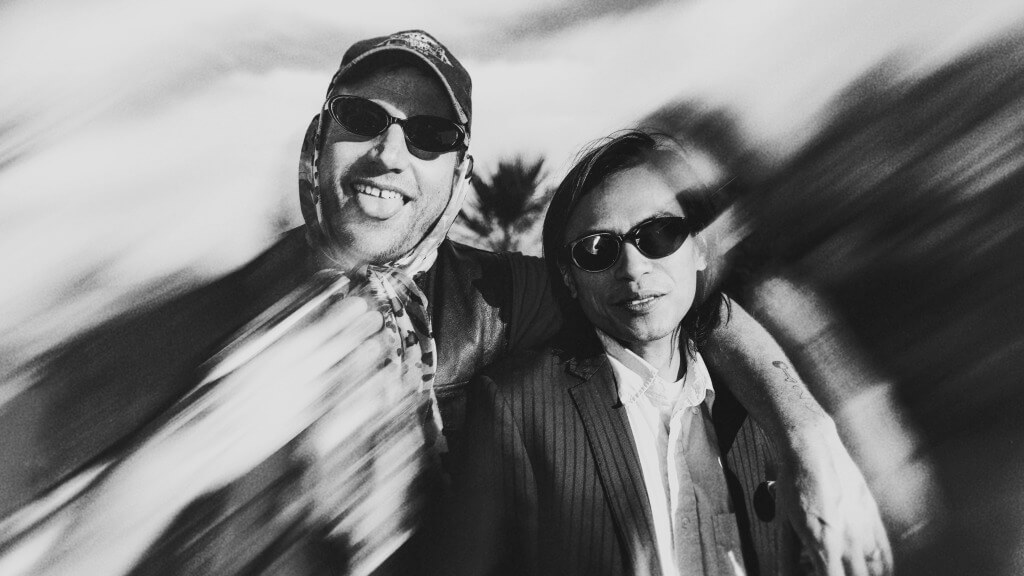
I don’t know what the fuck is going on. Caspian Hollywell and “Razor” Ramon “RJ” Santos are talking about stealing ideas from the dreamworld. “I strap myself to a kitchen chair with a heavy metal ball in my hand,” RJ explains. “And as soon as I pass out, my hand goes limp, the metal ball drops. That split-second of REM [before I wake up] is just so packed full of information that you can literally steal ideas from this split-second realm.” Apparently he did that a few times but got scolded by “spirits” for being an ungrateful sonuva bitch idea thief, so he’s been taking a break from it.
“Well, because your ideas aren’t really yours,” Caspian tells RJ. “The moon people bring you stuff, and then it’s your job to act on it. If they’re already giving you tons of shit and you’re not acting on it, they’re gonna get pissed.” Caspian, who habitually talks in 2x speed, also mentions the psychonauts getting banished from the 5G space in the DMT realm because there are too many “weird, random white burner guys who are just knocking around in there.” Twisted Teens is a two-person band in New Orleans, and somehow this is where we end up when discussing the vocal sample on their new song “Riding.”
That sample comes from one of Caspian and RJ’s friends, Sasha, a Sacred Harp singer who practices Southern Protestant shape-note choral music. A group of German musicians later recreated some of those hymns as MIDI files so singers could practice with them. Caspian had been passing the website around to friends for years before finally adding it to Twisted Teens’ new album, Florida Water Blues, as a songwriting homage to The Paragons’ “Riding High On a Windy Day.” “It seemed to fit the theme of our band, because it’s traditional music with a weird, awkward, future element to it,” Caspian says. “Riding” ends with God helping his band through life’s storms, echoing the Two of Pentacles.
“Look at the Waite-Smith [Two of Pentacles] card: you’re gonna see two ships riding on a big wave. One of the ships surfs the energy of the wave, and therefore it’s going really fast and being very powerful, and the other ship is sinking because it tried to fight the wave,” Caspian informs me. “The message of the card is that you have to do things, but to do things in the context of the chaotic world we live in, you have to surf the energy of situations.”
“I’m gonna try and corral you guys back into the music,” I say.
“You’re confused,” Caspian replies. “We’re talking about the music.”
I discovered Twisted Teens through musician Mike Krol’s Instagram post about them last Christmas. I gave Blame the Clown a rave review in February because I think it will stand the test of time, though I plan on letting future generations keep the score. Ahead of their big show at Sid the Cat Auditorium opening for Krol in March, I sent Caspian a DM to set up an interview, but I got sick and had to postpone. Fast forward to late June, and Going Underground Records sent Florida Water Blues to my inbox. After days of missed calls due to time zone fuck-ups, the three of us finally landed on a Google Meet. “There’s a reason we had to start a rock and roll band,” Caspian laughs, “It’s because we’re too stupid to do anything else.” RJ beams: “That’s what my mother always said!”
In just four months, Blame the Clown has turned Twisted Teens into a hot-shit act for a lot of people outside New Orleans. Songs about online gambling, circumcisions, and vagabonds are humid and hectic when Caspian and RJ scrap and streak through their brilliant Lead Belly-meets-Buzzcocks miscellany. “Apparently we’re an indie rock band,” Caspian adds, taking the piss out of recent online commentary. The “punk” label has been hitched to Twisted Teens’ wagon by writers like myself, but RJ shoots it down. “I always thought it was an avant-garde band.” There’s some jangle pop and country in there, too, I add. “It’s naive and recherché,” Caspian confirms. “We’re not some bubblegum-chewing, cutesy garage band. I mean, we are that, but that’s the clown costume.”
So what exactly are the origins of Twisted Teens’ cultic appeal? Whatever Caspian and RJ decide it to be on the fly, I suppose. “God put us on a stream together, and now we’re in the same canoe,” Caspian gestures, which makes RJ bellyache into laughter and lose focus on the joint he’s rolling. The real story is that they were neighbors—though, when they didn’t know each other from Adam, RJ slept at Caspian’s house while Caspian wasn’t there and had a “divine intervention” in his dreams to get a steel guitar. The next day, he drove to Asheville and bought one. “Now, when you go to start a band, you get on a message board of other people that are in the same music algorithm as you, so you can go find other aficionados of your genre,” Caspian chimes in. “But, in the old days, when you used to start a band, the first question you’d ask yourself was, ‘Who lives next door to me?’”
RJ had been bumming around the country for a while, and Caspian hopped trains when he wasn’t playing in the Santa Cruz anarchist band Blackbird Raum. The duo eventually ended up in New Orleans because the rent was cheap. “When the rent starts going up, you got to go outside and shoot into the air a little bit,” Caspian yelps. During our call, he paces his way around his house in Holy Cross, which also happens to be Twisted Teens’ studio. When I ask him one question, there’s silence, and then he turns a faucet on and off before responding. RJ is either thirty miles from the Arctic Circle or on the West Coast, depending on which of Caspian’s stories you choose to believe.
As for when they both started playing music, Caspian describes music as an extension of his personality and perspective. “That’s especially true when it comes to singing. It’s just about being who you are. You can show off sides of yourself. My voice is just an extension of who I am, but I did work really hard on it. I didn’t used to know how to sing very good at all. I fought for this shit.” RJ started playing steel in 2020, but he studied music in grade school because it was mandatory, and he hated it. At some point, his childhood guitar was smashed to pieces, and a few years later, his mom asked, “Do you want another guitar, or a Golden Retriever?” “And you know me…,” he smirks. “I love dogs, but I still chose the guitar.”
Twisted Teens’ sound is informed by everything from Leonard Cohen to whatever Caspian’s dad had on CD: Tom Petty, The Beach Boys, Nirvana. But it was punk rock that stuck with Caspian and never left. “And that gave me a little identity when I was a kid,” he remembers. “When I grew up, I was a loser, and that was a bad thing. Then I became a punk, and suddenly it became a good thing. So, it actually turned my whole life around.”
RJ quickly speaks up. “I’m gonna tell you a true story,” he says. “Ever since I was a kid, I really loved art. My mom and I were at a CD store, and she saw this record that had an artist’s painting on it. It was The Velvet Underground & Nico record, and she had no idea what the fuck it was. I had no idea what the fuck it was. She just purchased it for me because they had Andy Warhol’s art on it and she knew I liked art.” He pauses. “That record, as a 12-year-old boy, blew the fucking wiring out of my brain. Hearing what John Cale is doing is still something that I try to emulate with the Twisted Teens.” This makes sense to me, because Twisted Teens’ albums sound like they were made in a parallel universe where The Velvet Underground & Nico sold a million copies.
Caspian tells every cymbal-smashing drummer he works with to “understand the genius of Moe Tucker,” because, as he puts it, if you don’t recognize her drumming as a counterpoint to the jazz freakouts of somebody like Keith Moon, then “there’s no conversation.” The Velvets understood that rock and roll was “simple music for people to dance to” and then combined it with French poetry and New York street life. Caspian’s singing may sound like it comes from a different planet than Reed’s, but The Velvets are the true “guiding star” for him and RJ. “It’s a spiritual thing, right?” Caspian adds. “Most people would think I’m going to make a simple song or I’m going to make a complicated song. But Lou Reed will tell you a simple song can stay simple and still become complicated.” Charli XCX certainly figured that out by evoking Cale’s art-pop abrasions, and Twisted Teens even tried to imitate Reed’s repetitive finger exercises in “All Tomorrow’s Parties” on their new song “Why Did You Miss It.”
“So, Twisted Teens and Charli XCX aren’t too different then?” I ask.
“That’s the thing,” Caspian says. “We’re not the first band to figure this out. There’s an underlying first dao of pop songs that’s totally separate from the conventions of pop music as we understand it. Kate Bush makes songs that, if you were to pick them apart from a musical perspective, are very strange, and they’re coming from her dreamworld. They’re intuitive, but then they totally hit as pop songs. There is pop music that’s separate from what pop music actually is. That’s very inspiring to me.” John Cale’s minimalism works the same way: he brought the avant-garde into the language of rock and roll without stripping away its immediacy. That contradiction fascinates Twisted Teens: the strange becoming familiar, the experimental becoming something people can actually sing along with. It’s the same thing with Dylan—three chords and a voice made of sandpaper. Twisted Teens want their music to be naive and ignorant but also mystical and world-weary. “You got to be The Fool and you got to be The Hermit at the same time,” Caspian adds.
It helps that Twisted Teens can be anything Caspian and RJ want it to be. It can be punk, experimental, whatever. “That leaves a huge map of shit for us to go wander around in and explore,” Caspian continues. “We’re not stuck in a little lane around one particular thing as long as we keep our vibe up, which we can’t help but do, because that’s who me and RJ are. You guys want a country record? You want hardcore punk? We’ll do whatever.” Maybe there’s a Metal Machine Music in their future.
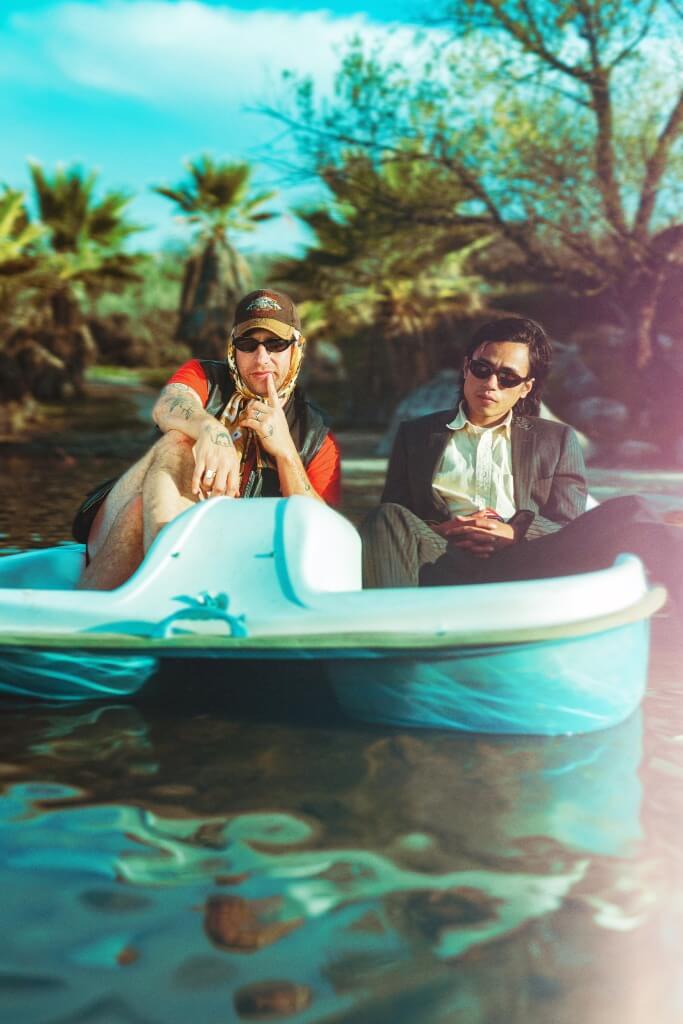
Twisted Teens released Blame the Clown in February, are readying Florida Water Blues for this Friday, and have another album, Holy Cross Tigers, lined up for the fall. Three records in ten months puts them in Bob Pollard territory, but Caspian and RJ aren’t interested in being prolific as a matter of course. The music isn’t encrusted with laborious edits, but speed ain’t a gimmick, either. “I’m not going to crank out shit for the people,” Caspian insists. “If it doesn’t have vital energy, you won’t hear it from us. I’m not saying everything’s always going to be the catchiest hit in the world, but we’re not gonna put anything out that’s not full of yang energy.”
Caspian and RJ aren’t sitting on these songs for very long. RJ says some tracks get written and recorded in three minutes, and that Caspian writes parts “while I’m taking a piss on a tree in the backyard.” The way they see it, you don’t need to be behind your instrument for a sound to reach you. Caspian doesn’t even think of Twisted Teens as “artists,” but, instead, as a tandem of chairmakers. “The chair has to be beautiful, but you also have to be able to sit in it,” he elaborates. “You get up in the morning and you make a fucking chair. You carve it out of your wood, or you make it out of pipes, but you have to make a chair. And that’s our job. To make a song for us is to walk eight feet from my bed, so why not make more?” To be more specific, Caspian has little patience for the romantic myth of the artist as a solitary genius. “You have to make your container,” he adds. “Then it fills up with things that come from outside of you.” When he asks whether that makes sense, I don’t quite have the courage to tell him no.
Blame the Clown became the overflow from Florida Water Blues. “It’s like, if you think Blame the Clown is that good, this one is gonna blow your mind,” RJ declares, though Caspian plays it more nonchalantly: “For the record, I actually like Blame the Clown better, because it was, like, catchy jingles. But this is more magnum opus variety.” The band had simply made too many songs for one LP, so they split the material into two worlds: the power-poppy, “plants growing little ditties” of Blame the Clown and the darker “blue one” of Florida Water Blues. “Imagine somebody with bipolar disorder,” RJ explains. “Blame the Clown is their manic state, and then the blue one is when they’re about to go into a four-month depressive state.” Caspian jumps in, “But the next one is, like, right after you leave the cycle of shit.”
“Do you have a color picked out for Holy Cross Tigers?” I ask.
“It’s burgundy,” Caspian reveals, “because it’s a breakup record, and RJ came in and was like, ‘Dude, this is our Blood on the Tracks.’ And I was like, ‘Let’s go,’ which is funny, because I love Bob Dylan but I have listened to Blood on the Tracks once in my entire life. I like ‘Boots of Spanish Leather’ and ‘The Girl From the North Country,’ that type of shit. We’re doing a whole series of middle-period Bob Dylan tributes. In the fall, we’re gonna record our John Wesley Harding.”
“Who’s gonna be your rockstar that covers one of the songs and blows it up?”
“Alynda Segara [of Hurray for the Riff Raff]. Their new record has a cover of ‘Marionette’ on it.”
“So the answer to your question is actually us covering our own songs to blow it up,” RJ adds.
“No,” Caspian rebuts, “the answer to that is us paying a psyop company to put our music in the background of key grocery stores in the Rust Belt region.”
RJ brings up another dream: a tarot card embossed with “Stalks of Yarrow” in old Germanic lettering, the title of the first song on Holy Cross Tigers. “If you think about it, the Stalks of Yarrow is how you do an eating divination,” Caspian says. “When you’re divining through the I Ching, you have broken and whole yarrow stalks and you pull them. So it’s actually all connected towards the theme of oracular and visionary understandings.” For Twisted Teens, tarot is less a belief system than another language for understanding the archetypes that power their discography. Their attraction to mystical properties allows them to transgress.
You might be reading through this feature and wondering why it’s not written in a Q&A format. I was wondering that too, because it’s nearly impossible to keep up with Twisted Teens or reduce their contradictions into pablum. In fact, it actively feels like they’re playing 4D chess with me, hijacking my trains of thought by answering simple questions through tarot deck readings and deep space-think. Interviewing Caspian and RJ is, by my approximation, the music-criticism equivalent of doing a hard-mode Sudoku puzzle on an airplane during catastrophic turbulence. When I zig, they zag.
Twisted Teens’ style is made up of lo-fi and sometimes off-key folk songs done all crunchy and posthaste, but their approach to being musicians is incredibly grounded. The music is no-bullshit and tight as a tick, packed with spaghetti-western guitar rolls and furious yawps. One of the new songs, “Business,” is a riff-based love letter to The Coasters, Dave Bartholomew’s New Orleans rock and roll, and Elizabeth Cotton’s “Oh Babe It Ain’t No Lie,” a tune that every “punk train-hopper hobo” knows how to play. Twisted Teens don’t use any effects, and Caspian doesn’t even own a tuner. They just plug in and go. No feedback, no distortion. Even the percussion is piecemeal: acoustic drumming matched up with a Roland 707, because that’s what Caspian did by accident on Twisted Teens in 2024 and plans to keep doing on every future record, just with a variation on the formula, because that album is “one of the best things I’ll probably ever do.”
Whether he’s just chockablock with metaphor or on the brink of psychosis, even Caspian’s reasoning behind tampering with the Twisted Teens drum recipe sounds like a ruse. “You know how you go to a taqueria and they make muletas and graditas, tacos, flautas, and all this shit, but it’s all the same ingredients? It’s the same thing,” he says. “Look at the end of the chorus [of ‘Business’], those are your flautas for today, not enchiladas. It’s the same drum set, same snare drum, same microphone. It’s just combined slightly different.”
Throughout Florida Water Blues, and especially on the title song, RJ’s console steel talks like Pete Drake’s pedal steel in “Forever,” adding harmony by duetting with Caspian’s vocals. “A lot of the times when Caspian goes low, I go high. When he goes high, I go low,” he says, to which Caspian calls him “the Hillary Clinton to my Donald Trump” without a lick of humor in his voice. “I’m constantly weaving between the frequencies of the music and tying it together. It seems simple, but it’s a very arduous job.”
But that’s the thing: RJ isn’t using pedal steel, despite the instrumental misattribution in almost every write-up about Blame the Clown. “On the next tour, I’m going to have a sign next to my steel guitar that says THIS IS NOT A PEDAL STEEL and then people are gonna think I’m doing some René Magritte stuff,” he jokes, and Caspian bounces off him. “You should do it in that René Magritte cursive with weird clouds in the background.” RJ prefers the console steel because the pedal steel sounds, to him, “like a fat wave of sound that’s drenched in the song’s body.” With the console, he can cut through every frequency by writing really spiritual melodic lines without ever sounding homogenous.
In a recent interview with The Big Takeover, RJ suggested that none of the musicians in Holy Cross are playing pretend. “People are actors, and they put on a mask, and it shows in their communities,” he elaborates to me. “But this community that we’re talking about, people are doing what they want to do, because everybody’s batshit crazy.” That’s what their song “Not Real” is about. “We live in a world of conditional fucking love,” Caspian reflects, “and if you don’t act and dress and do a certain thing, you’re gonna have no money; you can become isolated. That’s the secret whip that gets everyone to do everything before they bring the cops in.”
“We’re real working musicians, so we know how to make this record sound good live,” Caspian says. “Every fucking band in the world is leveraging technology to make up for a musical lack—just like how photographers are, in a way, using technology to make up for the fact that they can’t oil paint. No shade to them, but we actually have the skills to literally make a band that could have existed in the sixties in front of people and it’s still just as good.” He refuses to buy gear from Guitar Center and carry it around, calling it “civilized behavior” that makes him feel like a gringo while doing it. “I just want to get on stage and plug my shit in. The reason the album sounds the way it does is that it was the quickest way for us to do it. I’m not gonna spend all week practicing to go on tour. That’s insane.” Twisted Teens are an antidote to cultural acceleration.
Music is, by Caspian and RJ’s account, a form of devotion. “Anything else is superfluous,” RJ adds. “It’s just white noise to me. If you commune with something higher and greater like that, the answers will come to you. And I think a lot of people don’t have that, so they muck in the territory of the material realm and fucking each other over.” I mention the word “advocacy,” because the Twisted Teens Instagram account is full of political posting, and Caspian counters me, saying he’s not here to advocate on behalf of other people, nor does Twisted Teens buy into the “arrogance” of sticking up for the little guy. “Almost nobody has any political agency whatsoever,” he furthers. “We don’t share identities. Some people are queers, some people are straight, some people are this color. The only thing we share is our class, which, unless you own the world, then you are not one of them. The only thing we share is our position on this environment and this planet.”
Caspian didn’t always think this way. His twenties were spent preaching about the “demonic system and economic prison that we live in” and environmental collapse. “And that felt really radical at the time, but it makes you insane to sit there and go, ‘Hey, the capitalist powers are eating the planet,’ and everyone’s like, ‘They’re not.’ And then, one day, they wake up and are like, ‘Yeah, but now it’s too late to do anything about it.’ There’s never a moment of reckoning. But, at this point, I think things have gotten so obviously bad that there’s less relevance for someone like me to get up there and be like, ‘Fight them!’ even though you should. It’s more interesting for us to be like, ‘What if you were real? What if you validated your perspective?’” What replaces political mobilization for Caspian is not withdrawal but a different kind of intervention: validating individual experience, building a life around personal convictions rather than institutional identities. “What if you get in people’s heads and bring cultural perspectives and spiritual perspectives that are just outside of these two mind-control paradigms of the co-opted left wing that people identify with that’s just the right and left hand of the Devil?”
The answer Caspian and RJ keep returning to is personal autonomy: building a community around shared values rather than shared categories within the “dominator culture, the mind-control system.” They see themselves as the conduit, not the architect. RJ cuts in, “Just be real about everything, because everything you do matters. The integrity of the individual is what matters most, and that ripples out into your broader community.” If all of this seems kind of vague, that ambiguity appears to be Twisted Teens’ intention. “We’re not interested in trying to list off our activist credentials or incriminate ourselves in general,” Caspian says. “But your assumptions about us are probably correct.”
He and RJ have been shaped by their apocalyptic understanding of the “spiritual battle being fought between the earth and the mother and the moon versus the corrupted sun god. Everybody has different ways of framing that in their own world, and they’re gonna side with power or they’re gonna side with the slow cycles that dissolve power. Those are your options.”
Blame the Clown and Florida Water Blues aren’t pieces of art that explicitly promote any ideologies, and Twisted Teens aren’t here to persuade you into joining one movement or another. “A broken clock is right twice a day,” Caspian suggests. “You can listen to very fucked up people and get a lot of wisdom out of them. You just have to hold strong to your own energy and identity and not get overwhelmed by these systems that are trying to adopt you as a peon into their fighting force. My hope would be not that people sign up for whatever we’re shit on, but that people find ways to build their own communities that can support their own identities, you know?”
Failure comes up in our conversation because it’s the hidden philosophy behind everything Twisted Teens has been describing. “A lot of people strive for perfection in music, but their conception of what perfection is highly imperfect,” Caspian gestures. “That’s why, in Japan, when they break the bowl, they fix it with gold.” He mentions that he’s friends with a Navajo weaver and remembers how, whenever they make the most beautiful design, “they always have to put a bad stitch in it,” because that elevates that object’s beauty. “And it increases the humbleness and lack of arrogance in it.” Attaching negative value to failure, he believes, is a type of programming put in place to “keep people disempowered.”
“If you want people to be losers that can’t do anything, just make them afraid of failure and then they’ll never do anything,” he continues. “If you just whip people or shame them when they fuck one thing up, it’s one of the most amazing ways to keep people useless, because they will always be operating under the onus of that fear when they try to do anything new.” RJ considers failure to be a great incentive. “I grew up as a problem child. I was flunking out of the school system, and nobody had any hopes for me. But because of that, I was able to pursue a life in art and music, because I failed so, so drastically at the other thing. Every time you fail, it’s another opportunity that opens.”
We talk about fertility’s batting average, empty voids in space where creation can exist, and Onan jerking off onto the ground for the goddess Nuet. “Most things do not reach fruition,” Caspian suggests, and then his phone dies. When he gets back on the call, it’s nearly time to say goodbye anyway, so I ask him where he wants Twisted Teens to be in five years. “Well, hopefully our evil overlords don’t just nuke humanity to take out the population,” he responds, obviously. “But if not, I’m hoping that we can develop the band into a sustainable business model that just flows over time. The smartest people in music are not necessarily the random people that blow up really quick. Almost nobody made as much money in the nineties off music as Ani DiFranco.” We’ve already been talking for over an hour, so I don’t have time to ask whether Twisted Teens are making $4.25 for every record they sell. Instead, Caspian tells me that dropping out of school was the best decision he’s ever made, because he went and lived on a couch in a field, taking a shower every time it rained. “Most people ain’t willing to do that shit.”
Florida Water Blues is out July 10 on Going Underground Records.
Matt Mitchell is Paste‘s Editor-in-Chief. They live in Los Angeles.
 Keep scrolling for more great stories.