
Widowspeak turn everyday ephemera into love songs on Roses
The band's seventh album traffics in the nostalgic, atmospheric indie-pop it does best.

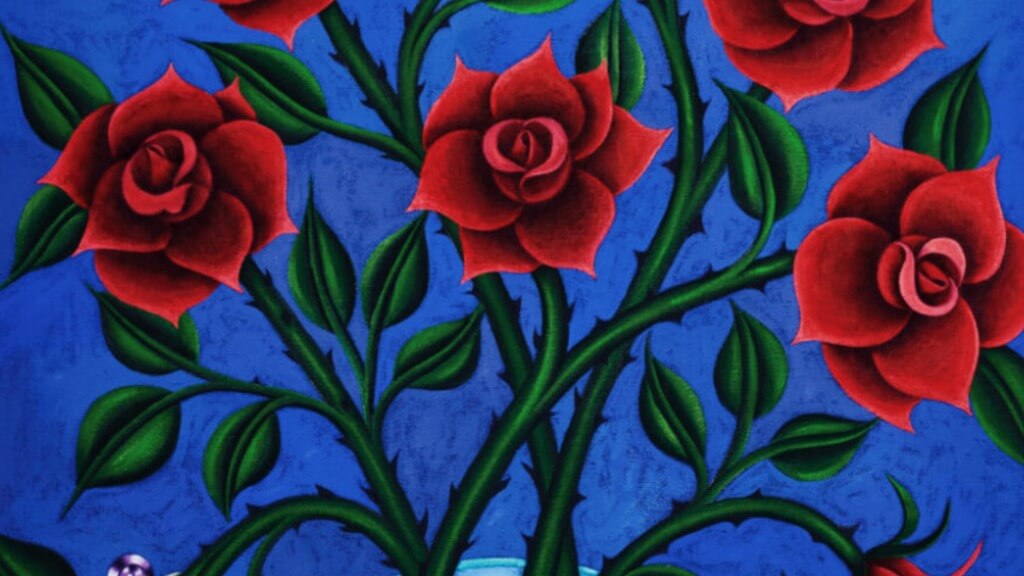
The Brooklyn duo behind Widowspeak have never been afraid of their own emotions. Molly Hamilton and Robert Earl Thomas, who have made up the band in its entirety since 2012, are old veterans of the dreamy indie-pop they’ve been slinging since 2010. Cloaked in sugary vocals and twangy, often dissonant guitar hooks, Widowspeak’s latest effort is, if not novel, delightfully self-assured: On Roses, the band’s seventh album and its first since 2022, Hamilton and Thomas dive into the manifold tiny heartbreaks of daily life with swirly acoustics and shimmery, evocative lyrics: “I wanna be your good company,” Hamilton croons on the twangy, steel-pedal-supported “Wondering,” a sepia-toned look into the day-to-day life that makes up Roses.
Indeed, Roses’ best moments treat mundanity like magic. “The Hook,” unhurried and intimate, describes both the quiet heartbreak of giving up on a relationship and the importance of allowing yourself to wallow in the pain of its demise. “Maybe some things aren’t worth saving,” Hamilton admits over an alt-country string riff and drums that crash like waves, “But I’ll keep every little thing that still reminds me of you.” The title track is a slow, jazzy, epistolary number that feels like sitting in a bar three drinks deep, waiting on a text that’ll never come from somebody you don’t even like all that much. “Maybe there’s no great love I’m looking out for / in the vast spoils of everything,” Hamilton croons over a moody piano and a twangy guitar line. “I’ve got nothing much to offer / but I feel richer than a king.”
That blasé, nihilistic attitude is immediately undercut by the shimmery, desperate “If You Change,” an obvious highlight of the album. The song bites and pleads like a cornered dog, then rains down around you as its chorus climbs into sweet harmonies. “If you change, don’t change too much / ‘Cause I really loved this one,” Hamilton sings on a chorus that knifes you right in the aorta. The lack of “action,” as it were, is more boon than burden: it’s in these moments of nothing-quite-happening that Hamilton finds the space to indulge her desires and fears. Thomas’s guitar is a constant, so slight sometimes it feels like background noise, and at moments just dissonant enough to indulge the indieheads who think themselves too sophisticated for his hammer-ons and sliding riffs.
As Roses slip-slides to an end, it spits out its teeth and collapses comfortably into the saccharine. “Actor,” a twinkly, ethereal number whose highlights lie in Hamilton’s non-lyrical vocalizations, is a self-soothing postmortem that gives way to an airy guitar solo; “Hourglass,” the album’s pouty closer, is all sighing arpeggios and reverby strings. “Can’t hold too tight or I’ll have nothing / like a candy melts in your hand,” Hamilton exhales as the music fades, resigned to a distance only she can feel. Through it all, she wields an impressive hold on the English language, idiosyncratic without seeming try-hard.
Roses is like a view from inside the fishbowl, the soundtrack of a dream you can’t quite remember. Hamilton and her husband Thomas are pros at this kind of Mazzy Star-esque atmospheric dream-pop, and these songs are the triumphant result of years doing careful genre study, if nothing particularly new for the band. The music pulls you close and spins you around with an unhurried conviction. It’s an album for lovers, by lovers. [Captured Tracks]
Miranda Wollen is a staff writer at Paste and is based in New York City. Follow her @mirandakwollen or email her.
 Keep scrolling for more great stories.