
A brief and biased history of the World Cup song
The two best songs in World Cup history are clever, catchy, and bend genre imaginatively without feeling confused. Like trapping lightning in a bottle, they capture the excitement and chaos of a good game of football.
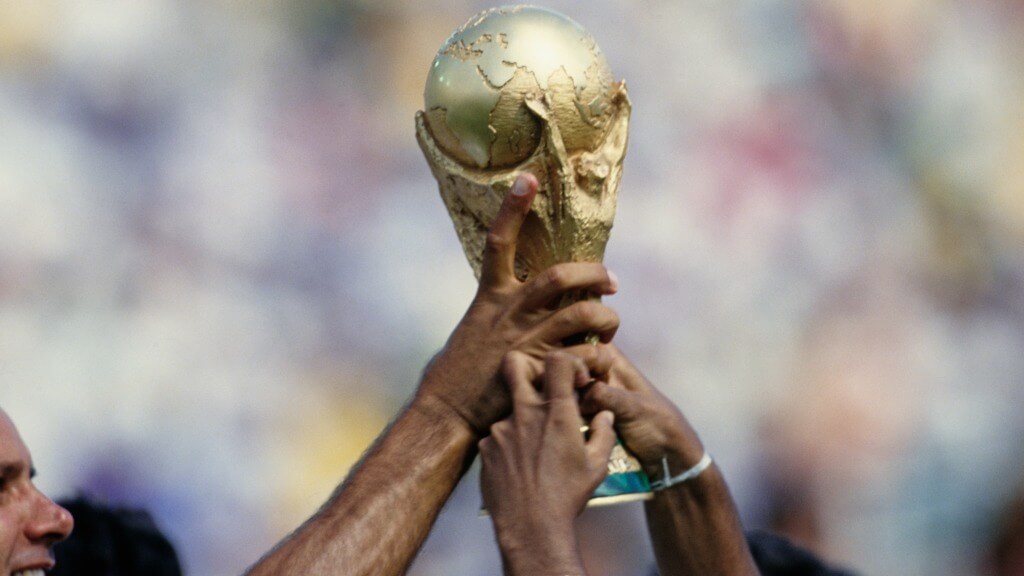
Photo by Henri Szwarc/Bongarts/Getty Images
Ah, the World Cup summer. Is there any time more disorientating than these three-odd weeks, when several nations descend upon another nation (or three, as the case may be) and kick a ball around in the name of love?
Yes, love. To me, there is no greater love than this: the sudden and confusing haze of national feeling; the strength of anger at a referee (human or video-based); the stomach-twisting agony of a penalty shoot-out. In this season everything and nothing is possible. It is steeped in the young, green haze of your back garden and the jubilant cries that erupt at all hours of the morning when eleven men several thousand miles away manage to do something beautiful. The genuine emotion that seems to drench every nook and cranny of our surroundings is irresistible. And, like any summer, it needs a soundtrack.
Here we come upon the sad but undeniable truth. Of all the joys that a World Cup can bring—and I can concede that, despite the best efforts of numerous political actors, this World Cup has been joyous—the music is not one of them. When we found ourselves watching Shakira perform her fourth official World Cup song at the opening ceremony, its complete and utter banality could almost put us off the entire tournament.
I needn’t talk to anyone reading this about the essential nature of music in the fabric of our society, and for the record, I think football is essential in the fabric of our society too. It really is the world’s game, and every four years, the World Cup proves the clichés are true. And the use of music in soccer is a time-worn tradition. Like pop music, a football chant needs two things: a catchy, memorable hook, and relevance. Many years ago, somewhere, someone thought to themselves: wait, why don’t we just use the pop songs for the chants, and vice versa? And so, the football song was born, and is continually reborn, only to be reinvented again and again for club and country.
When they’re created in this way, “unofficial” World Cup songs are usually stone-cold bangers. The reason is clear: they are not written under duress. One imagines the writers of “Dai Dai” (of whom one, unsurprisingly, is Ed Sheeran) locked in a dark room somewhere and prevented from leaving until they came up with a song that was inoffensive and multilingual enough, their inspiration having run dry that they eventually gave up and made the bridge just a list of famous footballers. Then a list of countries, for good measure.
Needless to say, the writer of “We Are the Champions,” which was not an official song for the 1994 World Cup but was used so frequently that it became synonymous with the tournament, was under no such constraints. I am sure that if FIFA had been so bold as to approach Freddie Mercury and ask him to write a song for the World Cup while he was still alive, he would have told them exactly where to go. Like every time we make music the soundtrack to our lives, the beauty is in its reinterpretation, the perfect synergy of making “Hey Jude” about England’s favorite footballer or “Muchachos” about Messi and Maradona.
The fact remains, however, that every four years, FIFA rolls out the red carpet for a song so culturally confused that one cannot help but admire it. Why create a music video featuring an animated reconstruction of Shakira, a Colombian singer, standing over Mexico City’s Ángel de la Independencia? Why not! Why give the song an Italian title, even though Italy has famously not qualified for the tournament this year and none of the three host nations speak Italian? Why not!
The entire endeavor is so clearly a money-making exercise that it hardly bears repeating. But there’s something really sinister about how bad these songs are. In attempting to speak to every culture, country, nation, and ethnicity in the world, they manage to speak to none; they are so abstract that you’d be better off watching paint dry than attempting to corral their various genres into something that makes any sonic sense. Far from considering that fans might use a global tournament as an opportunity to become more curious and engaged with the world around them, the hit-makers over at FIFA HQ decide every year, without fail, that listeners will feel insulted if they aren’t explicitly acknowledged in the song that no one really listens to anyway.
There’s absolutely no point in ranking every official World Cup song. I tried. Unlike the tournament itself, which can always surprise, there’s only one winner: 2010’s “Waka Waka,” a fitting tribute to South Africa becoming the first African nation to host the World Cup. Cleverly taking inspiration from musical traditions across the continent, and sampling Cameroonian band Golden Sounds’ 1986 song “Zangaléwa” for the chorus, it avoids the false universality that FIFA has attempted to create practically every year since.
The first World Cup song, though, was not a track aggressively promoted and distributed by a hulking conglomerate so steeped in corruption that its officials have been placed under house arrest. Instead, it was cultivated, tenderly, in the same way that many of our favorite football anthems are—sort of by accident. Back in 1962, the Chilean band Los Ramblers made a rockabilly hit that remains the best-selling song in the country’s music history. “El Rock Del Mundial” has a hint of innocuousness, sure—with lyrics promising that the host nation will be “good Chileans” who demonstrate “nobility and correctness”—but it still has a bit of bite. It’s catchy, too, and in 1962, when the world was still on its rock and roll kick, it would have made for a contagiously enthusiastic celebration of having the world in your backyard for the first time. Sadly, any lyrical assurances of nobility were quickly undermined by the first match of the tournament, in which the Chilean and Italian players became so violent that Italy needed a security escort to leave afterward, and the referee went away and invented red and yellow cards, but it’s the song that counts.
While plenty of songs were released before 1990, that was when FIFA first started to realize that music was something they could make money from. Before Edoardo Bennato and Gianni Nannini’s “Un’estate Italiana (To Be Number One),” the songs released were relatively localized, with a few exceptions. Ennio Morricone composed the still-familiar “El Mundial” for Argentina’s tournament in 1978, but that was an anthem, not a song (in fact, FIFA still makes a distinction even now, in case you were wondering why Andrea Bocelli, David Guetta, EJae, and Megan Thee Stallion were also releasing an official song for this World Cup).
That changed in a big way with “Un’estate italiana,” which sold well not just in Italy but across Europe, and was re-recorded in different languages by various other artists. Like “El Rock del Mundial,” it was a product of the genre influences circulating at the time, and in many ways it’s a pretty standard piece of 1980s New Wave pop, albeit with lyrics focused on how good it feels to score goals under an Italian summer sky. The guitars are squalling, the synths are chugging in the background, the chorus explodes into life, and the number of singers multiplies exponentially as we get that stadium-rock feeling. The music video also features the first instance of FIFA’s favorite-ever aesthetic, “children playing football in a dirt field.” What better demonstration of universality than showing that poor people can also kick a ball?
Cynicism aside, the song is pretty good, and Daryl Hall tried his very best to emulate that same excitement on the next installment in FIFA’s World Cup song saga, “Gloryland,” which celebrated the USA’s first turn hosting the tournament. Now FIFA takes their aesthetic one step further, turning it from “children playing football in a dirt field” to “Black and white children playing football in a dirt field, because football is not a magnifier of racial tensions but in fact eradicates them.” Certainly, football has the potential to diminish racial tensions, though I can’t be totally sure that “Gloryland” did. Audibly integrating “Glory, Glory (Lay My Burden Down),” it doesn’t get any more on-the-nose than putting Sounds of Blackness on the track with Hall. Every so often Chris “Snake” Davis dips in with his saxophone to give it a little flavor, and the gospel choir dutifully drag the track to its inevitably overblown conclusion.
The land of hope and glory was not much interested in “Gloryland”; it didn’t even chart in the host nation and has been broadly forgotten. Instead, you’re more likely to associate Queen’s “We Are the Champions” with that tournament; it’s even the opening track on the official compilation album. Such forgettable pop music could not have prepared us for what was to come: Ricky Martin.
We talk a lot about “Waka Waka,” but “La Copa de la Vida” was really the start of something interesting for World Cup songs. It marked FIFA’s first complete willingness to disregard culture and nationality (despite its language and singer, “La Copa de la Vida” was in fact released to celebrate the World Cup being hosted in France). It also showed FIFA realizing what every football fan knows from the moment they first enter a stadium—for a song to catch on, it needs a chant.
Martin was game, and with the cry of “Tu y yo / Allez, allez, allez / Go, go, go / Allez, allez, allez,” the best song in official World Cup history was created. It walked so “Waka Waka” could run, and although the latter is by far the most popular official World Cup song, “La Copa de la Vida” created a revolution in pop. After fierce resistance from the Recording Academy, Tommy Mottola (then-chief of Columbia Records) managed to convince them to let Martin perform “La Copa de la Vida” at the 1999 ceremony.
The result was surely one of the best Grammy performances of all time; it launched Ricky Martin into stardom and finally made pop start to take Latin music seriously. “The world is listening and [Latin music is] here to stay,” Martin told Billboard in 2019, twenty years after the performance. It isn’t a stretch to say that there would be no Bad Bunny without Ricky Martin, and there’s no Ricky Martin without “La Copa de la Vida,” the first truly inspired piece of official World Cup music. If you were to make a Venn diagram of “songs that can be played in a European club on a hot summer night” and “songs that can be shouted drunkenly by football hooligans on a summer night,” only “La Copa de la Vida” would be in the middle. Earlier, I said that the best football songs are the ones that aren’t written to be football songs; this is a clear exception to the rule. Over batucada-style percussion and a mad, invigorated piano pattern, Martin tells us with real conviction that “nothing can hold you back if you really want it,” and honestly, he sounds so good doing it that you don’t stop to think about how that lyrical message aligns more with Hall’s “Gloryland” than you might think.
But anyway, the lyrics don’t really matter, because the best part is the chorus, and the chorus is literally just “go” sung in multiple languages. When you look at this chorus, it is clear what “Dai Dai” has been trying to do, but its failure is two-fold: it lacks the clear sonic identity of “La Copa de La Vida,” which certainly counts as “fusion” but is still firmly in the realm of Latin pop, and also it is simply not as fun, in part because it lacks Martin’s sheer charisma.
Who can be the Ricky Martin for our times? After “La Copa de la Vida,” we wandered a wasteland. Again and again, FIFA attempted to replicate the formula, but to no avail. We had Anastacia’s “Boom” for the 2002 tournament in Japan and Korea. Il Divo and Toni Braxton paired up for “The Time of Our Lives,” Germany’s 2006 song. Each one strains to hit all the same notes of “La Copa de la Vida”: a simple, repeated chorus; vocal acrobatics; and naff lyrics that vaguely allude to football.
The brief joy that “Waka Waka” brought in 2010 cannot obscure the simple fact that the songs seem to be getting actively worse. Not just that, no one can even remember them. Brazil 2014 had a go with “We Are One (Ole Ola)”, a three-way extravaganza from Pitbull, Jennifer Lopez, and Claudia Leitte; Russia 2018 came and went without “Live It Up” from Will Smith, Nicky Jam, and Era Istrefi even making a dent, and in 2022, Qatar didn’t just release an official song, it decided to go for an entire “official soundtrack”. Presumably, this tactic was intended to increase the likelihood of a hit, but the opposite happened. The absolutely batshit crazy “Tukoh Taka” by Nicki Minaj, Maluma, and Myriam Fares bears the distinction of being one of the most disorientating songs you may ever hear, but is otherwise lost to the mists of time.
What I imagine must be most galling to the people over at FIFA is that, on paper, it always looks like it might happen. Just as, in each tournament, every country tells itself that this year is their year, so too must the poor executive tasked with tracking down the artists for these songs hope that, despite the simply impossible brief—Make every country feel included! Make it catchy! Make the music video have children kicking balls in the dirt!—the same freak of nature that generated previous hits will strike again and take the charts by storm.
Except it’s not a freak of nature. The two best songs in World Cup history are clever, catchy, and bend genre imaginatively without feeling confused. Like trapping lightning in a bottle, they capture the excitement and chaos of a good game of football. Maybe if they stop trying so hard, FIFA will manage it again. Until then, we’ll always have “Sweet Caroline.”
Mariam Abdel-Razek is a writer and critic based in London. Her writing has previously appeared in The Line of Best Fit, The Tonearm, and Varsity.
 Keep scrolling for more great stories.