
COVER STORY | YHWH Nailgun is practiced at the art of subtraction
The post-industrial NYC band talks to Paste about viscera as a native language, the physicality of sculpture, and why they chopped off an arm to make their latest album, the 11-minute Magazine.
Photo by Eve Alpert
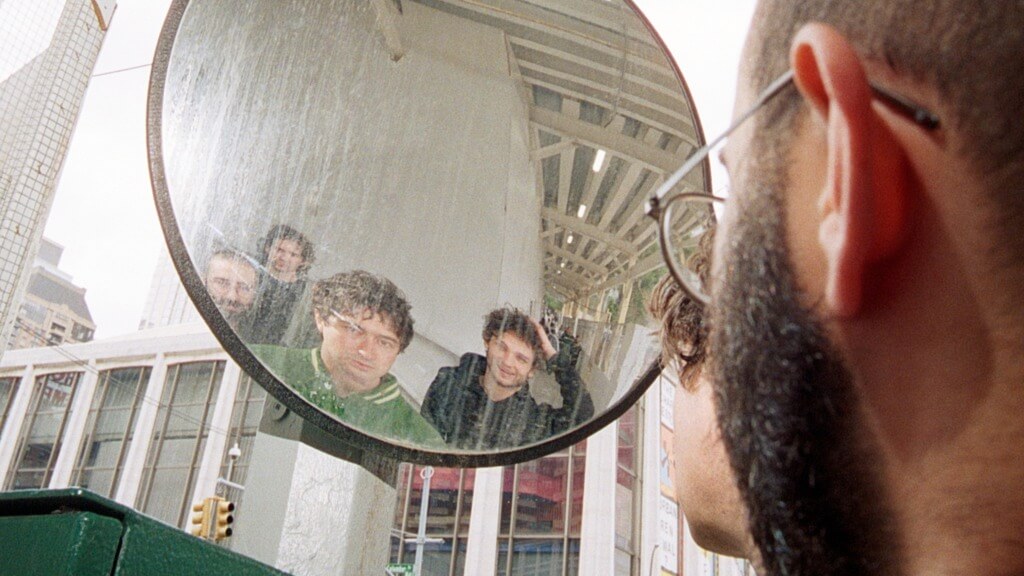
Amputation brings one closer to God. Lopping off extraneous flesh is the fastest route to finding the true, holy essence of a thing. This is the defining belief of the fictitious religious cult in Brian Evenson’s 2009 postmodern horror novel Last Days, and it is also an artistic sentiment that dates back to Michelangelo. Purity and beauty by way of somatic subtraction. “I saw the angel in the marble,” the sculptor once famously said, “and carved until I set him free.”
YHWH Nailgun brings this philosophy out of the annals of fiction and art history into the present moment on its second album, Magazine. According to drummer Sam Pickard, who had Evenson’s novel in mind while recording, the process of creation was that of removal, of chopping off body parts to discover the truth that remains. The lost limbs in question were the rototoms on the band’s acclaimed 2025 debut, 45 Pounds, that made Pickard a semi-willing poster boy for maxed-out weirdo percussion—the layers of processing that frontman Zack Borzone once tucked his voice behind. And, most conspicuously, roughly three-quarters of the standard album runtime.
Magazine is, rather notoriously, eleven minutes long. Why eleven? “Well, we decided on eleven when we realized five was too short,” guitarist Saguiv Rosenstock says. I remember seeing the band play the finished album in full at C2C Fest back in May and watching the faces of the crowd around me morph from mosh-infused excitement to empty confusion to an odd kind of entitled anger when the group’s much-awaited set came to a prompt conclusion at the 11:09 mark. I heard one greasy-haired devotee a few heads away mutter “Is this a fucking joke?” before begrudgingly disappearing into the dispersing crowd.
It’s not. “It’s been kind of funny to read these comments from people not really processing the album, thinking it’s, like, a big troll or something,” synth player Jack Tobias admits. “When, in reality, this has just sort of been in music for a little bit.” He means in music at large—as Pickard put it a minute earlier, “The only reason [Magazine] is surprising to people is because of where people suggest us to be in the world of music. SoundCloud rappers have been making whole mixtapes out of 50-second songs for over ten years. Hardcore bands have been doing this shit forever. It’s not even an unexplored territory; it’s actually out there in the world already; we’re just not as associated with those things, so people seem shocked by it.” But it’s also true that it’s been in the band’s own music for years now, too.
YHWH Nailgun have been practicing the art of reduction since their inception in 2020, and they’ve been talking about it nearly as long. When speaking about an EP-to-be (that either fizzled out or possibly turned into 45 Pounds) almost three years ago, long before the release of even their debut, Pickard had already declared, “We’ve trimmed the fat and have been zeroing in on the essence of YHWH.” Magazine’s length is not a gimmick, nor is it a reactionary response to their debut (although, Rosenstock tells me, it was in part inspired by a desire to “abandon whatever expectation there was” from outside listeners). It’s simply the most extreme round of an ongoing self-surgery—simply the band’s latest attempt at skimming the flesh of the angel already living inside the sound.
Fitting, then, that the album’s cover art is a literal sculpture—a squat, unearthly figure made by artist Hugo Winterland at the request of Tobias, who handles the band’s art direction. When I ask about it, he frames the choice in terms of first principles: “With the cover, I always wanted it to be a sculpture, because it’s the most fundamental form of physical art to me.” (Blues, he argues, is the musical equivalent.) If every artist is, at bottom, either a painter or a sculptor—either adding paint to a blank canvas until a picture emerges, or carving away at the material until a figure reveals itself—YHWH Nailgun has never once been confused about which camp it belongs to.
The band is mildly baffled by the outsized focus on Magazine’s runtime. As Borzone puts it, “We’re very late in album-making history, so it seems obvious to me to play with the form.” After all, the traditional shape of an album was born of necessity, not artistry: forty-five minutes is simply what two sides of vinyl could hold, just as the three-minute pop song is an artifact of how much audio an early 45 rpm single could physically contain. “At the end of the day, the length is just form,” Rosenstock shrugs. “It’s not the actual substance of it; it’s just kind of the vessel for the music. There are way more fundamental things about the record that have nothing to do with the length.” When we praise the artistry of a sculpture, we speak of the angel captured within it, not the fact that there’s clay left on the floor.
Reducing Magazine to its length undersells how much is crammed into these eleven minutes—how dense the material actually is and, moreover, what the material itself is actually doing. The album opens on a fade-in and closes on a fade-out, a trick Tobias attributes to Brian Wilson’s belief that a song that fades is a song that repeats forever, the whole thing playing like a loop you’ve tuned into partway through. The album, then, is a Möbius strip, an ouroboros eating its own tail—the latter being especially fitting, as serpents crop up everywhere: ”Serpent long as a limousine,” Borzone growls on “Give Blood”; “Serpent eater / Sucking on a feast” he moans in “To The Devil.” He spends every minute howling and grunting mangled mantras of Biblical fire and brimstone: wings of mercy and waves of blood and visions of sin. Gardens of Eden and their postlapsarian barrenness. War and ecstasy and life and death and everything in between.
These gory sermons are newly audible too. Gone are the effects slathered atop the vocals on 45 Pounds. “I put a lot into the songwriting of that album, but when it was finished, I realized maybe it wasn’t coming across as clearly as I would’ve liked—and then I realized I did that to myself, choosing to use those effects so I wouldn’t have to be as open,” Borzone admits. “And it’s hard! It’s a really crazy, nerve-wracking thing to step into more open space like that. I remember feeling like I was about to be crucified going up to record the vocals [for Magazine]. So internally dramatic.”
Borzone’s guttural ravings live inside the sonic equivalent of an abandoned hangar transformed into an industrial ravehouse, equal parts hollowed-out liminal space and overwhelming waves of noise. Rosenstock’s otherworldly baritone guitar carries the record on pitch-shifted riffs he half-jokingly traces to Jimmy Page, though the truer touchstone is the Pink Room scene in Twin Peaks: Fire Walk With Me, all seedy, fucked-up blues sawed out on a bowed upright bass. Tobias’s monophonic synth alternates seamlessly between subby gargles and squeaky sighs, while Pickard chops standard rudiments into unrecognizable formations, the percussion skittering in every direction.
And so much of the record’s sound is unplaceable: the bleating brass on “Stillness Blues” that’s actually just Borzone blowing a raspberry into the mic, the blurred lines between synth and guitar that lead to both feeling impossible to parse. It’s not the auditory beatdown of 45 Pounds, but something harder to locate—somehow looser and tighter all at once. It’s a record of contradictions: maximalist minimalism, dense reductionism, drunken precision. But how could it be anything else? The album was, after all, designed specifically to carve away everything that seemed, on the surface, to “be” YHWH Nailgun, but is there any YHWH Nailgun-ism more fundamental than the act of amputation itself?
Less than twenty-four hours before our interview, I watched YHWH Nailgun play the blue-lit, Guinness-strewn ballroom of Gottscheer Hall, a 102-year-old German beer hall in Ridgewood. The Queens-based band was sandwiched by screens showcasing Game 4 of the Knicks’ Finals. It was, as I later posted on my Instagram story, possibly the most NYC night conceivable. From my poor vantage point at the back of the crowd, it was often difficult to discern whether the audience was cheering because Rosenstock fingered a ridiculous riff or because Jalen Brunson scored a basket. Rosenstock himself had an even harder time telling—but he did, he admits, eventually come around to the setup. There had been a wedding at the venue earlier, and the leftover flowers ended up scattered across the stage and tucked into the band’s gear. (When I ask about it over Zoom, the band immediately descends into a riff about “blowing our whole 4AD budget on flowers for the tour bus, Morrissey-style.”) Between songs, Borzone stood with a rose behind one ear, smiling a shy, sweet, close-lipped smile. Then the music would start, and he’d morph into something animal.
Click on nearly any article about YHWH Nailgun and there’s a good chance it’ll open with some variation of: Zack Borzone moves onstage like a man possessed. It’s a cliché at this point, but—likely to the frustration of Borzone himself—there’s really no way around mentioning it, as a matter of journalistic integrity. I first saw YHWH at Paste‘s SXSW party last year, a couple of weeks before the release of 45 Pounds. On a tiny outdoor stage at 1 p.m. on a Wednesday, in front of a crowd containing no small number of politely bewildered sexagenarians, I watched Borzone lurch and buckle across the stage like a marionette jerked around by a severely coked-up puppeteer, like a zombie who’d only ever learned to walk backward. His limbs seemed—and still seem, if the Gottscheer Hall show was any indication—to receive instructions from somewhere several seconds in the future. The band pulses in unison behind him, moving like a singular body. The noises produced onstage don’t feel like the output of instruments but some Lynchian exorcism rendered in sound. To watch a YHWH Nailgun show is to witness the auditory representation of pure gut instinct be pushed out into the open air by sheer force alone.
That is, on some level, the truest distillation of the band: instinct made audible by force (and, of course, no small amount of technical prowess). “It’s purely intuitive,” Rosenstock tells me of the band’s creative process. “I guess you can be analytical in retrospect, but in the moment, you just purely feel it out.” Borzone concurs, “We never want to put too much weight on the conception of the thing. You can only control so much.” As a listener, I love artists who operate from a place of pure feeling, who refuse to dilute the raw power of art by awkwardly and pretentiously intellectualizing it.
But as a critic—worse, as an interviewer—I loathe it. Because it does make for a hard interview. The conversation becomes an endlessly polite battle between an unstoppable force (a writer in desperate need of quotes) and an immovable object (a band unwilling to mischaracterize their music by grafting words onto it). YHWH Nailgun is, of course, no exception: “They’re an opaque bunch when it comes to the fine details,” goes an NME article from 2025; a CRACK piece from a month later describes being “stonewalled” when trying to get anything from them beyond “intuition or instinct” (Borzone), “vibes” (Pickard), or a mere inability to put feeling into words (Tobias).
Language is fallible at best and utterly incompetent at worst. That is the heuristic through which I approach quite literally everything—it is, I think, the reason art is made at all: self-expression unmediated by the limits of language. Art ought to live in the gut, the heart, rather than the brain, and YHWH Nailgun’s certainly does. Theirs is some of the most nakedly somatic music being made right now, all convulsing rhythm and grunted incantation, and the tracklist reads like a coroner’s inventory—hips, blood, burns. Even the way they talk about the band defaults to flesh. Writing their first song together as a four-piece, Borzone has said, “felt like growing another arm on your body”—presumably one of the same arms that Pickard describes chopping off in the making of Magazine. For a band that flinches from meaning-making like it’s a hot stove, viscera is the closest thing to a native language they’ve got.
I try to do my journalistic due diligence anyway. The band tells me about its unique approach to Magazine, which revolved around something I’ll call “enforced short-term memory loss”: they’d write a song then refuse to touch it for weeks and weeks, in an active attempt to forget it while they wrote new ones. The hope was that, months down the line, they’d be able to listen to the songs in bulk and discover the threads that subconsciously arose in each track. I ask, then, what did remain—what they found could not be kept out of their music, even when they tried to forget it. After a unison murmur of “good question” and a beat of thought, Rosenstock simply sighs. “I feel like an asshole saying it—and I’m not trying to be an asshole!—but the only accurate answer is, like, the record itself.” (Listening back, you can hear the way my voice deflates when I reply, “Yeah. No, that makes sense.”) And when I ask how they found a balance between maximalism and minimalism—between their desire to make each second as dense as possible and their North Star philosophy of perpetual fat-trimming—Tobias just grins helplessly and says “Just… If it feels good.” Pickard then cites a quote from 100 gecs’ Laura Les in an interview where she too stood on that all-too familiar battleground: “She’s like, ‘It’s just whatever bangs.’ And that’s such a perfect fucking answer. It’s been stuck in my head for years now.”
“If you’re trying to fit the music into big ideas or concepts, instead of allowing it to organically come, you end up limiting yourself in weird ways,” Pickard continues. Going concept-first often means ignoring what the song itself wants to do—it becomes about the artist’s ego rather than the art’s intention. “We never think, like, ‘This feels good, but it doesn’t map onto some brain concept we have.’ We just roll with it anyways, because if we all like it, that means something.” That’s why there’s never any doubt in the YHWH process, Rosenstock adds. “You kind of just have to have faith in your bandmates. That’s, like, the whole point of having a band.”
Though calling them bandmates almost feels like a mischaracterization at this point. Bandmates are separate people who trust each other; YHWH Nailgun trust each other the way a hand trusts its fingers. They’re best friends who share a single brain. Watch them play—or, frankly, just watch them exist on a Zoom call—and the four register less as individuals coordinating than as a single body moving through its instincts, one nervous system distributed across eight limbs. The Pitchfork review of Magazine fixated on exactly this, describing the way the band “collapse the boundaries between members” until they read less as four musicians playing their parts than one being—and, for once, the band wouldn’t dispute the analysis. They talk about YHWH Nailgun as something separate from all of them, something none of them could claim individually. “It’s like a thing that’s sort of floating over all four of our heads,” Borzone tells me, then registers my face and clarifies: “I just mean that it’s not us as people. It’s something outside of us, from us.” The clarification doesn’t make it sound any less ominous, but it does make it sound true.
They even riff as a single organism, like a four-headed Hydra or The Joined from Pluribus. And more often than not, they’re riffing about being a single organism, too. When I ask what the band actually saw at the core of their music after every removable layer had been stripped away, and they don’t miss a beat, constructing the bit hand-over-hand the same way they construct their songs. “We saw inside of each other, frankly, and we couldn’t take our eyes off,” Pickard declares, before Rosenstock grabs the baton: “It was beautiful. We saw inside of each other, and we realized we were just one.” Tobias completes the age-old comedic rule of three: “Yeah. We are permanently inside of each other.” (“Woah. Yaoi Nailgun,” escapes my mouth before I can stop it; mercifully, no one seems to hear.) Borzone delivers the finishing blow, sincere as a eulogy: “I was filled with awe. When I saw inside of everyone, I tore my clothes and I poured ashes on my head and I begged for forgiveness.” I remark that that sounds like a lyric off Magazine. “That’s just how he talks all the time,” Pickard laughs. Borzone frowns good-naturedly: “No, I’m normal.”
Thankfully, though, it seems the band is content to leave Magazine as the final doll within the YHWH Matryoshka series, at least for now; carve at the marble long enough and eventually there’s no angel left, just dust. “This next album is totally new,” Borzone reveals near the end of our call. “We’re scrapping the whole YHWH Nailgun sound. Magazine was the end of what we’ve been doing.” My internal bit-or-truth scale—an instrument any interviewer learns to consult early and often—initially reads bit, given how, earlier, the band walked me through their forthcoming Pentatonix-style choir album, The Pillars, on which Pickard will sing, Borzone will beatbox, and Tobias will, for some reason, do graffiti (this was, of course, a bit). But then Borzone doubles down (“It actually is, to be honest. Being real, we’re completely changing everything”), and the needle swings toward truth—until Rosenstock offers, smirking, that the next record will be all cajón and acoustic guitar, and it wobbles right back.
The only concrete intel anyone will surrender is that Tobias got a new synth, and that the band is giddy about whatever it is they’re making: “I’m more excited about the new YHWH, the next record, than I’ve been about any music I’ve ever worked on,” Pickard tells me, and the rest pipe in with agreement. Naturally, I ask what makes it so exciting. Naturally, the immovable object holds. “I don’t know if I can give that information away,” Pickard says. “You’ll see,” adds Tobias. Rosenstock says “it’s still in diapers. Let’s just say that it’s beautiful and perfect.”
Time is up and the band has a flight to Europe in the morning, so I tell them I’ll let them go. There’s a beat of confusion, then I watch recognition dawn on Borzone’s face. “Fuck, I thought that flight was today until an hour ago.” Tobias nods. “I thought it was today, too, to be honest.” He laughs. “We don’t know anything besides music.”
Casey Epstein-Gross is Associate Editor at Paste and is based in New York City. Follow her on X (@epsteingross) or email her at [email protected].
 Keep scrolling for more great stories.