
Talamasca: The Secret Order’s Nicholas Denton Breaks Down Guy’s Place in Anne Rice’s World
(Photo: AMC Networks)
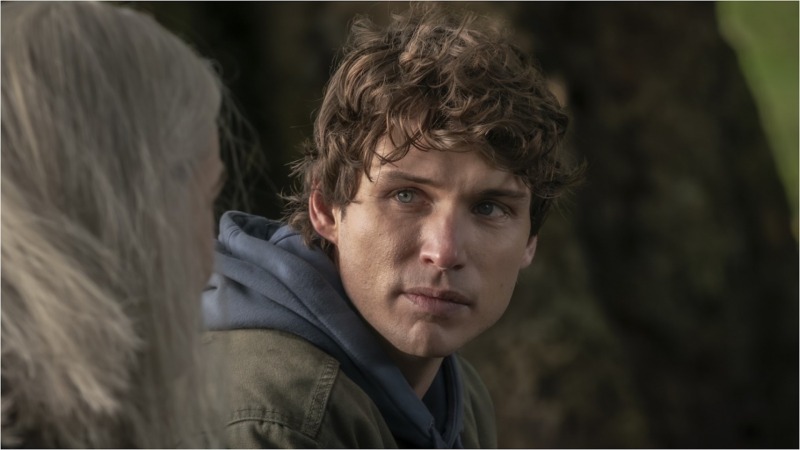
Talamasca: The Secret Order is the first installment in AMC’s Anne Rice universe that literally gets the chance to write its own story. Unlike sister series Interview with the Vampire and Mayfair Witches, Talamasca isn’t based on any specific novel from the author’s expansive catalogue. Instead, it’s built around a concept, an idea that’s heavily present throughout Rice’s work, but that’s never had its own story dedicated to it. Until now.
The Talamasca appear throughout Rice’s novels—and members of this secretive group of spies and scholars have already appeared onscreen in both Interview and Mayfair Witches. But while the organization is used as a sort of connective tissue throughout the author’s fictional universe, its agents have rarely gotten the chance to drive its story themselves. Who watches the watchers? Us, now, apparently, and the series’s six-part first season brings the group out of the shadows for a journey deep into a world of conspiracy-tinged bureaucracy, where paranoia, double-dealing, and secrets reign. But despite its lack of direct source material, Talamasca adds some intriguing depth to AMC’s sprawling depiction of Rice’s larger supernatural world.
The series follows the story of Guy Antole, a law school graduate with a troubling gift: He can read minds. Though he manages his condition with regular doses of medication, he can’t resist looking for answers when he meets a mysterious woman named Helen, who introduces herself as a member of the Talamasca and promises him the truth not only about the world around him (vampires are real!) but his own past, which the organization has apparently been manipulating for years. And where he goes from here is anyone’s guess—because the character doesn’t have a direct antecedent in any of Rice’s work, Talamasca can take Guy’s journey in any one of multiple directions.
“You have the best of both worlds, really,” Nicholas Denton, who plays Guy, told Paste. “You have references to characters that Anne has created in the past as a point of reference, so you kind of understand the tone and the style and whatnot. But then you are also given this freedom to play within the parameters that John Lee [Hancock] and Anna [Fisher] and [Mark] Lafferty and Vinnie [Wilhelm] — the writers — have created for Guy.”
Listening to Denton tell it, it certainly sounds as though he had considerable freedom when it comes to both shaping and interpreting Guy’s journey.
“It’s a mix: We have Anne, then we have the writers, then you have me, Nicholas. You want to be able to respect everyone, but there are times when the camera rolls and you’re just like, ‘Ok, I’m just going to do this a different way now.” Because the one thing you don’t want is to be doing what you’re told to do. You don’t want to just go, “Oh, I’m just going to do this because you’re telling me to do it. You want to think about it deeply, and I think that’s why…the instinct and the impulse in a scene can come from having a great foundation, but [it helps when] you’re given the room to fly.”
Talamasca’s unique premise gives the show the ability to incorporate many sorts of different characters, both mundane (Talamasca agents and local police) and supernatural (vampires and witches). But what seems immediately apparent is that despite their different perspectives, or species in some cases, they’re all looking for something—both literally and metaphorically, and it’s what helps us, as an audience, see the humanity in each.
“I think we find there’s a space, a commonality between spies and immortals and vampires and witches. And I think we find that spies have the same kind of—they have a wound that’s never healed,” Denton said. “They’re doing this for a reason, because there’s a void. Some people talk about the Green Berets. Or they talk about spies and MI-6. [Even in fiction], Bond is messed up! And if you’ve ever read The Spy Who Came in From the Cold, the John le Carré, that lead character is so sad and so depressed that it’s like—it’s a last resort to join this group, to become part of something like the MI5 or the MI6 or the Talamasca. Because there’s a wound in them. There’s a hole there. There is a void. And that is the same as a vampire. That is the same as anything else.”
Guy, for his part, has always been haunted by his mind-reading abilities, which have left him feeling isolated and othered throughout much of his life. (It’s honestly a bit hilarious how reluctant he initially is to believe in the existence of things like vampires, given that he is, you know, telepathic.)
“In the first episode, he’s so skeptical of everything,” Denton explains. “He’s skeptical of the idea of vampires. He’s skeptical of his own self. But then he slowly begins to believe in them—because he learns so much about them. The Talamasca investigates them. We learn so much about Burton. We learn so much about Jasper. And it’s, like, in doing [that], he also starts to learn a lot more about himself.”
The Talamasca doesn’t just offer Guy a (mostly) reasonable explanation for the ability that’s defined his life, it also presents the prospect of further answers about who he is and where he comes from.
“Guy’s never felt comfortable in his own skin,” Denton says. He’s always been this kind of outsider, never fit in, always kind of trying to control everything. So it’s….a weird blessing or perhaps a curse from Helen when she kind of rips the rug out from under him, saying ‘Your whole life’s been a lie.’”
Helen, leader of the Talamasca’s New York headquarters (known as a “Motherhouse”), is actually surprisingly upfront about all the ways that the organization has overtly interfered in Guy’s life, from placing him with the foster parent who raised him to orchestrating his law school acceptance. Meeting her not only throws Guy’s life into chaos, but also forces him to reconsider who he is—and who he wants to become.
“I think it tells this great story. One thing I kind of thought deeply about, when it comes to Guy’s journey, is the idea of: “I’m ready now,” Denton said. “The idea that he finds the freedom to say, okay, look, I’m ready now to trust what’s inside of me. I’m ready now to trust that whatever’s going on in my brain is what Helen says it is. It’s not an anxiety, it’s an actual gift. I can read minds. [And] I’m going to use that to the best of my ability. I’m ready now to go forth on this journey. I’m going to find out who the hell I am.”
Talamasca: The Secret Order continues Sundays on AMC and AMC+.
Lacy Baugher Milas writes about TV and Books at Paste Magazine, but loves nerding out about all sorts of pop culture. You can find her on Twitter and Bluesky at @LacyMB
For all the latest TV news, reviews, lists and features, follow @Paste_TV
 Keep scrolling for more great stories.