
Critical Role rolls for reinvention with Campaign 4
Q&A: Brennan Lee Mulligan, Marisha Ray, and Luis Carazo talk big tables, bigger stakes, and Critical Role's biggest experiment yet.
Photo courtesy of Critical Role
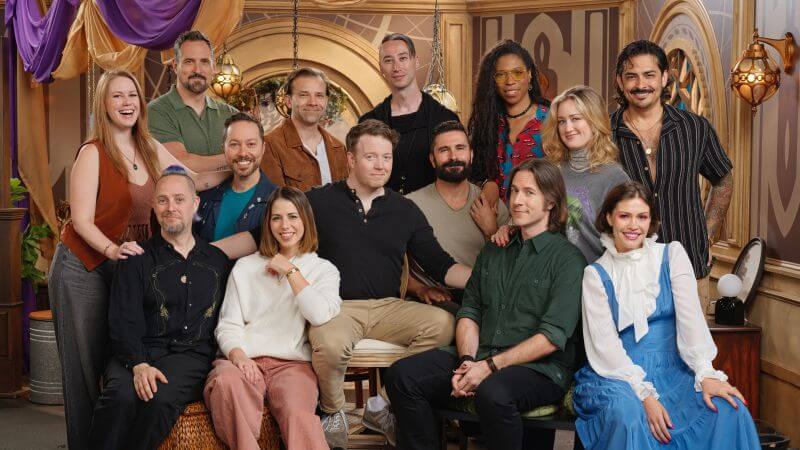
It’s been one hell of a year for Critical Role. In the fourteen months since the founders of the actual-play series responsible for pushing Dungeons & Dragons into the cultural zeitgeist graced the (digital) cover of Paste Magazine last September, the livestream-turned-multimedia-conglomerate has, in rough chronological order: released the third season of their Titmouse-animated campaign-based series The Legend of Vox Machina on Amazon Prime, concluded the decade-long Exandrian trilogy with the end of their three-year-long third campaign, published an entirely new TTRPG system (Daggerheart) that promptly sold out immediately upon release, made a NYT best-seller (the fantasy romance romp Tusk Love) out of a long-running inside joke, co-developed an AdHoc Studio video game (Dispatch) that is currently on track to outperform its three year sales target in just three months, and, most recently, released the first season of their second Prime show, The Mighty Nein (based on the series’ beloved second campaign), which debuted with a 100% rating on Rotten Tomatoes. But perhaps most notable of all, at least in terms of Critical Role’s own past, present, and future, is the beginning of the web-series’ fourth main campaign—an endeavor that, if the previous campaigns are anything to go by, will likely occupy the company for the next several years.
When we last spoke to Critical Role, creative director and co-founder Marisha Ray voiced the desire to expand the company’s brand beyond its original eight founders. At the time, this felt like something of a tall order, considering the series’ success has always been founded on the organic friendship between them (the show famously began as a private home game among friends): “The conundrum that we run into from time to time is that Critical Role is this group of eight people. Those two have become synonymous. So how do you grow what the definition of Critical Role is beyond the original eight founders?”
A year and some change later, it appears Ray and co. have not only found their solution but brought it to life in Campaign 4, which ushered in seismic changes: for the first time in Critical Role history, the campaign features a new world, a new Game Master, a new and expanded cast, even a new structure. Giving long-time Critical Role GM Matthew Mercer a much-needed break after ten long years of helming the series’ gameplay, Dropout’s Brennan Lee Mulligan took on the mantle to the shock and delight of TTRPG and improv comedy fans everywhere. For the actual-play world, it was a bit like the Red Sox sending their star pitcher to start for the Yankees—if the two teams also happened to be close friends who regularly played pickup games together. Mulligan, already one of the most recognizable GMs in the medium through his work on Dimension 20, is far from a stranger to Critical Role’s orbit—he’s run multiple short-form campaigns for the company (including the beloved four-shot EXU: Calamity) and even played a very cute little frog boy on a recent miniseries—but this marks the first time a mainline Critical Role campaign would unfold under someone else’s screen. Mulligan brought with him the world of Aramán, a setting of his own creation, checking off another first: Critical Role’s first long-form content not set in Mercer’s famed Exandria.
The founders told Paste last year that they hoped to add more fresh blood into the mix, and true to their word, the cast of eight has now been expanded to a cast of thirteen, with multiple friends of and guests on the show now promoted to series regulars—namely, voice actor and Campaign 3 guest star Robbie Daymond, Dimension 20’s Aabria Iyengar, and actors Luis Carazo, Alexander Ward, and Whitney Moore. Seven players (not including the GM) is already pushing it for most tables, though, and twelve is virtually unheard of—unless, of course, you’re running a West Marches style game, a unique TTRPG formula designed specifically for groups with too many people and too many conflicting schedules. Unlike a classic D&D campaign centered on a single party, a West Marches game plays much more fast and loose with groupings, allowing different people take the spotlight each session, depending on whoever’s available that week. In Critical Role’s case, this means the cast has been already divided up into three smaller tables (dubbed the Soldiers, the Seekers, and the Schemers) which will rotate every arc, giving each group time in the limelight—and, crucially, letting the other players take those sessions off.
Unlike previous campaigns, which followed relatively linear narratives defined by a single party of misfits discovering how they fit into the world—and into the group—in real time, Campaign 4 sees a multitude of characters with very established in-world positions and relationships (and, in some cases, day jobs) fracture into smaller guilds that will simultaneously explore their own plot threads, with the possibility of converging again later on. It’s an ensemble story with regular point-of-view switches, and while that structure is every bit as foundational in the high fantasy genre as dragons themselves, it’s a beast that has yet to be tamed in a mainstream actual-play space.
On October 2, the campaign kicked off with a devastating cold open—the first line of the series: “Someone you love very much is about to die.”—and a four (and a half) episode overture that featured all twelve characters hopping in and out of scenes like a fast and furious game of narrative musical chairs. The bulk of that first episode took place at a funeral following the execution of (mostly) beloved war hero Thjazi Fang, a man who, in one way or another, played a major role in the lives of each of our twelve protagonists. Over the course of the overture, Mulligan and the cast spun a densely interconnected and vast web of relationships, motivations, and conflicts, GM and players working in tandem to ensure the narrative reached a point for the groups to organically form and break off, while also still improvising the moment-to-moment interactions and developments that arose in the interim. By the overture’s end, the Soldiers (Sam Riegel, Laura Bailey, Whitney Moore, Travis Willingham, and Robbie Daymond) set off seeking revenge for Fang’s execution; the Seekers (Aabria Iyengar, Matthew Mercer, Ashley Johnson, and Alexander Ward) prepared to head east for allies; and the Schemers (Marisha Ray, Luis Carazo, Liam O’Brien, and Taliesin Jaffe) remained in Dol-Makjar to resist rising institutional oppression.
Ten years in, Critical Role has long since burst into the mainstream, so it’s only natural that the company’s latest experiments are less about breaking through than building out. What began as a group of friends around a table has become an ongoing study in collaborative storytelling at scale, and Campaign 4 is where Critical Role asks what happens when the table keeps getting bigger. To get a sense of how that experiment is playing out behind the screen, Paste recently spoke with Marisha Ray, Luis Carazo, and Game Master Brennan Lee Mulligan about building a new world, breaking old rhythms, and finding the edges of what Critical Role—and, most of all, the medium of actual-play itself—can be.
*****
Paste Magazine: There’s so much detail in this campaign from the outset—the relationships between the characters are already extremely interconnected and complex from the very first episode. What kind of preparation went into constructing a campaign like this?
Marisha Ray: It’s probably less planning time than you might anticipate. [laughs] We had a couple of big group “session zero” meetings to establish expectations, then one-on-one meetings with Brennan to get in line with what we wanted from these characters, what themes we wanted to explore. But that was mostly it.
Brennan Lee Mulligan: No, it’s very true. We had a series of meetings, the first of which was in the winter, I want to say; it was mostly a loose “Here’s the world” presentation to the company itself. Then a big cast character creation meeting where we went over Aramán in detail and people pitched character concepts. After that came one-on-ones, then table-specific session zeroes where character details got firmed up; by the time we got to those, it was like the third or fourth time I was meeting with people. And there was one last push right before the overture to solidify final touches on character relationships: like, who would you know? Who wouldn’t you know?
I guess the final prep, though, were these little paragraph-long packets I made for everyone the day we filmed episode one, basically “Here’s what was happening with you right before the first scene.” Like real Stanislavski known circumstances kind of stuff. There’d been so much info shoved at everyone—a brand new world, starting in media res, all these characters with interconnected lives. None of the characters were Luke Skywalker saying “Well, I hang out with my aunt and uncle, and that’s all the people I know.” No, man, they’re up in each other’s lives!
Seriously. I remember seeing all the relationship charts people made online after the very first episode and feeling insane.

MR: Oh my god. It’s funny you mention that; I was actively having a Slack conversation right before this about making official family tree graphics. And to Brennan’s point, Luis and I had a side meeting because we knew our characters were going to have a strong connection coming in. But I couldn’t have told you shit about Travis [Willingham]’s character Teor, for example, because we had no real connection established before the game, so we didn’t chat that much beforehand either.
Luis Carazo: And even though I had talked to Marisha and knew enough about [her character] Murray going in, meeting Murray in-game and seeing what that did to [my character] Azune was so interesting and unexpected. It’s been quite a tour de force of proving that no matter how much you prep, it’s only when you’re at the table that it becomes real, and it continues to evolve from there.
Brennan, you mentioned the in media res aspect of the campaign, which definitely caught me off guard when I first saw it in a really wonderful way—jumping straight into Thjazi Fang’s execution felt a little like beginning Game of Thrones with season two, episode one, after Ned Stark’s death. What made you decide on that scene as the moment the curtains opened?
BLM: Look, I will have a deep and profound love for “We all meet in a tavern!” for as long as I live. But this campaign is happening on a channel that has done the best possible versions of “We all meet in a tavern!” that have ever been done or will ever be done. So in part, I was just trying to figure out “What can I bring that’s not already been done?”
I also really believe there’s a benefit in starting with very high stakes. The example I always use—that I remember was on the EXU: Calamity intro document that I gave to Marisha and Luis and our other Calamity players—is Jurassic Park. There’s a whole hour of the movie where the T-Rex isn’t out of the paddock and dinosaurs aren’t attacking, but they start the movie on a velociraptor killing a guy, right? So I think there’s something to be said for, like, “We’re introducing a new world and our players are going to have total free rein to go where they want, so let’s start with what the stakes of the world are.” Opening with this war hero of the rebellion, who we understand to be a complicated but largely good guy, and seeing him killed right out of the gate—and then seeing everyone in his life at the funeral—that’s a kind of automatic investment.
There’s also a cheating thing to this as well, which is that this is a big cast, and a funeral was probably one of the more natural ways to have thirteen very different people meet in an emotionally vulnerable place. Going to a funeral reveals a lot about you: you walk in, you talk to the host, you pay your respects, and from that, we know a lot about you, your relationship with the deceased, and how you fit into this larger tapestry.
The overture was unlike any actual play I’ve really seen before, except for other prequels of sorts like EXU: Calamity, in that there was this really tangible blurring of inevitability and improvisation. So first, to clarify—and probably settle some fan debates in the process—did you all know from the start exactly where you needed to land, table and narrative-wise, or were you discovering that endpoint in real time?
LC: Honestly, both of those things were happening together. [laughs]
BLM: It was a really exciting mix for me. There was a true open runway of not knowing how people were going to react or what they were going to want to do, but there were also these moments that, while I didn’t know exactly how they’d play out, I knew were likely to come up. For instance, getting Sam [Riegel]’s character [Wicander Halovar] to the reveal about his family and their religion—I mean, you don’t want to ever put people on rails, but it’s not really putting Sam’s character “on rails” to imagine that he will, at some point, talk to his grandma. So it was about anticipating those moments without being rigid about when or how they happened.
LC: I knew at some point Azune would be on the job, and I know a lot of what my job [as an Arcane Marshal of the Revolutionary Guard] would entail, but I absolutely didn’t know exactly how I was going to be encountering the other characters. I had no idea what happened to [Laura Bailey’s character] Thimble [in the first episode]; I was discovering that and piecing that together in real time.
MR: Yeah. Outside of knowing that we were all likely going to converge at a funeral, I truly couldn’t tell you what else was going to happen. We knew that Wicander was looped up in some sort of weird family religion with the [Candescent] Creed that they had more or less invented, but I had no idea what any of it meant. It was just gibberish to us. It really does take walking in the shoes of these characters and experiencing the world in real time for any of it to have meaningful context. So we did have beats in mind that we wanted to hit, but I think people sometimes conflate that with the notion that the series is scripted or something, as somehow many people still hold on to that concept with a death grip. [laughs] We had rough goals of the tables that we were going to break up into, but it kind of didn’t feel that different from real life: Sure, you might have a goal that you’re working towards, but who knows what is going to happen in the interim that is going to either aid or thwart that entirely? Everything is flexible. You just go along for the ride.
LC: And even though we did know where we were heading in terms of the tables, there was also this constant sort of wrestling with like, “Okay, I know this to be true, but it feels like I could end up doing anything?” Honestly, I kind of convinced myself that even [the table designations] were still flexible—there was a time where I thought that I was going to go off with the Soldiers. I really had a moment where I just went “Oh, shit, I belong with them. I’m going with them, aren’t I?” Jumping into a game like this after doing the prep is sort of like being a tourist, you know? I’ve seen pictures of Paris, but then going to Paris is very different from reading the description of it.
Any particular moments that really caught you off-guard in-game?
LC: I will never forget what it was like seeing [Sir Harondus] Einfassen in-game, getting called in to meet this guy face-to-face while I was at work, and suddenly realizing, “Oh, I am terrified of this guy.” And kind of like seeing Paris in-person for the first time—but, like, bad—that moment of discovering [Einfassen] has stayed with me, sadly. [laughs]
BLM: Oh, yeah. People have asked before what my favorite monster is—and it’s humanoids! The scariest things in the world are people!
I mean, easily the scariest thing so far in the campaign has been, for me personally, the institutional oppression of higher learning. Like, Jesus. Close to home.
BLM: It’s a fantasy story, okay? This is a story about elves and goblins and stuff! [laughs]
The Schemers table in particular is so focused on the most realistic and mundane aspects of high fantasy, which I really love—sometimes you’ve got a job and you can’t go gallivanting off with the Soldiers. Sometimes you’ve got to go to work the next morning and face the institutions trying to take over your post. So Marisha and Luis, what made you guys specifically want to interface with that kind of structural, subtle form of oppression in this campaign? Not getting enough of it in day-to-day life already?
MR: [laughs] Man, right? There was a moment early on where I was like, “I’m going to try my hardest to not make something deeply rooted in a socio-political conspiracy.” And…then I turned right around and I did exactly that. [laughs] But I think, for me, art is always going to imitate life. Often with these games, everything is rooted in the classic hero’s journey—but in reality, there are so many small everyday people who are trying their best to make changes from inside the system. There’s something to be said about needing to put your head down and work on the problem step-by-step with the access that you have on the inside. That was something I latched onto early on—the idea of shining a light on the people who are doing that today.
LC: Well, I hate myself, so I like to start from: “What’s the maximum amount of torment that I can give myself?” [laughs] I liked the idea of creating a character that ends up where he doesn’t belong and just has to adapt to make the best of the sinking ship that he’s on. My favorite acting exercise in school was what was known as an “impossible task”: you’re trying to disarm this super sensitive bomb, but no matter what, it fails. Everyone blows up in the exercise, but it’s the commitment to that impossible task that makes watching it still feel exciting and compelling anyways. So I like feeling like I’m drowning, sort of, in an impossible or near-impossible task. Sometimes the bomb is another person, sometimes the bomb is the scenario. And to me, the Schemer’s table was a minefield, so I was interested in exploring the moral gray area there: What does it cost for you to try to keep this sinking ship from sinking? But, short answer, I hate myself.
Brennan, there’s long been a running gag about how, in most campaigns you run, the villain ends up being capitalism—but Aramán, as a much less modern setting, is largely a feudal society. It’s pre-capitalist, at least technically speaking. There’s still very much an overt socio-political emphasis here, especially with the Schemers table; is the transition between these different forms of institutional oppression something you’re hoping to explore?
BLM: Well, every oppressive system is trying to get back to the divine right of kings, right? They’re always working their way back to that. Let’s have no doubt about the fact that these tech billionaires would, in every circumstance, be like, “And what if we built a pyramid to me and I was pharaoh of all the land?” They would do it! That’s always what these guys are trying to do: find systems to get back into untouchable power.
A lot of my stories set in the modern era have been about capitalism because that’s the vector by which these sort of monarchist power-hungry tyrants are seeking their channels back to that in our world—but also, it’s imperialism too, it’s colonialism too. Pick your poison. There are a lot of different names for it, but at the end of the day, it’s just a small group of extremely privileged people sharing a social class allegiance to each other and trying to get more power and resources for themselves at the expense of the entire world.
We’re obviously following the Soldier’s table currently, but the table rotations in general seem like they’d probably require more of a regimented structure, at least scheduling-wise, than previous campaigns. Has that altered the way the game is approached, in terms of needing to get certain arcs to a conclusion with a time limit hanging over your head?
MR: Honestly, it’s probably far less regimented than it appears on the outside. [laughs]
BLM: I would say that we are being story first in a way that genuinely is a challenge for production. We have roughly an amount of episodes we’re aiming for with each table, but there’s always been the understanding of, like, “Hey, if this venture feels concluded an episode early—or we need to tack on another one—that’s fine.” There’s a lot of pre-planning, but we’ve had so much fun with these cold opens and exploring various ways to tell these stories; there’s a lot of really delightful flexibility. So, no, it’s definitely not like we’re living and dying by “we need to deliver that plot point by this episode, because then we’re outta here.” I mean, hey, we had our four-episode overture, but by the end of it, we still hadn’t split up the Schemers and Seekers tables, so we just did that in episode five.
MR: Yeah, Brennan nailed it. We always have a few contingency episodes, so if the story needs to go longer, then it can go longer. Even recently, we realized we needed a whole other day to finish a scene, which—well, I don’t want to do any spoilers—so we just hit the calendars and found a day that worked for people to come back in. It is story first, through and through. And yes, production are absolute champions. They are patient saints to deal with us.
This campaign kind of feels like a new frontier for actual play—not just with the West Marches structure (which is rare in actual play but obviously has a long history in D&D itself) but with the cold opens, the overture, all of that. It feels closer to a movie or a play in some ways, but is crucially still improvised and organic. As people who obviously have a whole host of experience with D&D and actual plays, has playing this campaign altered your sense of what a TTRPG narrative or an actual play can do?
LC: I think it’s really just hammered in that it can be anything. And I’ve played so much—I’m, like, Los Angeles’s D&D slut. [laughs] It just really can be anything at all: It can be novelesque, cinematic, a piece of theater scene work… To be honest, I barely even know how to answer that because I feel like it’s truly the biggest unknown buffet, and the sky’s the limit. It just feels like we’re in a ginormous experiment, and there’s something really exciting about that.
BLM: I’ve had experience off-camera running West Marches style games—some of my favorite campaigns I’ve ever run have had a similar format—but it just kind of felt like this sort of constellation of stars coming together here. This has been such a unique joy to dive into and see it made manifest, because this is not an unfamiliar storytelling style for fantasy storytelling, it’s just something that we don’t see much of in actual-play. This idea of a massive world explored by a party that splits to cover more ground and then reconverges is baked into the DNA of the fantasy genre; it’s Game of Thrones, [The Lord of the Rings: The] Two Towers, all these foundational texts of high fantasy. So it’s just been really delightful to bring it to a large stage in actual-play. And it’s a testament, I think, to Critical Role as an organization that these big changes were not only enthusiastically greenlit and met with thumbs ups, but executed on so well.
MR: And to speak from a Critical Role perspective, I’ll say that we’ve been talking about Campaign 4 and what it could be for a long time—really, since midway through Campaign 3. We knew we wanted to do something different. We said that through and through, and we’ve stuck to it, even if some things don’t end up working out, or we move away from them over time. The cold open structure is a good example of that—we were excited about the idea, but we said in the beginning that if it doesn’t feel like it’s working, then we can move away. Nothing’s set in stone. It’s always a work in progress, by the very nature of it. And at the end of the day, we knew that Critical Role’s been around for a decade, and everything was going to be different, and I’m thrilled that we stuck to that and really committed to going down that path.
This interview has been edited for length and clarity.
Casey Epstein-Gross is Associate Music Editor at Paste Magazine and is based in New York City. Follow her on X (@epsteingross) or email her at [email protected].
 Keep scrolling for more great stories.