
MVP: Babou Ceesay’s Star-Making Performance Is The Best Piece of Alien: Earth’s Sprawling Puzzle

Editor’s Note: Welcome to The MVP, a column where we celebrate the best performances TV has to offer. Whether it be through heart-wrenching outbursts, powerful looks, or perfectly-timed comedy, TV’s most memorable moments are made by the medium’s greatest players—top-billed or otherwise. Join us as we dive deep on our favorite TV performances, past and present:

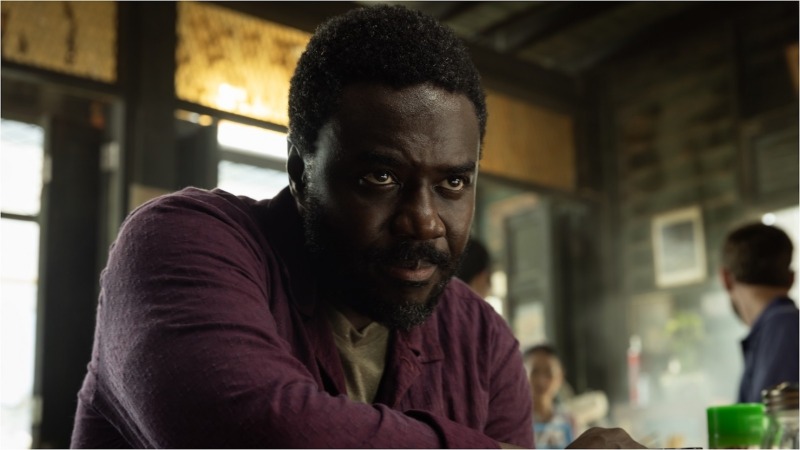
FX’s Alien: Earth debuted earlier this Fall to widespread critical acclaim. What makes the series stand out is its ensemble cast of characters, each of whom changes what we thought we knew about this franchise, and helps establish a new age of Alien. From the series’s first episode, it was clear that creator Noah Hawley was determined to expand the franchise’s scope, but that wouldn’t have been possible without the character of Kumi Morrow (Babou Ceesay). Originally the security officer on the USCSS Maginot, Morrow is tasked by Weyland-Yutani with recovering the Xenomorph cargo that escaped when the ship crashed into New Siam.
There have been many variations of synthetic beings introduced across the decades-spanning Alien universe, but never before has the franchise explored someone as fascinating as Morrow. Played with unwavering fierceness by British-Gambian actor Babou Ceesay, he slowly transforms from one of the series’s most ruthless villains to the show’s empathetic core. A bridge between man and machine, Morrow’s wants have been stripped and replaced with the greed of his employers, who will resist at nothing to get back the Xenomorph, which, along with Morrow and his autonomy, they believe they own.
Morrow views his sole purpose in life to be to do what his employers ask of him, by any means necessary, and his duty to Weyland-Yutani has stifled almost all his individual thought. The loyalty he has to them has led him to suppress the most human parts of himself, mirroring how humans have nearly become enslaved by a capitalist machine that is more than willing to chew us up, only to spit us out. This drive to make his life mean something, make the suffering he’s endured worth it, is what makes Kirsh (Timothy Olyphant) call him “the almost-human self-hating machine.”
It’s in the series’s third episode, wherein Morrow meets the childlike Slightly (Adarsh Gourav) and Smee (Jonathan Ajayi), that it became clear Alien: Earth was crafting a star-making storyline for Ceesay and his character. The cyborg pins the two young men into submission with his gaze, so sharply that it becomes impossible to look away from him as an audience member as well. As he hooks his mind into the ship’s computer by attaching pulsating cords to his face, he stares at his acquaintances, rapidly blinking as the yellow lights from the cords dance across his sweaty face.
“Are you a robot?” Slightly inquires. “Wouldn’t that be nice?” Morrow laughs. “To be all machine instead of what I am. The worst parts of man.” While we see these worst parts on display often, Morrow’s cold and calculating facade frequently wavers, indicated by little more than Ceesay’s sharp gaze and soft voice. In the fifth episode, in which Morrow ruthlessly abandons his crewmates aboard the Maginot when a Xenomorph gets loose, it becomes clear that grief has warped the man beyond repair. What remains is a man who is desperate to add some semblance of meaning to his life, and he finds that in his duty to his mission. By suppressing his own desires, Morrow has become something that he himself sees as unrecognizable.
With nothing else left to live for, the aliens are now Morrow’s primary mission, and he will do anything—including manipulating the sweet Slightly to do his bidding—to make it happen. Once again, we watch as Morrow adopts the facade of a man hardened by life’s circumstances, unafraid to use a child for his own ends, even though the loss of his own child has irrevocably shaken him. It’s in these interactions that Ceesay’s performance as Morrow becomes spine-chilling, turning on a gentle voice to placate Slightly, before bringing the hammer down and asserting himself as a figure both he and the show’s viewers should fear.
Yet at Morrow’s core is a disarming humanity that doesn’t exist in some of the series’ fully human characters. His voice trembles despite his face showing nothing but ruthlessness, as if uttering threats is inauthentic, no matter if he’s a being that can be programmed or not. Ceesay’s face often twists up in defiance or shame, allowing Morrow to become a character who, while not truly at war with himself like others are, understands that his willingness to achieve the goals of others will ultimately lead to his demise.
Through flashbacks, we get a look at a time before Morrow ever set foot on the Maginot, when he himself had a daughter. It was a life where smiles graced his face, and he spoke softly, not with the intent of intimidation, but simply because life had not yet broken him. These sequences display an entirely different person, and although he is physically (almost) the same man, his circumstances have indeed turned him into someone completely alien. The Morrow we’re introduced to in Alien: Earth’s first episode is a man irrevocably changed by his daughter’s death and the isolation that followed, as he grieved her and everyone else he knew. Morrow’s survivor’s guilt has warped his morality beyond repair, leaving in its wake a man who now only desires self-preservation.
By crafting such a rich character, Alien: Earth allowed Ceesay to work with the show’s best material, and he stands tall as the series’s most engaging performer. Each scene where he appears lingers as the next one begins, as if Morrow’s very being is stitched into each frame of the series. Ceesay perfectly displays the moral ambiguity found in a man desperate not to do what he sees as right, but what he sees as inevitable, and his performance reverberates throughout the foundation of this new series. Morrow’s progression from background character to the most layered piece of Alien: Earth’s ever-unspooling puzzle is harnessed by Ceesay’s powerful performance, which once again proves that maybe it’s not cinema where stars of the modern age are born, it’s television.
Kaiya Shunyata is a freelance pop culture writer and academic based in Toronto. They have written for Rogerebert.com, Xtra, The Daily Dot, and more. You can follow them on Twitter, where they gab about film, queer subtext, and television.
For all the latest TV news, reviews, lists and features, follow @Paste_TV.
 Keep scrolling for more great stories.