
ICYMI: The Newsreader Season 2 Is One of Modern TV’s Most Nuanced Portrayals of Queerness
(Photo: Sundance Now/AMC Networks)
Editor’s Note: Welcome to ICYMI! With so much TV constantly premiering, we’re highlighting some of the best shows you may have missed in the deluge of content from throughout the year. Join the Paste writers as we celebrate our underrated faves, the blink-and-you-missed-it series, and the perfect binges you need to make sure you see.

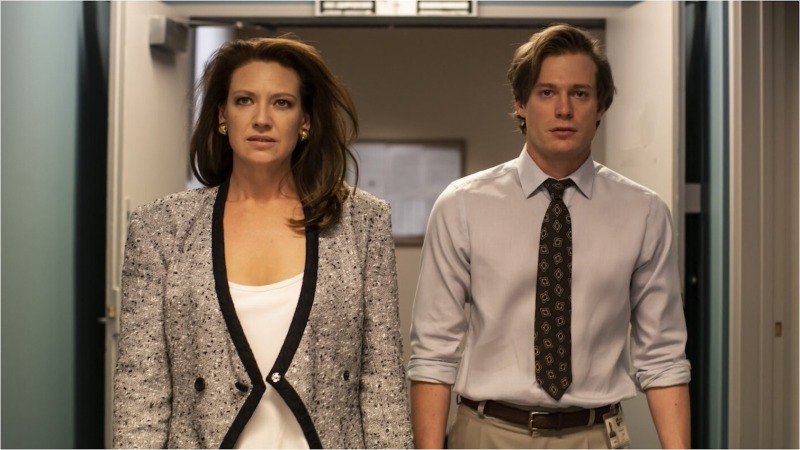
While The Newsreader aired its series finale earlier this year in Australia, for American audiences, Season 2 only began airing on AMC+ in August. Set in the 1980s, the show follows Helen Norville (Anna Torv), the first female newsreader on the News at Six, and her complicated relationship with fellow reporter Dale Jennings (Sam Reid) as they attempt to carve out a place for themselves in commercial television. The show begins as a strict drama about the two newscasters and their struggles at work, but its story eventually becomes something much deeper and more complicated, examining both the realities of mental health concerns and the process of coming to terms with one’s sexuality.
Season 2 takes place in 1987 amidst an Australian election and cultural reckoning that reflects a nation in flux. As the country grapples with its identity as the turn of the decade approaches, so do the show’s main characters, namely Dale. After sharing a passionate and desperate kiss with his coworker Tim (Chai Hansen) at the end of Season 1, Dale admits to Helen that he had grappled with having feelings for women and men throughout his life. Following this confession, Helen accepts Dale, and the two continue with their professional relationship.
Now firmly established as ‘The Golden Couple of News,’ the two seem on top of the world. But, despite confessing his innermost secret to Helen, Dale remains at war with himself. It’s an emotional struggle that brews beneath his very being, slowly festering within his chest and leading him down a path of self-destruction that threatens not only his mental well-being but his most precious relationship. Now under the intense watch of the public eye, Dale sheds the bright smiles that graced his face in Season 1, trading them in for a more manufactured demeanor, one that often looks as if it pains him. Despite Helen’s insistence that Dale doesn’t need to hide his true self from her, his inner shame manifests into a shadow that follows his every move.
In an attempt to solidify his place within the News at Six, Dale becomes somewhat of an antagonist character positioned against Helen, standing in the way of the news stories she believes they should be covering. His desperation to become the “king of news” forces him to become a nearly unrecognizable figure. And in doing so, The Newsreader deftly defies expectations of queer representation—it never absolves Dale of embracing toxic masculinity to shape his public figure into one that can’t possibly be read as queer to the public eye. From the way he speaks to the way he holds himself in a crowd, we watch as Dale slowly becomes a completely different man than the one we were initially introduced to in Season 1.
The series also doesn’t shy away from showing us the ways that Dale’s determination for success is one of the sole reasons he is incapable of embracing his sexuality, hiding behind a mask that is tailored to present what he believes to be an image of likability. Behind this facade is a man who is desperate for not just approval from the ones he holds close but acceptance from the queer community, as well as the general public. Homosexuality wasn’t federally decriminalized in Australia until 1994, and as a queer man in the 1980s, Dale has undeniably grown up not only hearing stories of men being imprisoned for being queer, but also by grossly misconstrued lies about the HIV/AIDS crisis. The fear that has been instilled within him takes hold and begins to fester, picking apart his insides until all that remains is a hollowed-out husk of the man he used to be.
Reid portrays this shift deftly in The Newsreader Season 2, laying bare for viewers the image of a man teetering on the edge of the point of no return. Watching each scene Dale is in feels similar to a ticking time bomb, one that, if it goes off, will shatter not only the facade he’s built around his image, but the cage he’s built around himself and his desires. These desires ignite once again when Dale reunites with Tim at their camera crew’s Christmas party, which sees the two and Gerry (Rory Fleck Byrne) going to an underground gay bar. Here, Dale’s inhibitions are finally released, in the comfort of not only the community he so desperately wants to be a part of, but under neon nights and the cover of darkness.
Where many cases of queer representation on television have become almost saccharine, The Newsreader isn’t afraid to showcase Dale as a deeply lost figure whose shame manifests in substance abuse patterns and passive-aggressive outbursts. His desperation drives him to attempt to mold himself into the perfect man, which in turn makes him incapable of being there for Helen when she needs him. Yet, as Season 2 goes on, the series never punishes Dale for his misgivings. Instead, his circumstances are made clear to the audience, who are encouraged to view his character with empathy rather than judgment.
But years of shame cannot be untangled in a night. The Newsreader understands that, exploring the ways Dale’s long-standing grief might manifest and inevitably implode. As Dale’s self-imposed shackles tighten, creator Michael Lucas invites viewers to reckon with how closeted queer men of the past, present, and future have been forced to completely rearrange their personhood in fear of the ridicule they would face if they were to come out. By allowing Dale to be a messy and volatile figure, The Newsreader establishes itself as one of the most nuanced portrayals of queerness in a television landscape that is often unwilling to showcase flawed queer characters on screen.
The Newsreader is available to stream on Sundance Now and AMC+.
Kaiya Shunyata is a freelance pop culture writer and academic based in Toronto. They have written for Rogerebert.com, Xtra, The Daily Dot, and more. You can follow them on Twitter, where they gab about film, queer subtext, and television.
For all the latest TV news, reviews, lists and features, follow @Paste_TV.
 Keep scrolling for more great stories.