
The Running Man Fights A Knowable Yet Nebulous Enemy

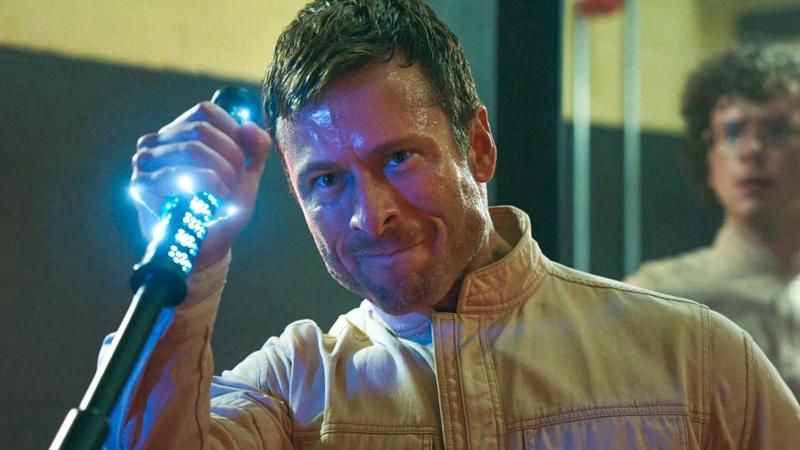
Two of this year’s multiple live-action Stephen King adaptations, The Long Walk and now The Running Man, share a similar dramatic punch. Both films take place in a not-too-distant American future where violent contests reward winners (i.e., survivors) with a desperately needed boost up the economic ladder. It’s also noteworthy that these grim yarns feel more relevant today than they likely did when they were initially published. Written during King’s “Richard Bachman” phase, the appeal of these novels (if “appeal” is indeed the word to use here) was their bleak depiction of the United States’ slide into showtime authoritarianism. King, an astute observer of humanity with a knack for locating and exploiting the rot beneath it, was showing us the writing on the wall. The Long Walk and The Running Man are cautionary tales—this is what will happen if we let the bastards call the shots, they warn us.
I’d say the time for warning is well and truly behind us, but that’s fodder for another article. What’s at hand is Edgar Wright’s crackling yet conflicted update of The Running Man, a crowd-pleaser that frowns at pleasing crowds and a studio picture about independence from corporate media released by Paramount, which is currently poised to buy its rival, Warner Bros. Clarifying matters, however, is this Running Man’s choice of who plays King’s rebellious Everyman: Paul Michael Glaser’s 1987 version featured Arnold Schwarzenegger as a cigar-chomping action hero, while Wright’s pick, Glen Powell, successfully obscures his million-buck grin as a father and husband driven to frenzy by the world’s innumerable injustices. Powell may not share the thundering screen presence of his predecessor (who does?), but he makes a hell of a sturdy lead—and a much more sincere one.
Besides, flashy products with messages have their value. And although Wright is hardly an iconoclast, when The Running Man cooks up a sizzling platter of Damn The Man, it really cooks. Skewing more closely to the novel than Glaser’s take, Wright’s film follows Ben Richards (Powell), a blue-collar joe whose complaints about unsafe labor conditions get him blacklisted, forcing his wife, Sheila (Jayme Lawson), to scrape by serving the elite while their daughter suffers from a worsening flu. With the financial walls closing in, Ben auditions for a lesser game show made by the government-run Games Network—until his palpable class rage (represented by a forehead scar that looks like a throbbing vein) catches the eye of unscrupulous producer Dan Killian (Josh Brolin), who manipulates Ben into becoming a contestant on “The Running Man,” a murderous ratings juggernaut where alleged criminals are hunted and killed by mercenaries led by the lethal McCone (Lee Pace).
Of course, Ben isn’t a criminal at all, just unrelentingly human, as established during an early, feisty exchange with a former employer. It’s here where Wright and co-writer Michael Bacall (Scott Pilgrim Vs. The World) begin flexing the film’s most potent idea: perception as manipulation. As Ben’s streaming manhunt escalates, the Network’s deepfakes and other forms of digital sleight-of-hand—produced instantaneously in a manner that obfuscates truth not just for the fictional hordes but for the film’s IRL audience—weaponize the public against Ben, who begins to rightfully view everyone around him as a potential snitch. Between the Network’s distortion of his combustible personality and his chiseled mug being advertised over every clean surface on the planet, his attempts at disguise (a playful nod to Powell’s turn in Hit Man, perhaps) are quickly rendered moot. The public might not be able to see through the Network’s lies, but they can clock Ben’s fake mustaches easily enough.
Naturally, his continued existence could use a helping hand, and similarly aggrieved citizens soon offer it in droves: there’s Molie (William H. Macy), a wizened counterfeiter; Bradley (Daniel Ezra), who exposes the Network’s inner workings via guerrilla webisodes; and Elton (Michael Cera), a squirrelly, zine-peddling anarchist whose desire to stick it to The Man threatens his philosophical obligations to Ben. Wright parcels out these allies in serialized chunks, with introductions and complete character arcs that make the middle stretch feel soggier than it should. It’s a relief, then, that whenever the movie begins to drag, we’re hit with a brisk and kinetic action beat that explodes with marvelous pyrotechnics and ferociously convincing stunt work. Powell acquits himself heroically during these sequences, leading the charge through all this mayhem with a granite jaw and toned bod, seen in full during one sequence where he’s dressed in naught but a very small towel.
Powell is far from being The Running Man’s primary sign of life. There’s Bobby T (Colman Domingo), Killian’s trusted master of ceremonies, a man who is happy to make a glittering farce out of tragedy once the check clears but whose overall morality operates on a sliding scale. Domingo plays Bobby with a louche charisma that lands somewhere between showman and sociopath; naturally, whenever he’s onscreen, the film is electric. When he isn’t, which is far too often, it’s difficult not to feel as though Wright’s letting the current fizzle out.
It’s a simple problem to diagnose. In an attempt to harness the fullness of King’s zeitgeist, Wright cast too wide a net and too far in one direction. Powell’s cross-country flight, pursued by Pace’s hunters and the Network’s floating cameras, draws in a parade of well-meaning eccentrics who toss Ben from one crisis to the next, sapping his agency until enough bodies and subplots are cleared and the film’s overcooked and consequently sauceless finale can emerge. Wright’s flair for freakazoids remains undeniable, but his focus on rebellion obscures the cruel machinery that incites it. That reluctance to linger too long in the muck of this world—to give perceptible shape to the apathy that creates this level of soulless greed—leaves Ben fighting an abstraction. It’s a devil we’re familiar with, just not one this film is willing to face head-on.
Director: Edgar Wright
Writers: Edgar Wright and Michael Bacall
Stars: Glen Powell, Jayme Lawson, William H. Macy, Michael Cera, Colman Domingo, Lee Pace, Josh Brolin
Release Date: November 12 (U.K.); November 14 (U.S.)
Jarrod Jones is a freelance critic based in Chicago, with bylines at The A.V. Club, IGN, and any place that will take him, really. For more of his mindless thoughts on genre trash, cartoons, and comics, follow him on Twitter (@jarrodjones_) or check out his blog, DoomRocket.
 Keep scrolling for more great stories.