
30 years ago, Fiona Apple had her own hell to raise
Most of us spend our entire lives trying to figure out how to say what we mean. Apple figured it out when she was a teenager, releasing her debut album Tidal on this day in 1996.
Photo by Brad Barket/Getty Images
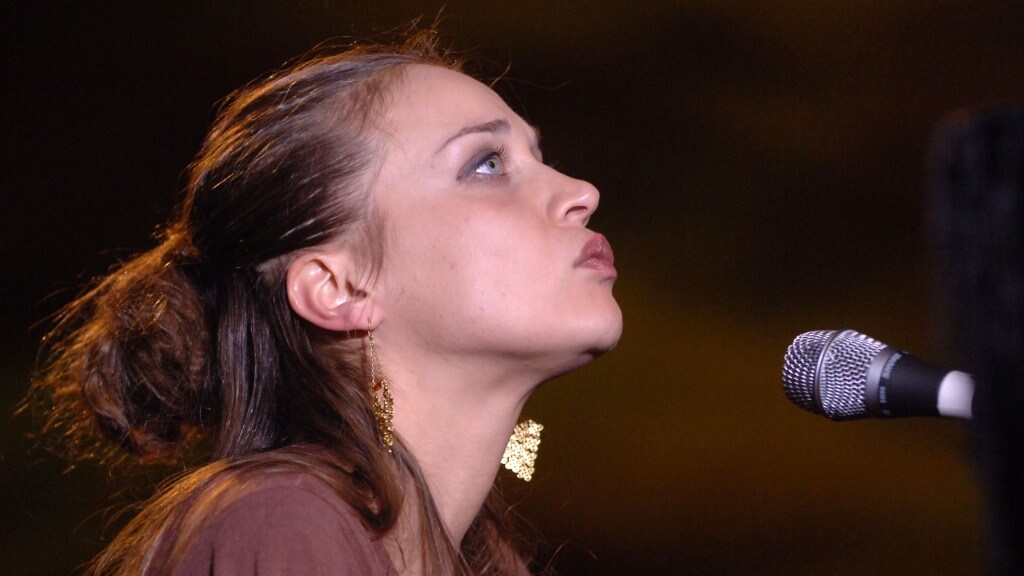
Everyone knows the acceptance speech—or, more accurately, everyone knows one line from the acceptance speech. I guess if you win the most prestigious award of your career thus far and in your acceptance speech call the awarding institution “bullshit,” that’s bound to be the legacy. “This world is bullshit,” a then-nineteen-year-old Fiona Apple said upon accepting her VMA for “Sleep to Dream”—“this world” being the exploitative, materialistic, arbitrary, and image-obsessed world of corporate entertainment whose award shows serve as pageants of false meritocracy. It’s a world that Apple has largely retreated from: she makes very few public appearances, she hasn’t toured in over a decade, and has no social media accounts of her own.
When Apple’s fifth album, Fetch the Bolt Cutters, won two Grammys in 2021, she did not attend the ceremony. She told The Guardian after the fact that she’d imagined smashing the award into pieces with a sledgehammer and inviting her fellow Best Rock Performance nominees—who, for the first time in Grammy history, were all female—onstage to share the pieces, all in protest against the hypocrisy of a Recording Academy that would nominate a daring album about the blunt and senseless cruelty the patriarchy inflicts upon women the same year they’d nominated a man with an extensive history of sexual abuse allegations—and just few years after they’d invited his alleged victim to sing a song about what he’d put her through. Bullshit, indeed.
When Fiona Apple said “this world is bullshit,” she was crucially not saying “the world is bullshit,” much like how she later retracted her infamous “there’s no hope for women” anti-mantra (“There’s always hope for women,” she said during a Q+A two decades later. “We are the hope in the world. We are. I don’t feel like that anymore; I was a kid, it was a strange situation, I felt really uncomfortable”). Much like how Apple’s songs are all too often reduced to flat, uncomplicated kiddie descriptors like “angry” or “sad.” “Is that why they call me a sullen girl?” she asks on one of Tidal’s most enduring ballads. “They don’t know I used to sail the deep and tranquil sea.” A surface-level snap judgment is an easier story to tell than one that requires a more generous, attentive assessment of a person’s character and context—and sometimes, it’s easier to just let people believe what they assume about you than to try to explain all that’s beneath it. “My fever burns me deeper than I’ve ever shown to you,” she sings on “Never Is A Promise.”
These quick quips of surliness or misery are what gets remembered, never the nuance behind them. Apple’s VMAs speech was enough to get her derided by the music press as a spoiled kid unappreciative of the spotlight she’d been recently thrust into. She’d called their world “bullshit”—but the world? That was bigger than some award show. That was something worth paying close attention to and taking in completely, tuning into its varying frequencies and answering back accordingly.
The night before the 1997 VMAs, Apple brought her breakout single “Criminal” to The Late Show with David Letterman. At the beginning of her performance, she peers out from behind the curtain, looking almost unsure if she’s in the right place, before running up to the mic and singing “I’ve been a bad, bad girl,” untinged by the shame of the studio version. Instead, Apple sounds like she can’t wait to boast about her devilish exploits to a trusted confidante. I’m sure I’ve watched this performance upwards of a hundred times, and I can still never predict which way her grainy alto is going to waver—still can’t decipher what words she’s mouthing as the keys roll roughly from the second chorus to the bridge. There’s the slightest hint of sarcasm built into her pained confessions, an eye rolled at an angle subtle enough that it could be passed off as a meaningless, sidelong glance.
“Criminal” was, relatively speaking, the poppy, grabby single that stood out to the masses among the more downtempo ballads that make up most of Tidal. Apple said she wrote it about the guilt of “getting something so easily by using your sexuality.” You don’t have to look hard to find plenty of interviews and reviews in which older male music journalists dismiss her as crazy, or spend more time discussing her doe eyes and exposed belly button ring than her artistry. When Apple hurls her final piercing plea—“So what would an angel say? / The devil wants to know”—during her Letterman performance, it feels as though she’s throwing it all back in their faces, as though the greatest sin she could commit would be leading some poor sucker on. If I am on my deathbed and the worst thing I’ve ever done is bruise a man’s ego, I will die knowing I’ve lived an honorable life. The woman under a microscope is the bad guy for making the most of her own dehumanization instead of playing nice and feigning oblivion. Why should she be blamed if they happen to walk into a trap that they’ve set? On Tidal’s opener, “Sleep To Dream,” Apple sang, “This mind, this body, this voice cannot be stifled by your deviant ways,” while bobbing and weaving among the punches of Jon Brion’s chugging vibraphone. Who says she can’t be deviant too?
When the public decides to collectively and loudly hate a female artist, it usually ends up further endearing her to me. Usually the public derision is the result not of any violent or hurtful behavior, but because she conducts herself in a way that makes audiences think that they probably wouldn’t like to have her as a mommy or a friend or a girlfriend (as if she’d want to hang out with them in the first place). So many of the women I look up to have been blacklisted or smear-campaigned for being publicly imperfect in a way that just begs bad-faith actors to project their own personal grievances onto them.
In Chip Chanko’s initial Pitchfork review of Apple’s When The Pawn…, which the site has understandably tried to retcon (Judy Berman’s Sunday Review published twenty years later being the implied canonical one), he dismissed Apple as “annoying” and “pretentious” with a few added backhanded compliments about how he shocked he was to be listening to a record by her and actually enjoying it. “Pretentious,” I’ve come to learn, is more often than not shorthand for “I feel out of my depth intellectually and am choosing to write off this thing that is challenging me rather than attempt to meet it where it’s at.” In Apple’s case, “pretentious” was a scoff at the idea that a teenage girl could make a record as perceptive, articulate and sonically present as Tidal. It’s like watching her sing live in some smoky jazz club every time you hit play. Most of us spend our entire lives trying to figure out how to say what we mean. Fiona Apple figured it out when she was a teenager, and her knack for it has only expanded with each few-and-far-between album since.
Maybe I’m just as guilty of the projection I’m criticizing when I internalize these unfair critiques levied at Apple as if they were directed at me. They ring not unlike the words of the exes who told me I was “intimidating” or “too intense,” the guys who’ve chastised me for not smiling enough, the faceless commenters who’ve painted me with the same broad brush of pretension, the male colleague in a writing workshop (in which I was the only female student) who called my prose “too smart for its own good.” Even the more well-meaning men and women alike who relied on backhanded-sounding words like “feisty,” “spirited,” and (ugh) “badass” when they didn’t know what to make of all my unsanded edges—either because I’ve refused to smooth myself out or because I’ve tried and failed repeatedly. I have envied those who, to quote Apple, are able to float by “unweighed down by passion or intensity.” I wonder if she ever wished she could just play the part of the grateful, palatable teen pop star to make things easier on herself, or if she knew from the start that it wasn’t worth trying to mold herself into unnatural shapes she’d just revert back from. Maybe that was what she meant when she told the people watching the VMAs—many of them teenagers like herself—not to model their lives after what they saw in that fake “bullshit” world. “Go with yourself,” she told them.
A couple months ago, I found myself on a rooftop with two friends and a band they’d just seen. One of the band members fancied himself a real class clown—leaving a gaping pause for laughter after nearly everything he said, funny or not (usually not). When he’d notice my blank expression, he’d single me out in front of the rest of the group, at first chiding, eventually accusatory, posing a rhetorical question to the rest of them: “What’s her problem?” he asked, making me an unwilling participant in his shitty crowdwork. When I did laugh, it was at his bandmate who’d self-identified as a “golden retriever boyfriend” and then proclaimed “Kill all men!” I’d been drinking that night—we all had—and if I’d been drinking a little more, I probably would’ve questioned his seriousness. “Kill all men? Okay, you first,” I might’ve joked. “We’re on a rooftop, aren’t we?” I knew the joke wouldn’t land and that it would just prove to everyone that I really was mean and no fun, so I lied when someone asked what I was laughing at and politely excused myself from the party a few minutes later. Sometime in between, one of my friends posed the question, “Who’s a songwriter who, when you listen to them, you feel like they’re inside your head, narrating your own thoughts?” Of course, Fiona was the first one I thought of, and I listened to the Bolt Cutters track “Under The Table” on the subway ride home and, just like always, it felt like she was banging on the walls of my own brain.
I wonder what Apple herself might offer as her own answer. My immediate guess is that she’s lightyears ahead of the rest of us when it comes to articulating her own emotional world to the point that she doesn’t need to outsource it to someone else, but she’s spoken with reverence about the powerhouse jazz vocalists like Billie Holiday and Nina Simone, whose storms she chased while finding her own voice. If we’re allowed to include non-musicians, perhaps Apple would say Maya Angelou, having cited the poet and essayist as one of her biggest influences. “She writes about her vulnerabilities and her sensitivities and the weak points in her life and the embarrassing points in her life,” Apple said of Angelou during a 120 Minutes interview.
In Angelou’s poetry, Apple saw a way to put words to the tangled web of unsayables inside herself, to bring it into the world and make it understandable to those willing to understand it. During her infamous VMAs speech, Apple quoted the poet again, saying, “We as human beings, at our best, can only create opportunities.” In the thirty years since, Apple has put herself in the public eye increasingly less, but has stuck to Angelou’s (and her own) convictions. When she addresses the public, it’s usually to speak out against injustice, whether that’s on behalf of Palestinians, trans youth, ICE detainees, or incarcerated women. She works at her own pace, releasing an album about once a decade. When she speaks with us, it’s because she’s got something of substance to say. “I’m not gonna do this like everybody else does it,” Apple prefaced her VMAs speech. Thank God she never has.
Grace Robins-Somerville is a writer from Brooklyn. Her work has appeared in Pitchfork, Stereogum, The Alternative, ANTICS, Marvin, Swim Into The Sound, and her “mostly about music” newsletter, Our Band Could Be Your Wife.
 Keep scrolling for more great stories.