
The history of the punk beat in 10 songs
This fast, galloping drum beat is ubiquitous in punk and hardcore music, propelling numerous songs by everyone from blink-182 and Turnstile to Operation Ivy and Jeff Rosenstock—but the consensus on its origins and evolution is muddy at best.
Image courtesy of Bad Brains Records
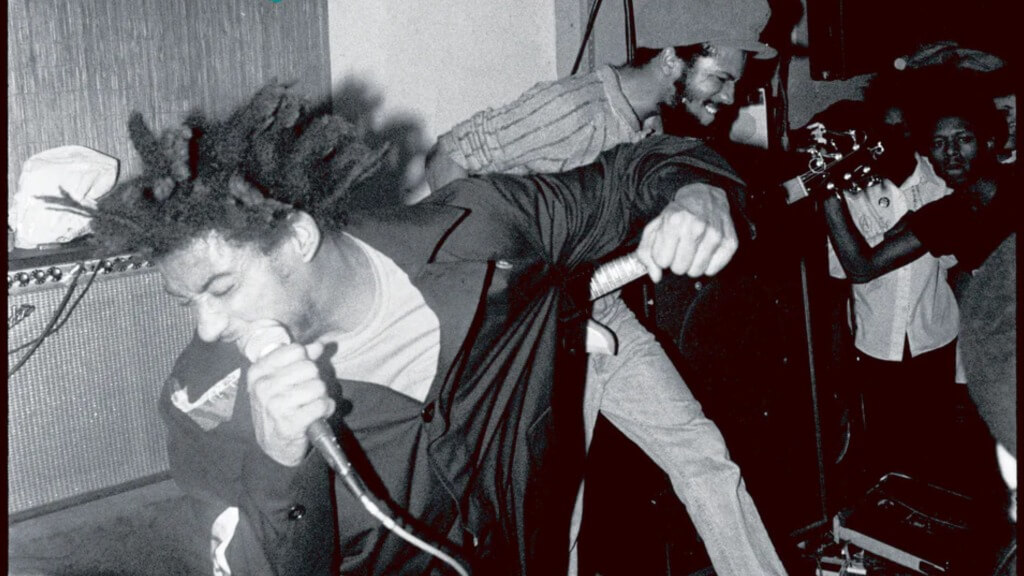
Do you remember the first time you heard the “punk beat”? Maybe it was via Tony Hawk’s Pro Skater, or watching one of blink-182’s first singles on MTV. Before that? The pioneering early-years output of Dischord Records, say. Or maybe it was only recently, when Turnstile’s GLOW ON and Jeff Rosenstock’s HELLMODE flung the double-time beat into galloping conversation with arenas and the Pitchfork + The Needle Drop in-crowd.
For Jono Diener—ex-drummer of Michigan band The Swellers, and a punk beat authority who generously lent his insight to this investigation—it was “M+Ms” by blink-182, the band’s 1995 debut single. It makes sense to consider this a textbook example of the beat going forward. “My cousin made us a mixtape when I was eight or nine. I remember thinking it was so crazy. I was like, that’s funny, no one can play that fast. So it was almost like a gimmick when I first heard it,” Diener tells me. Fast forward a decade and he’d become an expert, employing it across The Swellers’ discography.
What defines the punk beat, for all the nerds that care, is an offset kick drum. In other words: break down a bar of music into one-e-and-a, as you would when learning rhythm, and the second kick drum falls on the “a.” This is the important bit, because it’s what results in the signature bouncing, skipping, ‘shuffle’ feel. Besides that, you’ve got the hi-hat going the whole time (though it could be the crash, ride, or even floor toms) and a strong snare on beats 2 and 4.
Fast is the operative word with the punk beat. It’s sometimes referred to as the ‘gallop beat’ as it resembles the out-of-control gait of a bolting horse. It’s also called the D-beat—or, depending on your position, conflated with it. Brian Roe, drummer of the English eighties band The Varukers and one of the founders of the D-beat, says in a YouTube demonstration that its definition has been “distorted” over the years. The hi-hat shouldn’t be used, he explains, and there should never be a double kick drum. The punk beat, in contrast, typically defaults to the hi-hat, as on “M+Ms,” and often uses a double kick variation, which we’ll come back to later.
Diener was introduced to the beat as “the punk beat” and tells me “it’s obviously its own movement. It’s kind of a trend. People attach different meanings to the music. Really [all this comes down to is], it’s just a hyperactive beat that makes the song fast.” As with everything in punk, there are exceptions and disagreements.
Discharge: “Hear Nothing See Nothing Say Nothing” (1982)
Discharge put the D in the D-beat, with many pointing to them, along with The Varukers, as its progenitor. The British band formed in 1977, and the term was coined soon after to describe the beat used on their 1981 EP Why. From there, though, the D-Beat genre stayed surprisingly distinct from the subcultures of hardcore, skate, ska, and pop punk—two roads diverged in a grubby, noisy wood. Put another way: Discharge’s influence on thrash and heavy metal legends like Anthrax and Slayer is more widely reported than the influence they had on punk groups.
This great Bandcamp guide breaks down some examples. It discusses the D-beat’s export from the UK to the US, but doesn’t link it to US hardcore or more mainstream-flirting punk music outside of this specific subgenre. “There’s no time for breaks (or breakdowns),” the writer notes. The punk beat, in contrast, is often paired with both—from eighties hardcore linchpins like Gorilla Biscuits to Turnstile today. Still, this is close to where the punk beat’s story starts: the opening track from the band’s debut full-length is a quintessential example.
Bad Brains: “Banned in DC” (1982)
Bad Brains, often credited as the first hardcore punk band, complicate this origin story: that the punk beat—or D-beat, whatever—was “invented” by Discharge. While Stoke-on-Trent was moshing to the sounds of D, the DC quartet were transmitting the punk beat stateside, putting it in songs like “Banned in DC” and “Pay to Cum,” whose 1980 release date actually predates Discharge’s Why EP. (Oh god, this is going to get confusing.)
“Banned in DC” opens with a rumble of musical thunder before drummer Earl Hudson collides into the beat with a violent wash of hi-hat. The lo-fi production makes it hard to tell whether this is a straight or offset kick. But either way, in energy and spirit, this is a certified punk beat. “How you work with it is where bands start getting their own style—whether it’s more aggressive or more pop punk,” Diener explains.
Agnostic Front: “Existence of Hate” (1986)
If you thought Bad Brains were fast, wait until you hear Agnostic Front. They are the fastest proponents of the punk beat from this era that I can find. The New York band formed in 1980, released their first album in 1984, and are celebrated for blending hardcore punk and thrash metal. “Existence of Hate” is from their influential 1986 record, Cause for Alarm, said to expose punk to metal kids and metal to punk kids, furthering the work that Discharge and co. started.
Operation Ivy: “Missionary” (1988)
Between Agnostic Front’s barrier-breaking and the straight edge principles foregrounded by bands such as Youth of Today, hardcore as we know it was codified in this mid-eighties era, snowballing across the Northeast of the country in particular. Following their lead, bands such as Gorilla Biscuits, Madball, and Sick of It All put out seminal records, their templates soon to be reworked into post-hardcore and melodic hardcore. But it wasn’t just hardcore—and it wasn’t just the East Coast—making use of the punk beat.
“So this is where it gets interesting,” Diener tells me. “A lot of the East Coast stuff was fewer kick drums, hardcore, punchy. The West Coast stuff was almost mechanical.” He goes on to outline some regional distinctions: West Coast bands tended to double up on the second kick drum. So instead of dum ka / dum ka, the beat became dum ka/dum-dum ka, still accenting that offset “a,” but hitting the beat before it too. You can hear this on “Faith In God” by Bad Religion and, later, “Jaded” by Green Day. You can also hear it throughout the work of Operation Ivy, perhaps the most important ska punk band of all time.
Operation Ivy were instrumental for successive waves of ska punk (not to mention Green Day themselves). Less Than Jake used the punk beat all over their early albums. A decade later, Jeff Rosenstock formed Bomb the Music Industry! and employed the punk beat for his brilliant post-ska laptop tomfoolery. The DNA of these acts is obvious in a track like “Missionary,” from Op Ivy’s 1989 release Energy, its clattering double-kick gallop paired with runaway walking bass and an infectious group-yelled chorus.
NOFX: “Linoleum” (1994)
Sticking on the West Coast, let’s explore that “mechanical” comment from Diener. blink-182’s original drummer, Scott Raynor, certainly isn’t who Diener is referring to. His playing on “Josie” trips out of time so often that it’s essentially an entire beat late on the chorus, giving the section a different feel of ka dum/ka dum, rather than dum ka. For another example of his rad sloppiness, try playing guitar to “Carousel” when the drums break in. (What is happening there!)
“A lot of times when bands are recording they have to put it to a grid because no one can play it accurately. The joke was it sounds like shoes in a dryer,” Diener explains. Enter: NOFX. Listen to the opening statement of their 1994 album Punk In Drublic. The punk beat comes at you with military precision, shockingly locked in. It, too, showcases that double-kick drum variation clear as day, each beat at the same volume and velocity, compressed to the max.
Lifetime: “The Boy’s No Good” (1997)
It’s 1997, we’re back out East, in New Jersey, and we’re going as fast as we have since Agnostic Front. Lifetime aren’t exactly a well-known name, but they are an important gateway band, cited as a favorite by your favorite emo/pop punk/melodic hardcore bands: My Chemical Romance, Fall Out Boy, New Found Glory, Taking Back Sunday, Set Your Goals, Saves the Day, Thursday—the list goes on.
“Every day I hear a new band trying to sound like Lifetime, whether they know it or not. The impact they’ve had on music is enormous,” Frank Iero of MCR told SPIN. New Found Glory covered their song “Cut the Tension,” Fall Out Boy covered “Turnpike Gates,” and Rise Against covered this one, “The Boy’s No Good”—an extremely fun, snotty example of the punk beat, to which drummer Scott Golley takes a chaotic run-up. This is less militant and mechanical than NOFX, but tighter and punchier than the hardcore pioneers who led the way here.
The Wonder Years: “Don’t Let Me Cave In” (2011)
To continue charting punk beat history, take your pick of the bands mentioned above. Between Lifetime and The Wonder Years, there’s a whole major-label pop-punk boom decade, and bands like New Found Glory were liberal with their use of the beat, pairing it with half-time beatdowns.
But after journeying to the West Coast and around the world, the punk beat “came back to the East Coast in a really interesting way,” Diener says. “To me, it’s like a decade and time thing. So you have the origin of a beat, and then, region-wise, where it ends up. Nineties skate punk was a big influence on me—Fat Wreck [NOFX, Lagwagon]. And Epitaph [Bad Religion, The Offspring]. And then fast forward, it’s almost ‘Philadelphia pop punk’ with The Wonder Years.”
Unlike Lifetime, NOFX, and blink’s nineties output, The Wonder Years don’t rely overly on the punk beat. It’s part of their sound—especially on earlier records—but they aren’t doing an “M+Ms” with it. It’s interesting to see the beat’s application as it is more sparingly integrated alongside the band’s Bruce Springsteen, Mountain Goats, and literate-punk influences.
Granted, others in the Northeast were doing this around the same time. Title Fight’s debut album, 2011’s Shed, was released the same year as The Wonder Years’ Suburbia I’ve Given You All and Now I’m Nothing. Several songs from those albums showcase the bands’ tasteful, more accessible integration of the punk beat. You can’t go wrong with “Don’t Let Me Cave In.”
Sincere Engineer: “Overbite” (2017)
Something to address at this point is the over-preponderance of dudes featured in this timeline. Before the 2010s, it’s surprisingly difficult to find women, femme-presenting, or non-binary punk beat users. This speaks to a broader, inherent misogyny in the genre that we’re still belatedly counterweighting (how often do you hear any and every punk-adjacent band with a female vocalist compared to Paramore, now, still, in 2026?). The last decade or so has blessed us with several brilliant punk beat heavy hitters that aren’t solely made up of men. Examples include Japan’s Otoboke Beaver, Nashville’s Snõõper, Philadelphia’s Mannequin Pussy, California’s Bad Cop Bad Cop, and LA’s illuminati hotties.
A specific shoutout goes to Chicago’s Sincere Engineer, though, a project led by Deanna Belos and signed to Hopeless Records. Their 2017 debut, Rhombithian, is like Camp Cope meets Modern Baseball: delightfully scrappy, clamorous, and impassioned emo-punk that scratches the punk beat itch a few choice times, like on “Here’s Your Two Dollars” and this banger, “Overbite,” which will keep pulling you back in for more.
The Swellers: “The Best I Ever Had” (2011)
Rewinding a few years, in 2011 Jono Diener used the punk beat on The Swellers’ big, breakout single, specifically on the second verse and again in the outro. It’s one of the tightest, warmest examples in this timeline. Diener finds it funny that the final song on this list—“T.L.C.” by Turnstile—is by a band that plays stadiums. In his experience, the beat seemed at odds with that level of success.
As he explains, “When we did ‘The Best I Ever Had,’ I had to ask [producer and Descendents drummer] Bill Stevenson, should we do the punk beat? He’s like, hmmm, the song could be a lot bigger if you don’t. I was like, but what if it got big enough to where, if it were on the radio, there’s a section where there’s a punk beat—would that work? He’s like, I guess, but you’re kinda risking it, man. I was like, for the sake of nostalgia, I’m gonna keep it. And yeah, it didn’t work. But it was fun.”
I massively respect this move, and I’m curious whether the punk beat is actually a hindrance. Looking back at blink’s early singles, “M+Ms” and “Josie,” both of which use the punk beat throughout, these weren’t the tracks that shot the band into the stratosphere. It was “Dammit,” which sort of punk-beats, but at a far more conservative, family-friendly tempo. Beyond that, “What’s My Age Again?” and the other Enema of the State chart-toppers abandon it altogether, opting for straight, chugging-along eighths without that tripping, triplet feel.
New Found Glory’s biggest hit, “My Friends Over You,” didn’t use it either—the deeper cuts from that album did. The same premise holds for a mainstream punk band like Sum 41, whose singles swerved it while album tracks let loose on it here and there. An exception is The Offspring: the lead single from Ixnay on the Hombre, “All I Want,” delivers nonstop punk beat action from start to finish. As I said earlier—this is surprisingly not very straightforward.
TURNSTILE: “T.L.C. (TURNSTILE LOVE CONNECTION)” (2021)
Maybe it’s a time-and-place thing, then. It’s not 1994 anymore. Part of what makes TURNSTILE so fascinating and such a great subject for critical interrogation is how they pulled off pop hardcore—mainstream punk beating—in this century. Is their popularity the result of building on the trailblazing acclaim of Bad Brains (one influence they’ve cited) but transmitting that energy with the accessibility of blink-182, their “childhood heroes”?
“If I were in high school playing that [beat] today, no one would know what the hell I’m doing,” Diener says. “But at the time when I was, it was like, you’re trying to be the Tony Hawk Pro Skater soundtrack. I think people are so far removed from that fast punk thing. There’s almost a nostalgia to it. It doesn’t seem like a regular enough thing [today] for it to be recognized.”
So it’s not that the punk beat has come back into the public consciousness, but perhaps our collective approach to the more extreme corners of music has shifted. And could that be working in the beat’s favor? Nowadays, the beat may be novel and intriguing, and people want that in this post-genre, open-minded epoch. TURNSTILE complicate the narrative that the punk beat is a barrier to success, as does Jeff Rosenstock, who punk-beats across his critically revered 2023 record HELLMODE, right from the first song.
But the punk beat story, like punk itself, has been messy, complicated, and contradictory from the get-go—too hasty and urgent to pause and consider its own cultural legacy. Maybe this messy, complicated, and contradictory era provides the perfect conditions for its renaissance. Who knows where we go from here. All we know is we’ll be galloping there.
Hayden Merrick is a music journalist based in London and Senior Features Editor at The Line of Best Fit. He also writes for Bandcamp Daily, FLOOD, and other publications.
 Keep scrolling for more great stories.