
Ushering in a post-cool world at Pacha New York
The nightclub’s collaboration with Spanish “experience” brand elrow returns, with an endearing lack of embarrassment, to clubbing’s Eurotrash roots.
Photos courtesy of press
In the heady days of NYC intern season, it’s easy to wonder if, at 24, I might already be too old for the club. Maybe, I think, it’s time to take up pilates, or collect tchotchkes, or get way too into TheRealReal. But then I remember I already do all those things—and besides, going to the club is part of my job—so I’m off to Pacha New York, the swanky East Coast incarnation of the iconic worldwide nightlife venue (and the new incarnation of the storied Hell’s Kitchen nightclub that closed a decade ago).
It’s exactly 10:42 p.m. when my mini-skirt-clad friends and I tumble out of an Uber and into the twisty annals of East Williamsburg. Normally this would be early for a night out to begin in force, but Pacha’s collaboration with Spanish EDM event company elrow, “Dance With The Serpent,” has been bumping since sunset and promises to continue until 4 a.m.
We’re led inside through a VIP entrance by a well-dressed salt-and-pepper man, whom we’ll later learn is none other than the DJ A-Trak. Around us are people of all ages and ilks, united in a proclivity for Halloweeny outfits: here a skintight leopard-print romper, there something akin to a fursuit. Many of the men, for reasons unbeknownst to us, are wearing plasticky wigs—bearded Pippi Longstockings abound. About 25% of the populace is sucking on lollipops, meaning they are likely having the sort of chemically-initiated great time one can’t allow oneself when technically on the clock.
The last time I stood on this hallowed ground was to see Galantis of “Peanut Butter Jelly” fame. The stage then, for some reason, was made up as an enormous rose garden. I ran into seven people I’d known tangentially in high school, and a friend of mine tried to physically fight a man for bumping into her. It was amazing. It was also, technically, a different venue: after all, Pacha New York has been plopped on the site of the now-defunct EDM mecca Brooklyn Mirage.
That venue closed down in late 2024 after financial issues had become too insurmountable to remedy—and a damning New York Times article chronicling a triptych of mysterious deaths around the event space didn’t help, either. It was meant to open again in May 2025, but a series of delays, cancellations, internal squabbles, and alleged corruption led to its demolition instead. A private equity firm slithered in and made a deal with Kabir Mulchandani, a Dubai businessman whose company owns the Pacha brand. And thus, Pacha New York was reborn. The brand, best known for its Ibiza flagship, is synonymous with touristic hedonism; as a too-liberated 16-year-old fond of summer immersion trips, I used to slip into Pacha Barcelona to investigate what clubbing was all about and inevitably get super perved on.
Luckily, everyone at Pacha New York seems to be of age, likely because the evening is a bit too expensive to risk wasting a fake ID on: regular ticket pricing runs in the high double-digits, while backstage experiences start at $500. If that sounds excessive, it’s because I’ve not yet enlightened you on just what elrow has promised the event’s attendees: total bedlam. The experience was marketed as an immersive world, a universe dedicated to the pursuit of fun. The website of Gray Area, a group of NYC-based dance music event planners also nebulously involved in the event, boasts that the two-night party “invites guests into a surreal environment where dance becomes a form of escape, meditation, and connection, a place where time disappears and the outside world fades away.”
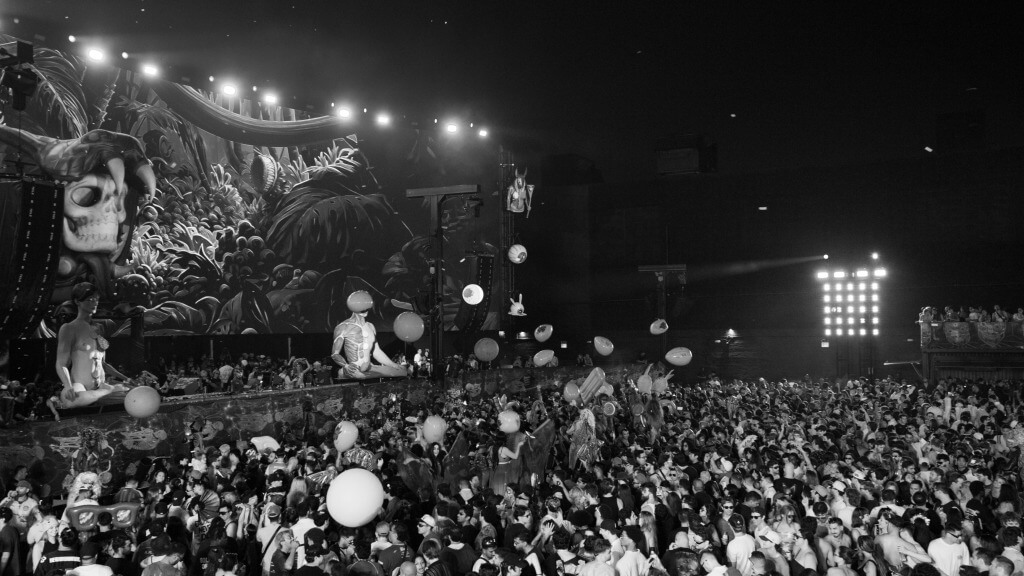
What this means, in practice, is Pacha New York looks like one of the most intricately designed places to do drugs I’ve ever seen. As is the Pacha way, twin cherries burst from every corner; my friends and I debate if they’re meant to be yonic. Bursts of confetti nearly suffocate us at carefully timed intervals. There is a hallway covered on three sides in LED screens, each bearing meaty ripples of red and white. Each corner of the venue is covered in designs that look like tattoos you’d regret. Ripley’s Believe It or Not!-esque statues depicting enormous naked men, stripped on one side to their viscera, flank the DJ booth like guardians.
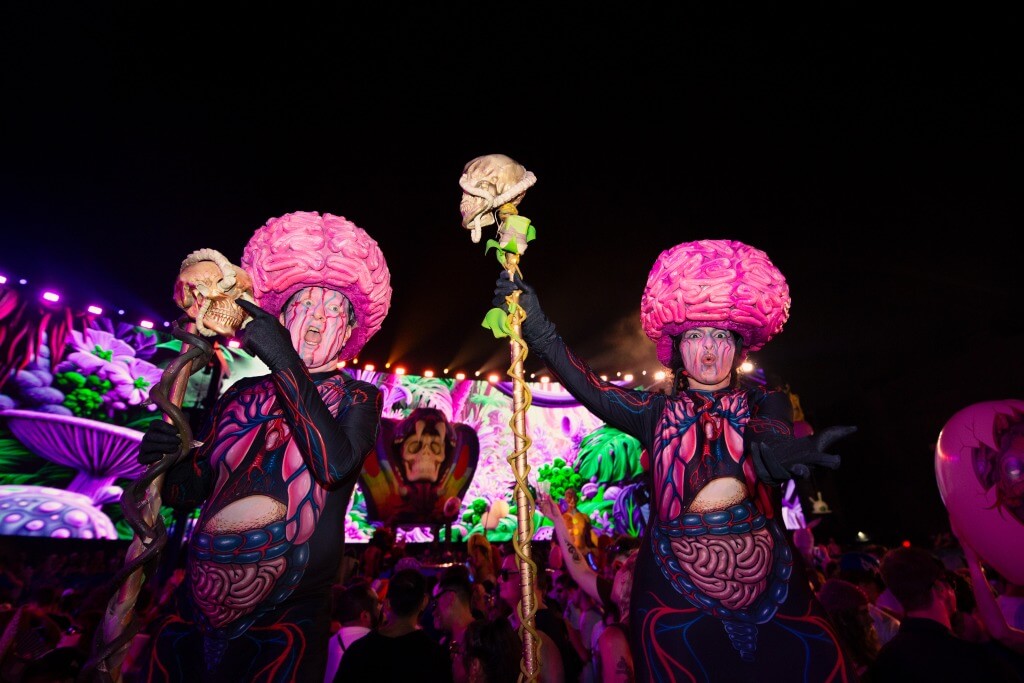
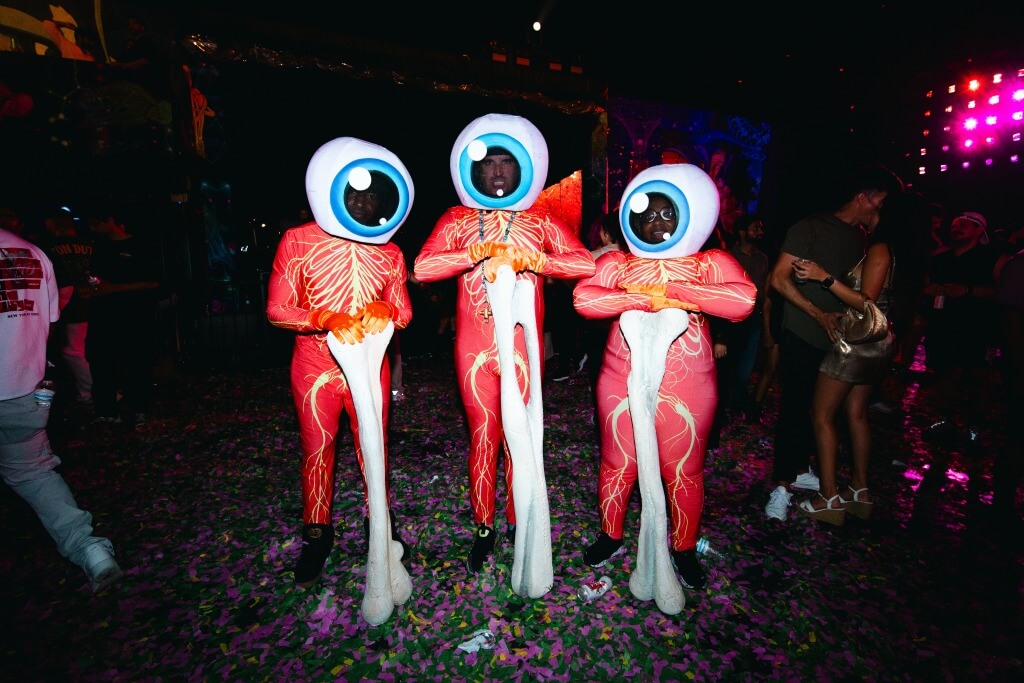
Throughout the night, performers emerge wearing outfits reminiscent of the Dada movement: Anubis helms a parade that features giant walking eyeballs, snake-men on stilts, a humanoid bunny with seven eyes, and skeletal birds carrying crystalline staffs. Enormous screens behind the stage show a many-headed snake gyrating to the beat. The elrow mascot, a giant chicken named Rowgelia, keeps getting twerked on. If I were on enough drugs, I’d have probably self-immolated upon seeing the whole ordeal, because the bass is in your teeth and your ribcage and the beds of your fingernails—and because everyone is acting like it’s normal. That’s the promise of a place like Pacha: hedonism dependent on total randomness; a series of events so devoid of logic they divorce you from reality almost entirely.
The night is hilarious, and fun, and incredibly cheugy (though use of the word may be cheugy itself at this point). It is also, remarkably, mostly free from embarrassment, because a sense of ludicrous community reigns supreme. A nearly naked and very inebriated man is wheeled backstage, stroking his chin like the drunk Thinker, and is greeted by a choir of cheers. People keep offering me fistbumps. Everyone has tattoo sleeves. An older gentleman in a muscle tank and a bowler hat flails and catapults himself around the venue; people are wearing those gloves with the light-up fingertips. There are more than a few DJ Pauly D lookalikes, all trailed by beautiful plasticated women. There’s a guy with a selfie stick taking a video of a middle-aged man breakdancing. My friend kisses someone named Granite. A white guy dances past us in what appears to be a Diana Ross wig, which can’t be allowed. Despite the sea of bodies, and the fact that more than a few men seem to have taken style tips from the Tate brothers, there’s a desexed feeling to the evening; I am blessedly un-ogled, minus a few unfortunate incidents.
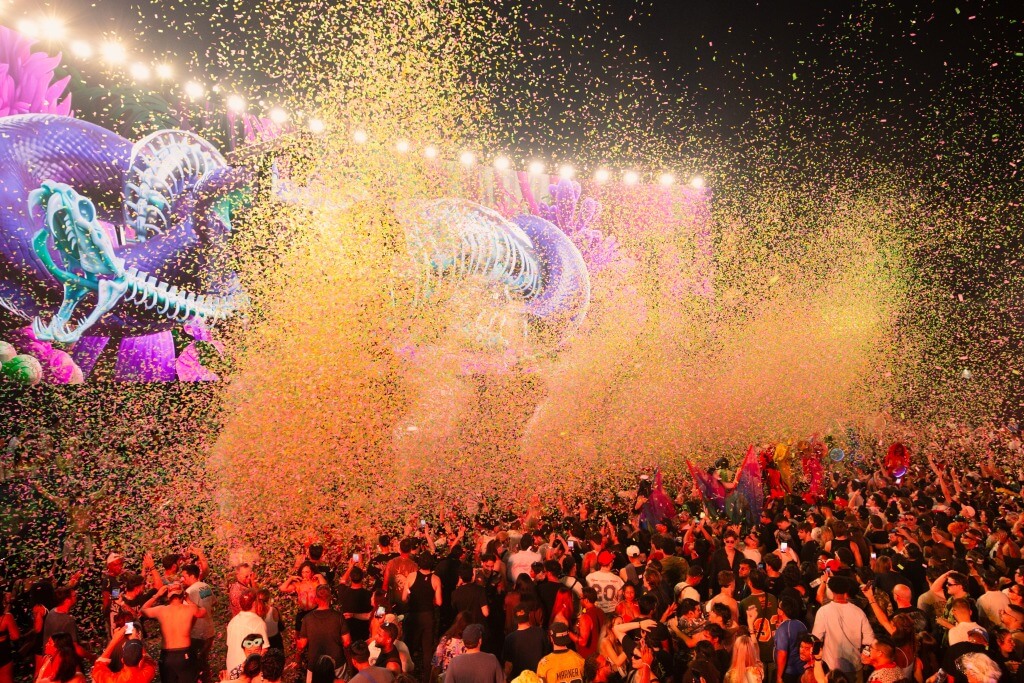
At risk of revealing myself to be a dance music dilettante, I, like Paste’s own Casey Epstein-Gross, am having an enormously difficult time identifying individual songs in the hours-long medley of house music being thrown at us. I can only tell you that there’s a banging remix of “Perfect (Exceeder),” and that during a dutiful A-Trak performance of “Heads Will Roll,” the place erupts into excitement. We rush up to the stage, three admirers preening and pouting around him as he beeps and boops. (This must, I imagine, be why so many men want to be DJs.) What I do know is that the music is uniformly good and universally enjoyed. Even in the lapses between the walking eyeballs and the confetti machine guns, everyone seems totally entertained.
It’s no coincidence that Pacha has taken over the predominant club venue in Brooklyn, nor that its brand of clubbing has returned to the zeitgeist with such force. Maybe it’s a Gilded Age of sorts, or, inversely, a response to the impossibility of living securely these days. Maybe everyone’s tired of trying to seem cool. Maybe Eurotrash is in just because it looks like fun, and our addiction to nostalgia mandates a new subculture be reincarnated out of its fossilized remnants. Whatever the reason, a bright, flashy, happily un-chic brand of clubbing has reinserted itself into the middle of New York’s nightlife scene, and it’s super duper weird. But it’s also infectiously fun and satisfyingly unique. In a world of basement raves and secret Charli XCX concerts, that a place like Pacha exists at all is a welcome change.
Miranda Wollen is a staff writer at Paste and is based in New York City. Follow her @mirandakwollen or email her.
 Keep scrolling for more great stories.