
On The Queen Is Dead, The Smiths never sounded more alive
Forty years after releasing their masterpiece, Johnny Marr and Morrissey’s musical partnership remains an exemplar of collaborative songwriting.
Photo by Pete Cronin/Redferns/Getty Images
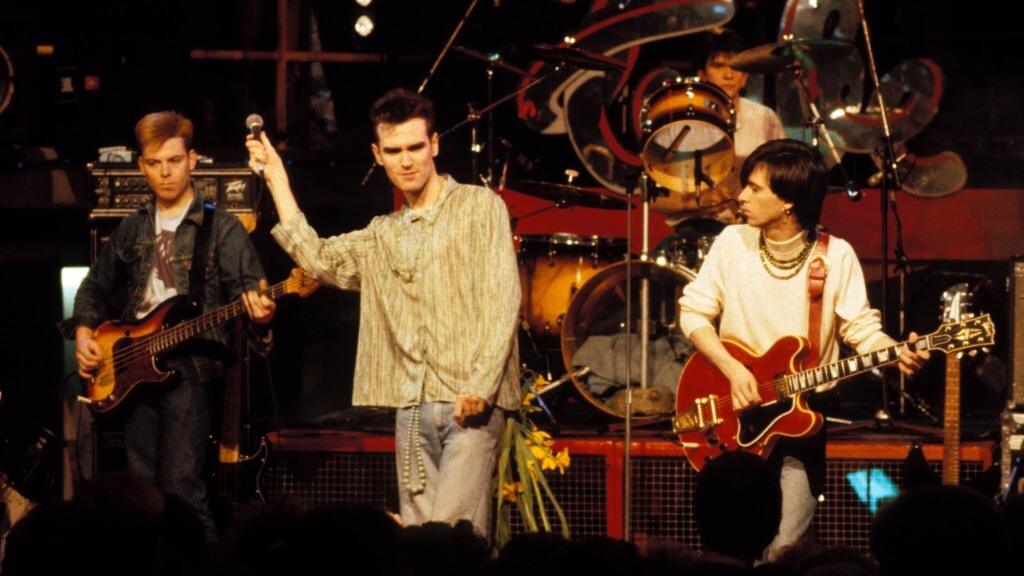
Many of the best songwriters come in pairs: John Lennon and Paul McCartney; Mick Jagger and Keith Richards; Elton John and Bernie Taupin; Carole King and Gerry Goffin; Robert Plant and Jimmy Page; the Gallagher brothers. The list could go on ad nauseum. Even when some songwriters are perfectly capable on their own, some work better as one half of a duo, repeatedly bouncing ideas off each other like players in an Olympic ping-pong match, achieving something far greater than either would have realized without their partner. For guitarist Johnny Marr and vocalist Morrissey, that creative fever arrived at the pinnacle of their careers.
Following the completion of the Smiths’ sophomore record, Meat Is Murder, guitarist Marr got to work immediately on the follow-up. Months after wrapping up that album’s recording process, he purchased a home in Bowdon, a forty-minute drive from the band’s native Manchester. Over the course of 1985, Marr and Moz isolated themselves in that Bowdon base to compose The Queen Is Dead, the best entry in the Smiths’ brief but revelatory four-album run. Here is one of the most influential bands in indie rock operating at its zenith. The Queen Is Dead is a masterclass in pop craftsmanship that, forty years after its release, remains an exemplar of the boons of collaborative songwriting.
Sometimes, one person sees the potential in a track that otherwise may have been shelved. Such is the case with the centerpiece “Cemetry Gates,” whose rudimentary three-chord vamp felt too basic for Marr’s liking. But Morrissey saw what the song could become. “When I played it I wasn’t sure about it—but that’s one example of how a partnership works,” Marr recalled in a 2020 interview. “Because Morrissey loved it, and it came so effortlessly and easy, I was just about to bin it.” The twosome riffed on it in Marr’s kitchen, developing it into the jaunty, jangly tune that adds some literary levity to what is, for the most part, a generally dour record.
At other times, both musicians pair their greatest strengths and end up with a generational anthem. In the late summertime, Moz and Marr were on a brilliant writing streak that birthed “Frankly, Mr. Shankly,” “I Know It’s Over,” and the angsty anthem in question, “There Is a Light That Never Goes Out.” Marr didn’t know it would become the band’s most enduring piece of music, that it would take on a life of its own as a paean to teenage outcasts and hopeless romantics, or that it would become a catalyst for cinematic meet-cutes and serve as a fictional hitman’s favorite song decades after its release. He based the chord progression on the Rolling Stones’ rendition of Marvin Gaye’s “Hitch Hike,” from whom he once said the Velvet Underground stole it for their own “There She Goes Again.” It had an origin as a self-described “in-joke,” but it has transformed into something far more profound.
Rough Trade, the band’s label, vouched for it as the lead single, but the band defaulted to “Bigmouth Strikes Again” because they liked the idea of not releasing some of their best material as singles. When writing “Bigmouth,” Marr had a goal to make his own “Jumpin’ Jack Flash,” modeled after his musical heroes the Stones, as he once told Guitar Player. He wanted to write a high-energy piece that would resonate with audiences for its kinetic riffage and propulsive tempo, a track perfectly suited to be a lead single. Still, Marr did think “There Is a Light” was the best song he ever heard. Morrissey depicts a gruesome yet picturesque death, in which a fatal car crash is “such a heavenly way to die” as long as you’re beside the one you love. The melodrama is at an all-time high here, in which a violent automobile accident is rendered in total tenderness.
Although Moz can be sardonic and facetious, he’s often at his best when he’s woeful and sincere. Marr’s melodies on the flute and E-mu Emulator, whose synthetic strings are credited to the Hated Salford Ensemble, heighten the histrionic flair. Morrissey’s gifts for somber introspection also find outlets in “I Know It’s Over” and “Never Had No One Ever,” the former of which has become a Smiths standard and ode to perpetual loneliness. “See, the sea wants to take me, the knife wants to slit me,” he sings, his voice wavering with despair. He assigns his suicidal ideations to external forces beyond his control, making the desperation that much more palpable. In the outro, he lends even greater passion to his words, tracing the dynamic arc of his voice and the totality of his tone, delivering what may be his greatest performance to date while repeating one disquieting couplet: “Oh Mother, I can feel / The soil falling over my head.” “I’ll never forget when he did that,” Marr reminisced to Far Out Magazine in 2024. “It’s one of the highlights of my life. It was that good, that strong.” There’s a reason that vocal powerhouse Jeff Buckley famously covered it.
Moz can certainly write some of the most heart-wrenching lines put to paper, but he can also be ruthlessly funny. When Morrissey and Marr were writing The Queen Is Dead, they were resentful of an unfair deal they’d signed with Rough Trade in 1983, just before the release of their self-titled debut a year later. The contract had leeched money out of their ever-expanding pockets, the band claimed, so Moz allegedly directed some barbs at the label’s founder (and his good friend), Geoff Travis, on “Frankly, Mr. Shankly.” Travis reportedly took the diss in stride, even the lines about his “bloody awful poetry” that practically gave away the song’s subject. On “Cemetry Gates,” Moz displays some self-awareness by using “a dreaded sunny day” to take a stroll in a cemetery, singing lyrics inspired by his visits to Chorlton’s Southern Cemetery with photographer Linder Sterling. He chastises his graveyard companion for claiming erroneous Shakespeare passages as their own, all the while plagiarizing the 1941 film The Man Who Came to Dinner in the process.
He also deploys his wit to excoriate the monarchy on the opening title track. He insisted that the album begin with a sampled performance of “Take Me Back to Dear Old Blightey,” a popular, homesick song shared among British soldiers in World War I, from the 1966 film The L-Shaped Room. The mocking pseudo-patriotism grounds Moz’s invectives toward Elizabeth II, who reigned as queen from 1952 until her death seventy years later, making it the longest rule in British history. “Her very lowness with her head in a sling / I’m truly sorry, but it sounds like a wonderful thing,” he quips, definitely not sorry at all. At the same time that uber-conservative Margaret Thatcher widened the wealth gap as UK’s Prime Minister from 1979 to 1990, former U.S. President Ronald Reagan enacted similarly destructive policies overseas from 1981 to 1989. Both of them further disadvantaged the working class and other marginalized groups and have left behind legacies of social unrest and shameless bigotry. When Elizabeth II, who appointed Thatcher to the lofty Order of Merit, died in 2022, “The Queen Is Dead” saw a 1,687% increase in streams.
Moz had some choice words for other parties, as well. On “The Queen Is Dead” and “Vicar in a Tutu,” he expresses his disdain for the “church who’ll snatch your money,” as he puts it on the former. Of course, he also has a combative relationship with journalists that exists to this day. He refers to himself as the nominal bigmouth on “Bigmouth Strikes Again” while comparing himself to Joan of Arc, and he widens his target to include the music industry writ large on “The Boy with the Thorn in His Side,” in which he wonders how no one can “see the love in our eyes,” as Marr adorns the track with his signature melodic fretwork. “The thorn is the music industry and all those people who never believed anything I said, tried to get rid of me and wouldn’t play the records,” Morrissey said of the song in a 1985 television interview. “So I think we’ve reached a stage where we feel: If they don’t believe me now, will they ever believe me? What more can a poor boy do?”
However, relegating all of The Queen Is Dead’s greatness to its two core songwriters would be reductive. Bassist Andy Rourke, drummer Mike Joyce, and engineer Stephen Street also contributed, especially on the album’s opening and closing bookends. After that sample of “Take Me Back to Dear Old Blightey” plays, Joyce’s thunderous toms come rolling in, who, alongside Street, drummed up the idea to loop it to create the song’s (and album’s) booming intro. Rourke’s sharp bassline on it also remains a hallmark of his career. Upon Rourke’s death in 2023, Marr took to Instagram to extol the abilities of his ex-bandmate: “Watching him play bass on the song The Queen is Dead was so impressive that I said to myself ‘I’ll never forget this moment.’”
For closing track “Some Girls Are Bigger Than Others,” Street had the idea to increase Joyce’s reverb at the beginning, quickly fade the mix in and out, and then remove the reverb when fading it once again. He explains it in the seminal Smiths text, Simon Godard’s Songs That Saved Your Life, that he wanted the effect to be like “opening a door, closing it, then opening it again and walking in.” Although The Queen Is Dead is by and large a showcase for one of the best songwriting duos to ever exist, the closing track also ends the record on a stumble from Morrissey. Even Marr has since lamented that one of his most beautiful guitar melodies is a backdrop for some of his frontman’s clunkiest lyrics, in which Moz ponders the shape and size of, presumably, women’s breasts, a speculation that becomes confirmation when taking into consideration the stanza he added in the Smiths’ sole live performance of the song. That performance, which took place at 1986’s Artists Against Apartheid at London’s Brixton Academy, was also their final show altogether.
The Smiths may have been active for only five years, but their striking music feels eternal. On their third album in particular, they were firing on all cylinders, each moment capturing something special and timeless. Legacy can be a fickle beast, especially when its remaining members release subpar solo work, say stupid shit, or both, but on The Queen Is Dead, the four kids from Manchester never sounded more alive.
Grant Sharples is a writer, journalist and critic. His work has also appeared in Interview, Uproxx, Pitchfork, Stereogum, The Ringer, NME, and other publications. He lives in Kansas City. You can follow him everywhere @grantsharpies.
 Keep scrolling for more great stories.