

The best movies on Hulu span international hits and cheeky originals, with its curated selection fitting squarely between the content glut of Netflix and the highly selective Criterion Channel. More experimental than its peers, Hulu’s film library offers a surprising range of arthouse picks and Hollywood blockbusters. Still, navigating this catalog and finding something great to watch could stand to be a bit simpler. That’s where we come in.
Our 2025 list of the best movies on Hulu is updated regularly, reflecting movies that have left the service due to streaming churn and those that have been added. Sure, Hulu is best known for its TV arsenal, but its movies shouldn’t be discounted. In particular, the streamer’s relationship with the distributor Neon means that ton of excellent indies find their home here after they wow us in the theater. So whether you’re after Anora‘s scintillating romantic drama or the updated sci-fi action of Prey, Hulu has you covered—and so do we.
Here are the 30 best movies on Hulu right now:
1. Anora
Year: 2024
Director: Sean Baker
Stars: Mikey Madison, Mark Eydelshteyn, Yura Borisov, Karren Karagulian, Vache Tovmasyan, Darya Ekamasova, Aleksei Serebryakov
Rating: R
By sheer volume of people screaming obscenities and insults at and past each other, Sean Baker’s newest film harkens back to his breakthrough Tangerine, in which a trans sex worker recently released from jail embarks on a day-long journey to track down her cheating boyfriend/pimp. Anora runs nearly an hour longer, is shot on 35mm film instead of an iPhone, and follows the whirlwind courtship of its title character, an exotic dancer played with fire by Mikey Madison, and the aftermath once she marries the son of Russian oligarchs. The movie uses this extra time, and a gorgeously expanded frame, to live in its scenes a little longer, past some of the big laughs they contain. When confronted with Russian and Armenian muscle, Ani reacts with combative self-defense. She’s not willing to leave her marriage quietly, or possibly at all. But Madison’s performance is less shticky than it might seem from the Brooklyn accent and brassy attitude; notes of panic and hurt creep onto her face in between her passages of crowdpleasing bravado. Baker’s whole movie is like that: wildly entertaining even as a surprising range of emotions show themselves. —Jesse Hassenger
2. Everything Everywhere All At Once
Year: 2022
Director: Daniel Kwan, Daniel Scheinert
Stars: Michelle Yeoh, Stephanie Hsu, Ke Huy Quan, James Hong, Jamie Lee Curtis, Jenny Slate, Harry Shum Jr.
Rating: R
Everything Everywhere All At Once follows Evelyn Wang (Michelle Yeoh), a jaded, middle-aged laundromat owner who may or may not be involved in some minor tax fraud. Her tedious, repetitive life is thrown into total pandemonium, however, when her husband, Waymond (Ke Huy Quan)—or at least a version of him—alerts her to the existence of the multiverse on the elevator ride to an IRS meeting. He then explains that a powerful villain named Jobu Tupaki is in the process of constructing a universe-destroying force that only Evelyn has the ability to stop. And so Evelyn reluctantly plunges headfirst into the multiverse. The facts: There are an infinite number of universes that exist simultaneously, containing just about anything you could possibly imagine. The rules: To acquire different skills, you must picture a universe in which you inhabit that skill, whether it be inhumanly strong pinky fingers or a mastery of knife-fighting. (If you can think it up, it exists.) What follows, then, are roughly 140 frenetic minutes filled to the brim with dense, complex science, colorful setpieces and scenes that feel like they’ve been pulled straight out of dreams far too abstract to describe. As you can probably gather, Everything is not dissimilar to its title—and a lot to wrap your head around. If all this sounds intimidating (which, let’s be honest, how could it not?), rest assured that Everything is grounded by an effortlessly simple emotional throughline. Indeed, the film contains as much emotional maturity as it does cool concepts and ostentatious images (yes, including a giant butt plug and raccoon chef). At its core, it is a story about love and family, carried by the dazzling Yeoh in a subtle and unsentimental performance. Where Everything’s emotional throughline is Evelyn’s relationship with her family, its visual thread manifests as a series of hypnotic, vertiginous action sequences, choreographed like a ballet by Andy and Brian Le. As a bonus, these sequences recall Yeoh’s iconic role in Ang Lee’s wuxia film Crouching Tiger, Hidden Dragon. The directors do not shy away from the use of dizzying flashing lights, or rapidly shifting light sources that disorient the viewer. They also aren’t afraid to implement over-the-top images, like a person’s head exploding into confetti or a butt-naked man flying in slow-motion toward the camera. At the same time, movement between ‘verses feels seamless through Paul Rogers’ meticulous editing, as does the effortless fashion in which different aspect ratios melt into one another. If Everything Everywhere All at Once can be boiled down to one, simple question, it would be reflexive of its own title: Can you really have everything everywhere all at once? Whatever the characters’ answers end up being (I’ll let you discover that on your own), I am certain that the Daniels would say yes, of course you can. —Aurora Amidon
3. Interstellar
Year: 2014
Director: Christopher Nolan
Stars: Matthew McConaughey, Anne Hathaway, Jessica Chastain, Bill Irwin, Ellen Burstyn, Matt Damon, Michael Caine
Rating: PG-13
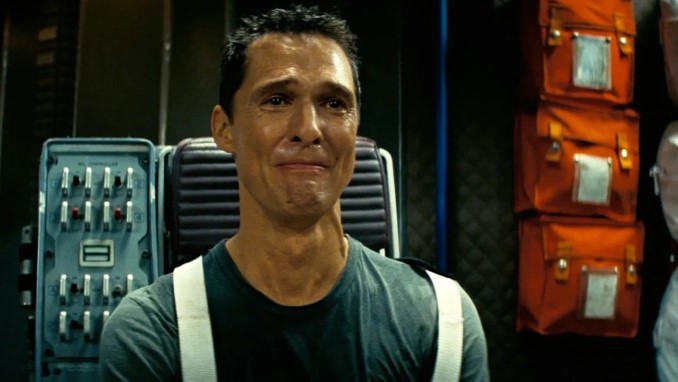
Whether he’s making superhero movies or blockbuster puzzle boxes, Christopher Nolan doesn’t usually bandy with emotion. But Interstellar is a nearly three-hour ode to the interconnecting power of love. It’s also his personal attempt at doing in 2014 what Stanley Kubrick did in 1968 with 2001: A Space Odyssey, less of an ode or homage than a challenge to Kubrick’s highly polarizing contribution to cinematic canon. Interstellar wants to uplift us with its visceral strengths, weaving a myth about the great American spirit of invention gone dormant. It’s an ambitious paean to ambition itself. The film begins in a not-too-distant future, where drought, blight and dust storms have battered the world down into a regressively agrarian society. Textbooks cite the Apollo missions as hoaxes, and children are groomed to be farmers rather than engineers. This is a world where hope is dead, where spaceships sit on shelves collecting dust, and which former NASA pilot Cooper (Matthew McConaughey) bristles against. He’s long resigned to his fate but still despondent over mankind’s failure to think beyond its galactic borders. But then Cooper falls in with a troop of underground NASA scientists, led by Professor Brand (Michael Caine), who plan on sending a small team through a wormhole to explore three potentially habitable planets and ostensibly secure the human race’s continued survival. But the film succeeds more as a visual tour of the cosmos than as an actual story. The rah-rah optimism of the film’s pro-NASA stance is stirring, and on some level that tribute to human endeavor keeps the entire yarn afloat. But no amount of scientific positivism can offset the weight of poetic repetition and platitudes about love. —Andy Crump
4. Palm Springs
Year: 2020
Director: Max Barbakow
Stars: Andy Samberg, Cristin Milioti, J.K. Simmons, Peter Gallagher, Meredith Hagner, Camila Mendes, June Squib, Conner O’Malley, Jena Friedman
Rating: R
Imagine living the same day of your life over and over, stuck within an hour and a half of Los Angeles but so closely nestled in paradise’s bosom that the drive isn’t worth the fuel. Now imagine that “over and over” extends beyond a number the human mind is capable of appreciating. Paradise becomes a sun-soaked Hell, a place endured and never escaped, where pizza pool floats are enervating torture devices and crippling alcoholism is a boon instead of a disease. So goes Max Barbakow’s Palm Springs. The film never stops being funny, even when the mood takes a downturn from zany good times to dejection. This is key. Even when the party ends and the reality of the scenario sinks in for its characters, Palm Springs continues to fire jokes at a steady clip, only now they are weighted with appropriate gravity for a movie about two people doomed to maintain a holding pattern on somebody else’s happiest day. Nothing like a good ol’ fashioned time loop to force folks trapped in neutral to get retrospective on their personal statuses.—Andy Crump
5. The Prestige
Year: 2006
Director: Christopher Nolan
Stars: Christian Bale, Hugh Jackman, Michael Caine, Scarlett Johansson, Rebecca Hall, Andy Serkis, David Bowie
Rating: R
In The Prestige two competing magicians, played by Christian Bale and Hugh Jackman, try to outdo each other, but are really trying to achieve a brand of immortality. They are competing for the same audience’s faith, and they need all of it, because it is not something that can be shared (many religious institutions hold similar dogma for similar reasons). Each wants to invoke utter and absolute belief in their audiences, much like Nolan wants to do in his own, as if that achievement grants the doer divinity, whether or not it is built on tricks and illusions. Nolan begins the film with a trick, in fact, a shot of top hats littering the forest floor, with the voice-over asking, “Are you watching closely?” It is a shot out of time and place from the rest of the film, Nolan once again doing as he pleases, manipulating our perception of what we’re seeing and when so as to emulate the pledge, turn and prestige of the “magic” acts the film portrays. Our faith is built on lies we tell ourselves and others, Nolan seems to posit, and it’s a thesis on which he elaborates with his Dark Knight trilogy, insinuating that symbols are sacred not for their truth, but simply for what they inspire. —Chet Betz
6. Thelma
Year: 2024
Director: Josh Margolin
Stars: June Squibb, Fred Hechinger, Richard Roundtree, Parker Posey, Clark Gregg, Malcolm McDowell
Rating: PG-13
Every good action hero knows you’ve got to stick to your guns. Ethan Hunt is a marathon-running master of disguise. John Wick has never lost count of his remaining bullets. Jackie Chan’s various inspectors and agents view the world as their personal set of monkey bars. When writer/director Josh Margolin’s debut Thelma keeps its sights trained on its rogue granny on a mission (June Squibb), its hilarious geriatric reframe of action-movie tropes has a game champion. Like its absentminded hero, the film can sometimes get sidetracked right when things are getting good, wandering down schmaltzy or twee narrative paths. But when it lets Thelma (and Squibb) do her thing, the comedy is perfectly cute and a stellar showcase for what an actor’s late career can offer.
In fact, much of Thelma is about adjusting our ideas around aging. There’s novelty in the comedic turns from the 94-year-old Squibb and her 81-year-old co-star, Richard Roundtree (in his final film role). These actors get to tap a well that’s unique to their age and the genre without sticking them into the boxes that generally contain old performers. They’re not utterly dignified, wisdom-dispensing elders. They’re not tragic victims of time. And they’re certainly, blessedly not the dreaded “rapping grannies” who are more punchline than performer. As the pair abscond on their quest to retrieve Thelma’s stolen savings, solicited from her cookie jar and mattress by phone scammers, they’re clearly complex, pulling off warm humor, endless charm and impressive stunts. A 94-year-old doesn’t have to ride a motorcycle off a cliff to make you gasp. —Jacob Oller
7. Robot Dreams
Year: 2024
Director: Pablo Berger
Rating: NR
Robot Dreams was at least to some extent lost in the hubbub of this past year’s Academy Awards for one primary reason: Pretty much no one in the U.S. had actually had a chance to see the film at the time. Nevermind the fact that it competed for the Oscar for Best Animated Feature back in March–all of the conversation at the time was revolving around choices either far more populist (Spider-Man: Across the Spider-Verse) or from creators so revered that they’ve achieved mythological status, as in Miyazaki’s The Boy and the Heron. It’s unsurprising that Spanish director Pablo Berger’s sweet but emotionally resonant Robot Dreams was more or less swept under the rug, but its eventual arrival in U.S. theaters and streaming services in 2024 has allowed American viewers to finally realize what they had been missing: One of the most charming and tear-inducing, wordless stories of friendship we’ve been gifted in recent memory.
Robot Dreams is a classic story of loneliness and friendship, as created in the relationship between Dog, a mute resident of a beautiful version of NYC occupied by anthropomorphic animals, and Robot, the sentient automaton who becomes his closest companion. On its own, that premise might provide enough material for a short film, but Robot Dreams ventures into unexpectedly poignant territory when a series of accidents forces the two apart. Again, one expects convention to step in, for Robot Dreams to coalesce into a story about finding your friend against all odds and refusing to give up. But instead, it eyes these events with both a pragmatism and emotional maturity that is refreshingly and distinctly realistic: Dog and Robot both find a next phase in their lives, without needing to let go of how much their time together meant to both. Few would-be comedies or dramedies of this sort are so adept at holding both POVs at once: The simultaneous sense of profound loss at having drifted away from a former close relationship, but also the acceptance, cherishment of the memory, and hope for a future of new, novel experiences. Robot Dreams recognizes that emotions don’t happen sequentially, but all at once, and captures it in beautifully fluid animation as it brings to life a lovingly rendered portrait of New York at the same time. —Jim Vorel
8. The Death of Stalin
Year: 2017
Director: Armando Iannucci
Stars: Steve Buscemi, Simon Russell Beale, Paddy Considine, Rupert Friend, Jason Isaacs, Michael Palin, Andrea Riseborough, Jeffrey Tambor
Rating: R
You can trace that dynamic from The Thick of It, through In the Loop and Veep, and then especially in his new film, The Death of Stalin, whose subject matter can be inferred from a mere glance. The Death of Stalin marks a major temporal departure for Iannucci, known for skewering contemporary political embarrassments and turmoil, by taking us back to 1953 Russia. Years out from the Great Purge, the country remains in the grip of widespread fear fomented by nationalism, public trials, antisemitism, executions, mass deportations and civic uncertainty. Iannucci asks us to laugh at an era not known for being especially funny. That’s the give and take at the film’s core: Iannucci drops a punchline and we guffaw, then moments later we hear a gunshot, accompanied by the sound of a fresh corpse hitting the ground. Finding humor in political violence is a big ask, and yet Iannucci’s dialogue is nimble but unfailingly harsh, replete with chafing castigations. We howl with laughter, though we can’t help feeling bad for every poor bastard caught on the receiving end of trademark Iannucci verbal abuse, which typically means we end up feeling bad for every character in his films. He spares no one from insult or injury, even when they’re lying dead on the floor, soaked in their own piss. A tale of mortal sins as well as venial ones, The Death of Stalin adds modern urgency to his comic storytelling trademarks: As nationalist sentiment rears its ugly head across the globe and macho authoritarian leaders contrive to hoard power at democracy’s expense, a farcical play on the political clusterfuck that followed Stalin’s passing feels shockingly apropos. It takes a deft hand and a rare talent to make tyranny and state sanctioned torture so funny. —Andy Crump
9. Blue is the Warmest Color
Year: 2013
Director: Abdellatif Kechiche
Stars: Léa Seydoux, Adèle Exarchopoulos
Rating: NC-17
Three-hour movies usually are the terrain of Westerns, period epics or sweeping, tragic romances. They don’t tend to be intimate character pieces, but Blue Is the Warmest Color (La Vie D’Adèle Chapitres 1 et 2) more than justifies its length. A beautiful, wise, erotic, devastating love story, this tale of a young lesbian couple’s beginning, middle and possible end utilizes its running time to give us a full sense of two individuals growing together and apart over the course of years. It hurts like real life, yet leaves you enraptured by its power. —Tim Grierson
10. Prey
Year: 2022
Director: Dan Trachtenberg
Starring: Amber Midthunder, Dakota Beavers, Dane DiLiegro, Stormee Kipp, Michelle Thrush, Julian Black Antelope
Rating: R
Filmmaker Dan Trachtenberg’s Predator prequel Prey succeeds by daring to embrace what prior sequels did not: Simplicity. The basics of Predator cinema boil down to skull trophies and rival combat, but most of all, the thrill of an uninterrupted hunt. With brutal ease, writer Patrick Aison translates Predator codes to hunter-gatherer dichotomies in Native American cultures. There’s nothing scarier than the laws of natural hierarchies on display in their most elemental forms, and that’s what Prey recognizes with menacing regard. Trachtenberg understands what Predator fans crave, and executes without mercy. Set in the Northern Great Plains of 1719, Prey pits a Predator challenging any species’ alphas—wolves, bears, people—against a Comanche tribe. Taabe (Dakota Beavers) leads other boys on hunts while his sister Naru (Amber Midthunder) practices her deadliest skills in secrecy. She’s dismissed by most for her gender, but not by Taabe. Naru’s chance to defeat a lion (thanks to Taabe) and earn her warrior’s rite of passage fails when a Predator’s alien technology distracts from afar—which no one believes. Only Naru can protect her family and tribespeople from the unknown Yautja threat since no one will listen, which will be the warrior-wannabe’s ultimate test. Prey is inarguably the best Predator since the original. The film gets so much right, paying homage to John McTiernan’s 1987 masterwork—through cigars and direct quotes that it’ll have fans hooting—and adding Indigenous representation with real cultural strength. Trachtenberg and Aison keep things simple, and that’s the special sauce. The performances are tough-as-nails, action sequences absurdly gory and intensity streamlined like a high velocity arrow. By going back to beginnings, Prey sheds pounds of franchise dead weight for a leaner, meaner Predator prequel with all the spine-tearing, one-liner-spouting gladiatorial conquest that fans desire—computer-generated or not. —Matt Donato
11. In & Of Itself
Year: 2021
Director: Frank Oz
Stars: Derek DelGaudio
Rating: NR
How do you translate In & Of Itself—a stage meditation on identity and the self that needs to be a profound, shared experience—into something someone watches passively on a screen? If you’re Frank Oz and Derek DelGaudio, you do it by pulling off another great piece of “magic”—figuring out via performance, lens and subtle editing how to transmute the heart of the show without sacrificing the emotion that those two summoned 552 unique times inside that black box theater. Like Oz, DelGaudio is a multi-hyphenate performer, writer and magician—and the antithesis of what that last word usually conjures in the mind. He doesn’t use jazz hands, or sport gaudy tattoos or flashy clothes. Oz captures him as the play presents him: An understated, sad-eyed everyman who knows how to tell a compelling story. And he does just that. In the same space and format of the stage show, he conjures six wildly different stories/puzzles/tricks that take the viewer on an existential journey. Each one is almost deceptively simple, but the payoffs are bold and contingent on the participant being present and open to the gifts that DelGaudio bestows. Miraculously, it all manages to still translate through our seemingly impersonal screens.—Tara Bennett
12. Small Things Like These
Year: 2024
Director: Tim Mielants
Stars: Cillian Murphy, Eileen Walsh, Michelle Fairley, Clare Dunne, Helen Behan, Emily Watson
Rating: PG-13
In his first credit as a producer, Cillian Murphy, alongside director Tim Mielants, offers a profound story inspired by very recent history. Based on the novel by Claire Keegan, Small Things Like These follows Bill Furlong (Cillian Murphy), a coal merchant who stumbles upon the abuse occurring at a local Magdalene laundry, an institution that supposedly offered rehabilitation to “fallen women” (largely sex workers and unwed mothers), but in reality operated more like a workhouse.
The film opens with Bill watching as a young woman is dragged into the local convent, her mother ignoring her apologies and pleas to take her home. Though visibly disturbed, Bill walks away and returns home to his daughters, clearly haunted by what he has seen. This opening sequence establishes the film’s focus on the role that willful ignorance played in the continuation of abuse at these institutions. Young women, abandoned by their family and exiled by society for being “sexually promiscuous,” were forced to work at these laundries under excruciating conditions for little to no pay, and often endured abuse at the hands of the nuns who ran the laundries. In the film’s setting of New Ross, an intricate web of power is woven to ensure that the church is able to get away with these crimes by having a hand in almost every aspect of town life. In Small Things Like These, melancholy seeps through every frame. Unlike other dramas of a similar vein, Mielants’ film doesn’t have a neat ending where justice is served in the name of all the young women who were harmed. Instead, the film lingers at a time when the abuses were still ongoing, forcing us to reckon with the reality of such a recent horror. —Nadira Begum
13. The Babadook
Year: 2014
Director: Jennifer Kent
Stars: Essie Davis, Noah Wiseman
Rating: NR
Classifying Jennifer Kent’s feature debut, The Babadook, is tricky. Ostensibly this is a horror film—freaky stuff happens on an escalating scale, so qualifying Kent’s tale of a single mother’s fractious relationship with her young son with genre tags seems like a perfectly logical move. But The Babadook is so layered, so complex and just so goddamned dramatic that categorizing it outright feels reductive to the point of insult. There’s a grand divide between what Kent has done here and what most of us consider horror. You’ll spend your first week after the experience sleeping with the lights on. You will also come away enriched and provoked. Australian actress-turned-filmmaker Kent has made a movie about childhood, about adulthood and about the nagging fears that hound us from one period to the next. There’s a monster in the closet—and under the bed, and in the armoire, and in the basement—but the film’s human concerns are emotional in nature. They’re not aided by the ephemeral evil lurking in the dark places of its characters’ hearts, of course; going through personal trauma is enough of a chore when you’re not being stalked by the bogeyman. —Andy Crump
14. Once Upon a Time in Hollywood
Year: 2019
Director: Quentin Tarantino
Stars: Leonardo DiCaprio, Brad Pitt, Al Pacino
Rating: R
Once Upon a Time in Hollywood is as much a run through Quentin Tarantino’s obsessions as any of his other movies—Spaghetti Westerns, bad ’60s television, Los Angeles subculture, so, so many women’s feet—but there is an odd, almost casual generosity that I’d argue is entirely new to him. Is it possible Tarantino, at 56, has finally decided to share? This is a film that luxuriates in its indulgence, but it opens the door for us, at last lets us in. It’s an elegy for a long-dead Los Angeles that Tarantino both wants to sell us on and vigorously stir back to life, an era that, because it ended in violence, can only be resuscitated through that same violence. But more than anything, this is the most Hang Out Film of any of Tarantino’s films, a world that he wants to live in and roll around in and maybe just spend forever in. We follow three characters with three stories, though it takes a while for two of the stories to separate and they all end up in the same place. There’s Rick Dalton (Leonardo DiCaprio), an old-time television star with talent but an alcohol problem whose time seems to be passing him by, symbolized by a series of villainous guest spots on TV shows with diminishing returns. There’s Cliff Booth (Brad Pitt), Dalton’s old stuntman and full-time assistant/gofer, a man with a dark past but the sunny, sun-splashed disposition of a guy who’s always going to get away with it. And then there’s Sharon Tate (Margot Robbie), the Sharon Tate, an up-and-coming movie star who lives just down the road from Dalton with her husband Roman Polanski, with the whole world ahead of her but with … occasional strange characters showing up outside her house. The movie leisurely weaves in their stories, sometimes down narrative cul-de-sacs, sometimes their goings-on simply an excuse to dance through Tarantino’s meticulous, almost sensuous recreation of 1969 Hollywood. But it’s all leading up to the moment when they all cross paths, and history both gets in the way and is shoved aside. The greatest achievement Tarantino pulls off here is, by pure force, to yank this era back to life, to recreate it and revive it as if driven by some sort of religious mania. Dalton might be on his way down and Tate on her way up, but they’re a part of the same world nonetheless, and when their paths cross, it feels like divine justice: It feels like Tarantino at last making history lock up the way it was supposed to. It elevates the material while consciously never wanting to rise up from the muck. This is as close as Tarantino will ever come to showing his full heart, what there is of it. —Will Leitch
15. Ready or Not
Year: 2019
Director: Matt Bettinelli-Olpin, Tyler Gillett
Stars: Samara Weaving, Adam Brody, Mark O’Brien, Elyse Levesque, Nicky Guadagni, Henry Czerny, Andie MacDowell
Rating: R
Eat the rich–or at least defeat them with some good ole Judeo-Christian magic. Weird that Ready or Not made it through the right-wing cultural abattoir while The Hunt was taken apart–maybe the latter sacrificed itself for the former–because Ready or Not is very much about how rich people are all psychopaths when confronted with the limits of their money and power, willing to indulge in whatever games, traditions or ancient blood rites proscribed by Satan they have to in order to stay on top. We know the Le Domas family is a hive of grotesque villainy from the beginning, before the true nature of her in-laws is ever revealed to Grace (Samara Weaving) on her wedding night: Ready or Not begins with people in gowns and tuxedos engaged in a violent chase through lavish hallways and gilded passageways, offering a brief, brutal glimpse of this family’s past matrimonial gatherings. No matter how kind or protective her new husband Alex (Mark O’Brien) is, we know he’s still a part of the Le Domas clan. He’s always bound to disappoint us. —Dom Sinacola
16. Plan B
Year: 2021
Director: Natalie Morales
Stars: Kuhoo Verma, Victoria Moroles, Michael Provost, Myha’la Herrold, Jolly Abraham, Jay Chandrasekhar
Rating: NA
The meeting of past and present is on full display in Plan B which puts a new spin on one of the tried and true plots of the genre—the road trip. Sunny (Kuhoo Verma) is a responsible student trying to do everything right. Her best friend Lupe (Victoria Moroles) seems to walk more on the wild side, but it’s really just bravado hiding some inner insecurity. When Sunny’s mom Rosie (Jolly Abraham) goes out of town for a real estate convention, Lupe convinces Sunny to throw a party to get the attention of Hunter (Michael Provost). “Who plays hockey in a cardigan? He’s like an athletic librarian,” Sunny sighs. But after one too many shots of some very questionable alcoholic punch (pickle juice is involved), Sunny has sex for the first time with the super religious and super geeky Kyle (Mason Cook from the late, great TV series Speechless). The next morning, to her horror, Sunny discovers the condom and its contents have been inside her all night long. The quest for the Plan B pill begins. All films require a willing suspension of disbelief and Plan B does need its viewers to not ask too many questions. Suffice to say a lot of Sunny and Lupe’s problems could have been solved by a simple Google search on their phones. But once you set aside any lingering doubts, the movie is a delight. That’s in large part due to first-time director Natalie Morales. Morales, known for her roles on Parks & Recreation, The Middleman and Dead to Me, clearly understands these characters and the emotional angst of high school. Perhaps because Morales is an actress herself, she’s even more conscious of ensuring that the female leads are treated with the respect they deserve.—Amy Amatangelo
17. Handling the Undead
Year: 2024
Director: Thea Hvistendahl
Stars: Renate Reinsve, Bjørn Sundquist, Bente Børsum, Anders Danielsen Lie, Bahar Pars, Inesa Dauksta
Rating: R
A zombie tragedy of false hope and brutal realizations, Handling the Undead adapts John Ajvide Lindqvist’s follow-up book to Let the Right One In with contemplative quiet. Director and co-writer Thea Hvistendahl positions three families afflicted by the sudden resurrection of a newly dead loved one as isolated units, staring in disbelief at the thing we’ve been trained since birth to avoid. A grandfather and mother care for a boy whose distended belly and unseeing eyes are like punishments inflicted upon them. An elderly woman jabbers away about her garden with the wife that walked back from her funeral. A comedian and his children ride an emotional roller coaster after his wife doesn’t stay dead after a car accident. Each is shot in strict compositions defined by straight lines, distancing angles and obscured frames. Hvistendahl’s lovely yet unnerving aesthetic is as cold and tangible as its corpses, paced with plenty of time for us to think. In this telling, the realities of death don’t go away with the unreality of revitalization, and the cannibalistic motivations that drive similar genre stories to crisis are avoided in favor of a creeping, omnipresent desperation. Where Let the Right One In‘s austere and icy vampire tale played more to our sympathies for its characters, Handling the Undead allows us to project our own fears and sadnesses onto its unaware zombies—just like those still living in its world.–Jacob Oller
18. Rye Lane
Year: 2023
Director: Raine Allen-Miller
Stars: David Jonsson, Vivian Oparah, Simon Manyonda, Benjamin Sarpong-Broni, Poppy Allen-Quarmby
Rating: NR
Part of the joy of making a romantic comedy is reimagining the stakes of a story, relitigating what is deemed cinematic. Rather than the traditional blockbuster terrain, you are charting the more familiar fallout from relational misunderstanding. Romantic comedies are bound by relatability, and truly great romantic comedies understand this relatability grows from specificity. Where many recent examples of this genre fall short is in dodging this degree of specificity, scared to ground an audience in the monotony of the everyday. Rye Lane leans into this perceived monotony, animating everything with the promise of new love. Rye Lane takes place over the course of a day, following Dom (David Jonsson) and Yas (Vivian Oparah) as they wander across South London, concocting new, increasingly ridiculous ways of spending time together. They use local landmarks as a set of interpersonal stepping stones, guiding one another through the physical ruins of their own romantic histories. Everything is captured in sharp, bright colors, reflecting the joy buried in every corner of this city. But the color scheme is only one way director Raine Allen-Miller navigates the playfulness of Dom and Yas’ dynamic. She stages elaborate setups to heighten their budding relationship: A cinema full of multiple Doms, passionately cheering Yas on as she recreates her recent breakup, is both a funny joke and a constructive character beat, showing two people who bond over a shared way of coping. Allen-Miller experiments with the focus and angle of the camera, switching between the extremes of the fish-eye lens and wide shots to capture the blurred and busy texture of the city. Their love story is one dedicated to recontextualizing their surroundings, to overhearing an embarrassing conversation and seeking out the other’s amused gaze, to buying burritos from the stall in Brixton and letting the other one order for you. Each new location is a gateway into understanding the other person, a prompt for a new story. In this way Rye Lane builds a lovingly transportive setting. Thanks to Rye Lane’s specificity and care for its central relationship, Allen-Miller has made one of the best British comedies–certainly one of the best London-based films—of the last decade.—Anna McKibbin
19. Werewolves Within
Year: 2021
Directors: Josh Ruben
Stars: Sam Richardson, Milana Vayntrub, George Basil, Sarah Burns, Michael Chernus, Catherine Curtin, Wayne Duvall, Harvey Guillén
Rating: R
With the release of his feature film debut “Scare Me“:https://www.pastemagazine.com/movies/scare-me-review/ last year, director Josh Ruben put himself on the horror-comedy map with his tale about horror writers telling scary stories. With Werewolves Within, Ruben further proves his skills as a director who knows how to walk that delicate line between horror and comedy, deftly moving between genres to create something that isn’t just scary, but genuinely hilarious. The cherry on top? This is a videogame adaptation. Werewolves Within is based on the Ubisoft game of the same name where players try to determine who is the werewolf; Mafia but with shapeshifting lycanthropes. Unlike the game, which takes place in a medieval town, Ruben’s film instead takes place in the present day in the small town of Beaverfield. Forest ranger Finn (Sam Richardson) moves to Beaverfield on assignment after a gas pipeline has been proposed to run through the town. But as the snow starts to fall and the sun sets behind the trees, something big and hairy begins hunting the townsfolk. Trapped in the local bed and breakfast, it’s up to Finn and postal worker Cecily (Milana Vayntrub) to try to find out who is picking people off one by one. But as red herrings fly across the screen like a dolphin show at the local aquarium, it feels almost impossible. Just when you think you’ve guessed the killer, something completely uproots your theories. Writer Mishna Wolff takes the core idea (a hidden werewolf in a small town where everyone knows each other), and places it in an even more outlandish and contemporary context to pack an even funnier punch. While the jokes never stop flowing in Werewolves Within, Ruben and Wolff never lose sight of the film’s horrific aspects through plenty of gore, tense scares and one hell of a climax. This film full of over-the-top characters, ridiculous hijinks and more red herrings than you can keep track of is a great entry in the woefully small werewolf subgenre.–Mary Beth McAndrews
20. Minding the Gap
Year: 2018
Director: Bing Liu
Rating: NR
In a year rich with slice-of-life glimpses at pubescence in flux care of the arrested development of skateboard crews, Minding the Gap is undoubtedly the best of its cinematic ilk—not because it’s “real,” but because it’s so clearly focused on interrogating the toxicity that keeps these kids from truly growing up. In Rockford, Illinois, just a smidge too far outside of Chicago to matter, three kids use Liu’s camcorder to chronicle their days spent avoiding responsibility and the economic devastation suffered by so many Rust Belt cities of its kind: Zack, a cute and reckless elder of the crew, about to embark on fatherhood with his (noticeably younger) girlfriend Nina; Keire, a seemingly always-grinning black kid who stays stiffly quiet whenever Zack claims that he has permission to use certain racial epithets, or when another kid insists that white trash kids have it the same as black kids; and Bing, the director himself, one of the few from his friend group able to escape Rockford. Splicing nostalgic footage of their time skating with urgent documents of their burgeoning adult life, Liu builds a portrait of the modern male in Middle America, lacing ostensibly jovial parties and hang-outs with shots of Rockford billboards vilifying absentee parents and pleas from Nina not to tell Zack that she admitted on-camera he’s hit her. As Liu discovers more and more about the abuse indelible to the young lives of his two friends, he reveals his own story of fear and pain at home, terrorized by his stepfather up until the man’s death, pushing him to confront his mother in the film’s climax about what’s been left unsaid about their mutual tormenter. It all breathes with the nerve-shaking relief of finally having these burdens exposed, though Liu is careful to ground these moments with the harsh reality of Rockford and those towns like it: Billboards beg men not to leave, not to hit their family members, not to take out their deep-seated emotional anxiety on their loved ones, because it will happen anyway. Zack, who was abused, will pass on that abuse. We hope he won’t, because we see simultaneously how he skates, how all of his friends skate together, the act less about being great at skating (though a sponsorship could help their pocketbooks), and more about finding respite from the shackles of their worlds. That Liu shoots these scenes—especially the film’s opening, set to a stirring classical score—with so much levity and beauty, with so much kinetic freedom, only assures that, for as much as Crystal Moselle and Jonah Hill love their subjects, Liu lives with them. He’s shared the weight of that. —Dom Sinacola
21. Lee
Year: 2024
Director: Ellen Kuras
Stars: Kate Winslet, Andy Samberg, Alexander Skarsgård, Marion Cotillard, Andrea Riseborough, Noémie Merlant, Josh O’Connor
Rating: R
When Antony Penrose discovered a box of journals, love letters and thousands upon thousands of photographs taken during World War II hidden in his mother’s attic, he saw a woman he did not recognize. His mother, Lee Miller, had never recounted her experiences of the war to her family, nor did she go to much effort to promote her work. It was only after her death in 1977 and upon the discovery of these items that her son would come to learn who his mother really was—which would in turn provide the inspiration for Ellen Kuras’ Lee, a gripping biopic documenting the life of the photojournalist.
Kuras avoids fashioning Lee as a generic war biopic by using Miller’s life story as a means through which to explore the myriad experiences of women during war. The relationships Miller (Kate Winslet) builds with women—and the combative nature of most of her relationships with men—shape much of the film. As a female photographer and war journalist, she is constantly belittled by her male peers; fellow photographer Cecil Beaton (Samuel Barnett) makes scathing remarks about her age and appearance, she is forbidden military access where her male counterparts are welcomed, and she is told point blank by a colonel that they “don’t send women into combat.” Each double standard fuels Miller’s desire to pursue her career with that much more fervor despite the warnings from her friends and colleagues of the danger ahead. —Nadira Begum
22. How to Blow up a Pipeline
Year: 2023
Director: Daniel Goldhaber
Stars: Ariela Barer, Kristine Froseth, Lukas Gage, Forrest Goodluck, Sasha Lane, Jayme Lawson, Marcus Scribner, Jake Weary, Irene Bedard
Rating: R
Andreas Malm’s 2021 book How to Blow Up a Pipeline saw its argument for more climate activism morph into an argument for different climate activism. Money isn’t cutting it. Protests aren’t either. Maybe sabotage will. Its vitality flows like an antidote to the poisonous nihilism surrounding the climate crisis from progressives; its fiery points threaten the crisp piles of cash collected by conservatives. Filmmaker Daniel Goldhaber’s air-punching, chair-clenching, heart-in-mouth adaptation is the best way to convert people to its cause—whether they’re dark green environmentalists or gas-guzzling Senate Republicans. Adapting a nonfiction treatise on the limits of nonviolent protest into a specific, heist-like fiction is a brilliant move by Goldhaber and his co-writers Ariela Barer and Jordan Sjol. In its execution of a carefully crafted plan, held together by explosive and interpersonal chemistry, it thrusts us into its thrilling visualized philosophy. How to Blow Up a Pipeline isn’t naïve enough to rely on optimism, opting instead to radicalize competence. Think of How to Blow Up a Pipeline like a word problem. The most exciting word problem you can imagine, where the two trains leaving the station collide in an explosive snarl of steel, your onboard loved ones saved only by quick thinking and teamwork. How to Blow Up a Pipeline contextualizes its concepts into actions so we can better understand, internalize and identify with them. There’s not a moment lost getting us there. Malm’s chapters (”Learning from Past Struggles,” “Breaking the Spell” and “Fighting Despair”) are elegantly transposed, their high-level arguments humanized into character and conversation. The ensemble—led by student protestors Xochitl (Barer) and Shawn (Marcus Scribner), whose plan organically gathers together surly Native bomb-builder Michael (Forrest Goodluck), horny crustpunk couple Rowan (Kristine Froseth) and Logan (Lukas Gage), terminally ill Theo (Sasha Lane) and her reluctant girlfriend Alisha (Jayme Lawson), and disillusioned landowner Dwayne (Jake Weary)—is colorfully drawn and filled out through savvy, well-cut flashbacks. Everyone has their reasons, and we have everyone’s back. By structuring its simple plot (blow up a goddamn pipeline) as a zigzag, How to Blow Up a Pipeline builds its team without losing steam. It’s as efficient and thoughtful in its planning as its heroes, and the results are just as successful. It’s as satisfying as any good bank job, only it’s stealing a little bit more time on this planet from the companies looking to scorch the earth. Responding to tragedy not with hopelessness but with proficiency, it’s not a dreamy or delusional movie. It knows its sabotage doesn’t take place in a vacuum. It understands that people get hurt. What makes How to Blow Up a Pipeline great, is that it so deftly wins us to its cause anyway. It’s absolutely electric filmmaking.—Jacob Oller
23. Longlegs
Year: 2024
Director: Oz Perkins
Stars: Maika Monroe, Nicolas Cage, Alicia Witt, Blair Underwood, Kiernan Shipka
Rating: R
The first thing I wanted to do after seeing Longlegs is take a shower. Some horror movies have you looking over your shoulder on the way out of the theater, jumping at shadows in the parking lot. These are the horror movies that follow you. Longlegs doesn’t follow you. You’re drenched in Longlegs. It’s all over you—in your hair, on your clothes—by the time the credits roll. Its fear is less tangible than a slasher or a monster, even less than a demon. It’s just something in the air, in the back of your mind, like the buzz of a fluorescent lamp. Oz Perkins’ Satanic serial killer hunt is his most accessible movie yet, putting the filmmaker’s lingering, atmospheric power towards a logline The Silence of the Lambs made conventional. Precisely crafted and just odd enough to disarm you, allowing its evil to fully seep in, Longlegs is a riveting tale of influence and immersion. After FBI agent Lee Harker (Maika Monroe) successfully, and mysteriously, locates a killer on little more than a hunch, her charming boss, Agent Carter (Blair Underwood), assigns the quiet savant to a long-dormant investigation into a suspect known only by how he signs the coded letters found at the crime scenes: Longlegs (Nicolas Cage). Only, the mystery to be solved isn’t Clue. You’re not filling in weapon, location, suspect. The question crawling under Longlegs’ skin is how grounded this case actually is, whether it’s a truly by-the-book procedural or whether that book is bound in skin and filled with spells. Lee is tight-lipped and uneasy in her own skin, a child’s soft voice wrapped in a blue FBI windbreaker. But she doesn’t balk at corpses, or head for the hills once she realizes she’s on Longlegs’ radar. Longlegs could also feel like familiar territory for Cage, at first glance. And that’s all we get at first, glances. Like any good monster movie, we’re denied a close look at Longlegs for a decent chunk of the movie’s three segments, but once we see him, that’s all you can think about. You see how a demonic seed has been planted and left to its own devices, down in some forgotten cellar, festering in the dark. As Perkins’ story progresses, you wonder where else those seeds have spread. It’s rotten Americana, every god-fearing Bible-thumper’s fears proven right. Longlegs contains a handful of impressively controlled performances, a dilapidated aesthetic rich with negative space, a queasy score, a methodical but always gripping pace, and one of the most original and upsetting horror villains in a long while. Perkins’ haunted vision is so convincing, you also might feel like scrubbing it off of you after you’ve hustled back to the safety of your home.–Jacob Oller
24. Happiest Season
Year: 2020
Director: Clea Duvall
Stars: Kristen Stewart, Mackenzie Davis, Mary Steenburgen, Victor Garber, Alison Brie, Mary Holland, Dan Levy, Burl Moseley, Aubrey Plaza
Rating: R
The grounded sobriety of Happiest Season lasts long enough for a reprieve from the still-present cornball Christmas melodrama, which director/co-writer Clea Duvall stages with the relish of someone who appreciates that melodrama in spite of themselves. But frankly, if every Hallmark movie was this over-the-top hilarious, they’d all at least be watchable as background noise, but then we’d have less reason to appreciate Duvall’s appropriation of their core components in Happiest Season. Kristen Stewart, continuing to prove wrong all the smug remarks about her one-dimensional dourness starting around 2008, remains a treasure. She’s lively, lovely, and having a wonderful time vibing with Mackenzie Davis. The latter ends up shouldering juicier theatrical speeches and breakdowns as her character, Harper, unravels under the dual pressure of being the daughter she thinks her parents want and being the girlfriend she wants to be to Stewart’s Abby. The ensemble keeps things fresh throughout these conventional plot beats, with Mary Holland coming out ahead as Duvall’s friction-seeking SRBM. Anytime the atmosphere chafes, Holland flies into the room and annihilates it with adorable, well-meaning awkwardness. She’s a gift, but the whole cast glitters in this holiday fare. Everyone’s tuned to Duvall’s wavelength, playing their human sides while keeping the mood appropriately hammy and saccharine—just sweet enough without killing the pancreas. And that’s the film’s secondary message: It’s okay to like Christmas schmaltz. The greater message, of course, is that it’s okay to struggle with the sometimes-bruising process of coming out. Duvall dovetails the seasonal pap with her characters’ pain, treating it like ointment for their mellowing emotional stings. The message isn’t just about liking Christmas. The message is that everybody deserves a Christmas movie.—Andy Crump
25. Good Luck to You, Leo Grande
Year: 2022
Director: Sophie Hyde
Stars: Emma Thompson, Daryl McCormack
Rating: R
If you thought the “sex worker with a heart of gold” genre had fully blown its load, then director Sophie Hyde’s latest endeavor will surprise you. Warming hearts and other body parts, she and screenwriter Katy Brand have crafted a delicate, hornt and hilarious two-hander between a widowed retiree (Emma Thompson) and the lean boy-toy of her very modest dreams (Daryl McCormack). Good Luck to You, Leo Grande can bobble the more dramatic elements of the pair’s professional and personal relationship, but its feel-good story satisfies to completion. Nancy plans everything out. The ex-Religious Education teacher never comes unprepared and is prepared to never come. And yet she arrives at her precisely booked hotel room early, prepared with a sexual to-do list. Leo Grande (which, what a great name for a gigolo), in his way, does the same. He arrives with his backpack full of sex toys and mood music, armed with disarming conversational techniques to put his clients at ease. Over the course of their encounters, Good Luck to You, Leo Grande unpacks how this level of intimacy—not inherently sexual, but with sexual availability acting as a gateway to vulnerability—can be therapeutic. In this would-be secret world—confined to fake names, and the blocky furniture and sterile familiarity of a hotel room—you can be more honest than in real life. A painfully cheesy penultimate scene gives way to glorious release, once again highlighting the movie’s best features and boldest choices. Thompson and McCormack’s potent bond elevates the humble film, its talky core giving both the rich foundation of a play. They make the smart film smarter, the sexy film sexier, and the funny film funnier. They even use the word “concupiscence” in a sentence. Multiple times! Even if it takes some negotiation to figure out where its comfort zone lies, Good Luck to You, Leo Grande still finds a hell of a sweet spot. —Jacob Oller
26. Bob Trevino Likes It
Year: 2024
Director: Tracie Laymon
Stars: Barbie Ferreira, John Leguizamo, French Stewart
Rating: PG-13
There’s a tired yet truthful notion that, as per Harper Lee’s To Kill A Mockingbird, “you can choose your friends but you sure can’t choose your family.” Tracie Laymon’s charming dramedy Bob Trevino Likes It challenges this very notion, showing that when the cards you are dealt are losing ones, it’s possible to change the deck.
Lily Trevino (Barbie Ferreira) has had a challenging few decades of life life thanks in major part to her doofus of a dad, Robert (French Stewart). Lily helps provide care to her acerbic yet kindhearted client/friend named Jeanie (Lolo Spencer), but it’s the constant neediness, financial drain, and psychological digs from her narcissistic dad that are wringing out the last drops of patience and kindness. Eventually having enough, Lily abruptly cuts off her dad from her life, pursuing a parentless life freed from such constant negativity. In a moment of emotional vulnerability and wanting to check in on her father’s situation, she searches on Facebook and happens upon a different Bob Trevino (John Leguizamo), this one a warm hearted, childless construction worker with whom she ends up having an unlikely connection. —Jason Gorber
27. The Damned
Year: 2025
Director: Thordur Palsson
Stars: Odessa Young, Joe Cole, Siobhan Finneran, Rory McCann, Turlough Convery, Lewis Gribben, Francis Magee, Mícheál Óg Lane
Rating: R
You can say this, for The Damned, the feature film debut of Icelandic director Thordur Palsson: It understands the shivery allure of a classic ghost story. And not only that, but it understands the captivating allure of being physically present for a great ghost story, to be able to glance around at your fellows as the storyteller weaves an unbearable web of suspense, everyone lost in a sort of trance, their present circumstances utterly forgotten. Palsson and cinematographer Eli Arenson capture one of these moments early in this story of fishermen at a remote outpost who will eventually tangle with the dual threat of guilt and madness, a brief indication of the spirit of camaraderie that might exist in such a small, tight-knit group in better times. As an old caretaker tells a tale to chill the blood of all the assembled fisherfolk, Arenson captures the wondrous mix of delight and awe in those Spielberg Faces with slow, patient zooms. In doing so, he preserves the characters as they fortify their bonds against the ever-grinding ice, the absence of fish, the oppressiveness of hunger and disease. Tonight, they celebrate their shared connection. Tomorrow? Perhaps they throw it all to the howling winds outside their flimsy fortifications. —Jim Vorel
28. The Order
Year: 2024
Director: Justin Kurzel
Stars: Jude Law, Nicholas Hoult, Tye Sheridan, Jurnee Smollett, Alison Oliver, Marc Maron
Rating: R
Directed with a cool precision by Justin Kurzel, and based on the non-fiction book The Silent Brotherhood, the film follows a burnt-out agent appropriately named Husk, who in turn is played equally appropriately by a man named Law. We’re treated to a grizzled, cigarette-chomping mustachioed Jude Law looking like he’s been run over by a liquor delivery truck, and the result is fantastic, a composite character reflecting the realities of those that did the actual investigation, heated up to a hard boil, and exactly the kind of cop (too cerebral for his own good) that elevated 1970s cinema.
Moving to Idaho to remove himself from the turmoil of taking down the New York mob, the restless agent soon finds himself part of a more local affair, connecting the dots between bombings of porno houses, bank robberies, and the rise of a reactionary right wing group intent on causing political havoc.
The Order is a fine police thriller in an escapist sense, but it also illustrates the cancer of hate at the heart of an increasing number of those in America. Beyond mere existential cynicism, this is a fruitful reminder of the ideological fault lines that continue to be a source of death and destruction. Rather than being polemical or didactic, The Order simply manages to be truthful, exposing the insidiousness of this type of counter-reaction and how, thanks to charismatic leaders, the weaponization of grievances can lead to grievous actions. With great performances, a taut script, and an execution an order of magnitude better than Kurzel’s previous films, The Order provides a chilling yet compelling look into the past—and the same forces shaping our present. —Jason Gorber
29. Summer of Soul (…Or When the Revolution Could Not Be Televised)
Year: 2021
Director: Questlove
Rating: PG-13
The 1969 Harlem Cultural Festival is the subject of Ahmir Khalib “Questlove” Thompson’s debut documentary feature, Summer of Soul (…Or When the Revolution Could Not Be Televised). More specifically, the documentary examines how this six-week summer festival, which featured many of the most revered Black musicians of all time— including Nina Simone, Stevie Wonder, Sly and the Family Stone and Gladys Knight—went largely unrecognized in America’s cultural consciousness. Featuring an immense catalogue of footage that sat in a basement virtually untouched for 50 years, Summer of Soul acts as an interrogation of what the absence of these materials has meant for the subsequent generation of Black artists, including Questlove himself. Despite the apparent cultural amnesia that followed the event (at least among non-Black Americans), the Harlem Cultural Festival easily overshadowed a ubiquitous moment in American history: The 1969 moon landing. Archival interviews with several attendees reveal that for many Black Americans, the moon landing was not seen as a boundary-pushing event worth celebrating. Catching Stevie Wonder’s set, on the other hand, was. Considering the undeniable essence of colonialism that space travel entails, who can blame them? 300,000 music lovers descended on Mount Morris Park that summer—hardly a negligible amount, especially when compared to Woodstock’s 500,000 attendees. While Woodstock may have been emblematic of the power of counter-culture, the predominance of white spectators in the crowd cemented the event as an artistic awakening. Meanwhile, the equally hyped Harlem Cultural Festival was relegated to the sidelines of historical preservation due to its predominantly Black audience and centering of Black acts on stage. Summer of Soul was easily one of the most successful films at this year’s Sundance, earning the Grand Jury Prize and Audience Award in the documentary section. But Questlove was never in it for the acclaim, a sentiment made evident in some of the first words the filmmaker uttered during his remote acceptance speech: “I didn’t even know this was a competition, yo!” The documentary was quickly picked up by Searchlight, with a streaming release on Hulu imminent. Whether interested in unraveling an overshadowed cultural event or eager to experience awe-inspiring performances from beloved artists at their best, Summer of Soul surely won’t disappoint.—Natalia Keogan
30. Donnie Darko
Year: 2001
Director: Richard Kelly
Stars: Jake Gyllenhaal, Jena Malone, Drew Barrymore, Mary McDonnell, Katharine Ross, Patrick Swayze, Noah Wyle
Rating: R
Apparently, at some point in its burgeoning cult ascendency, director Richard Kelly admitted that even he didn’t totally get what’s going on in Donnie Darko—going so far as to release a “Director’s Cut” in 2005 that supposedly cleared up some of the film’s more unwieldy stuff. Yet another example of a small budget wringed of its every dime, Kelly’s debut crams love, weird science, jet engines, superhero mythology, wormholes, armchair philosophy, giant bunny rabbits and Patrick Swayze (as a child molester, no less) into a film that should be celebrated for its audacity more than its coherency. It also helps that Jake Gyllenhaal leads a stellar cast, all totally game. In Donnie Darko, the only thing that’s clear is Kelly’s attitude: that at its core cinema is the art of manifesting the unbelievable, of doing what one wants to do when one wants to do it. —Christian Becker
 Keep scrolling for more great stories.