
The Curious Case of Benjamin Button

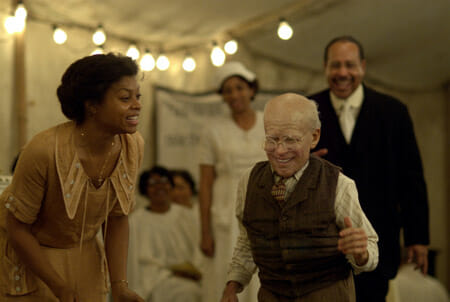
Release Date: Dec. 25
Director: David Fincher
Writer: Eric Roth (story by Eric Roth and Robin Swicord)
Cinematographer: Claudio Miranda
Starring: Brad Pitt, Cate Blanchett, Taraji P. Henson, Julia Ormond, Tilda Swinton
Studio Information: Paramount Pictures, 159 mins.
Because of a crazy clock built to run backward, Benjamin Button was born with a strange malady. This is not the sort of thing we question in a film like this. We simply accept it and move on. He starts his life with the wrinkled skin and arthritic joints of an old man and seems to look and feel younger as he ages. As Arthur says of Merlyn in Lerner and Loewe’s Camelot, “He lives backward. He doesn’t age. He youthens.”
Because of a crazy clock built to run backward, Benjamin ButtonBased loosely on an F. Scott Fitzgerald short story, The Curious Case of Benjamin Button is indeed a curious case. Directed by David Fincher (Zodiac, Fight Club) and written by Eric Roth (Forrest Gump, The Horse Whisperer), the film is strangely mundane given the fantastical premise.
Unlike Fitzgerald’s character, this Benjamin begins and ends his life the size of a baby. In text, Fitzgerald had the freedom to make the weird newborn as big as a seventy-year-old man (he just skipped the details of the birth), but Fincher leans toward something more realistic, you could say, by trying to visualize Benjamin literally, inspiring an impressive slate of special effects but a distinct lack of imagination.
How strange to see Brad Pitt’s face on a shriveled old body, the film seems to say. How strange to see him resemble Robert Redford—at different ages—or an elderly Henry Fonda. And even when Pitt inevitably syncs up with his character’s physical appearance, allowing the effects to recede for a time, the freak show curiosity lingers in absentia: how will Brad look when Benjamin has the face of a teen? How will they do it?
Maybe it’s my own fault for wondering about the facade instead of paying more attention to the romance and the life lessons, but I can’t help thinking Fincher set us up to wonder about the surface and little else. Born in 1918, Benjamin lives through a depression and several wars, and he maintains a strong connection to a nursing home run by his adopted mother (the place where he spends his formative years), but he’s an idle observer to most events. “You’re so young,” his life-long girl Daisy (Cate Blanchett) says after a long separation, and in that soft, aww-shucks way of his, he replies, “Only on the outside.”
What’s on the inside, I really can’t say. Animatronics, perhaps. Or maybe a couple bushels of buttons from his father’s factory. You’d think that someone who lives backward would approach his high school and college years, the years when he looks like a young man, with an odd blend of wisdom and inexperience, wisdom gained from his sixty-some years on the earth but inexperience from using fresh muscles for new tricks. But Benjamin is as bland and passive in those years as he is the rest of the film; his supremely unusual circumstances don’t have any noticeable effect on his outlook.
It’s only when poor Benjamin shrinks to the size of a newborn late in his life and curls helpless in Daisy’s arms that the movie achieves a weird poetic hum, a sadly busted-up situation for a couple of sweethearts who had the misfortune of being star-crossed by reverse aging. (Plus, hurricane Katrina is bearing down on Daisy’s reminiscence. She’s got hellish timing.) There’s symbolism in that motherly embrace, I suppose (the nurturing lover whose drive to coddle her man enables his unfortunate childishness), but those are themes that exist nowhere else in the film. Curiously, they echo the plight of Forrest Gump’s girl, Jenny, but after hours of empty special effects and golden-hued sets, this philosophical conundrum amounts to a tiny non sequitur, a clever couplet at the end of a mind-numbing soliloquy.
 Keep scrolling for more great stories.