
A band drowned by the flood: The story of Ramones
Tales about New York City, punk rock, and the people who made it, loved it, and wanted it dead.
Photos courtesy of Danny Fields, Tom Hearn, Michael Ochs Archives, Keystone/Hulton Archive, Getty

In September 1975, the band recorded a poppy, somewhat sensible demo of “I Wanna Be Your Boyfriend” and “Judy Is a Punk” with Marty Thau at 914 Studios. “Marty was trying to make his way as a producer after he had not done so well as a manager with the New York Dolls,” Leon says. “He was into the Bay City Rollers and thought he could find the American Bay City Rollers. He made a ‘record-friendly’ demo of them, so to speak. He was trying to commercialize them. I thought there was more to the band than either of the demos, and that they needed to make a radical statement to get themselves heard in the marketplace.”
Leon worked closely with Tommy on the Ramones’ edge, and they came up with a “bizarro-world Beatles” concept plugged into a sonic assault: “You know the Superman comics where everything was backwards? The idea was that, while in our world the Beatles are the biggest thing going on, there’s an alternate dimension somewhere out there where the Ramones were the biggest,” he explains. “And it’s hysterical that they got as big as they’ve gotten with that being one of the original premises. So, maybe we’ve reached that dimension already.” But the story goes that the Thau demo is what convinced Sire co-founder Richie Gottehrer to offer the Ramones a singles deal, which Tommy turned down on the spot.
Leon calls the story of the Ramones getting signed by Sire a “myth” and “load of crap” that’s “partially true,” because he turned the Marty Thau demos over to Seymour Stein. The Ramones auditioned for Stein soon after, and the details after that are murky. Johnny once said Sire gave the band an advance of $20,000 to make Ramones and buy equipment. Leon tells me that Stein wanted the band to make two singles for $6,400 and Leon said, perhaps stupidly, “I’ll make the whole album for $6,400.” And that’s the budget Sire set for the Ramones’ debut. The band signed their contract at Vega’s loft, and Sire, thanks to one of their European licensing deals, even tossed them a couple of bucks to buy a PA.
Giving a band $6,400 total for recording, mixing, and mastering was basically unconscionable, especially because home studios and home equipment simply weren’t available. Debut records, even then, were being made in the $50,000 range. Blondie’s debut, which Leon also produced, cost $20,000 to complete. $6,400 was only a few days of studio time. Not to mention, conventional managers had no concept of how to record something as loud as the Ramones—the only band louder than the Ramones was Blue Cheer, who recorded an album out in the open on Pier 57 because their studio didn’t know how to place mics around them. Leon and the Ramones tried to circumvent this by recording at Plaza Sound, a beautiful studio with huge rooms attached to each other, in January 1976. It was where the NBC Symphony rehearsed.
The first thing engineers tried to do with the Ramones was block the amplifiers from the drums so they didn’t leak, because nobody wanted leakage. “I could give a shit about leakage,” Leon scoffs. “Everything was leaking when you were recording a live band, and I didn’t know how much punching in we’d have to do. The guys hadn’t really recorded in a studio with headphones.” The band was set up at Plaza very conventionally but Johnny complained that the compartment the engineers built for him was too small for his amp, which couldn’t get enough volume in it. So Leon put him out in the Rockettes’ rehearsal studio with mirrors about 20 feet away, amps cranked up. “He didn’t need headphones or anything. We had all the doors open and he was just hearing everything,” Leon elaborates. “We did Blue Cheer the best we could.”
Johnny and Tommy had creative arguments, especially when it came to overdubs. Tommy wanted to produce that album the way albums were being produced at the time, but Johnny wanted it minimal. Tommy said, “You can’t make an album like that. Things have become modernized, and it won’t sound current.” But Johnny was insistent. He didn’t want overdubs. Leigh, who had been hanging around the sessions, chimed in: “Well, we all love Live at Leeds, right? That sounds good.” Johnny agreed: “Yeah, Tommy, why can’t we do it like that?”
Live at Leeds, the Who’s 1970 live record, utilized a recording technique that, by 1975, had become totally radical. The band’s instruments were coming out of different speakers: bass on one side, guitar on the other; tambourines, vocals, and drums all on one track. It was a very ‘60s style of doing things, because 24-track recorders were king by 1975. Ramones was not only a return to minimalism, but a fuck-you to the musicians spending 21 days on a bass drum sound in California. “In 21 days, you should be able to make at least five albums,” Leon declares.
“Craig did the best he could by bringing Tommy and John’s ideas together, so they wound up not doing overdubs and kept it minimal,” Leigh says. “Sometimes it’s harder to do less, to leave well enough alone. It’s a challenge. You always think you need to do more. An album’s got to be competing with all the other albums coming out. Production-wise, Craig didn’t force that. He let Ramones be what it was, which was bold of him.” Except, not quite: “We ended up doing overdubs,” Leon cheekily reveals, “but John didn’t know we did.”
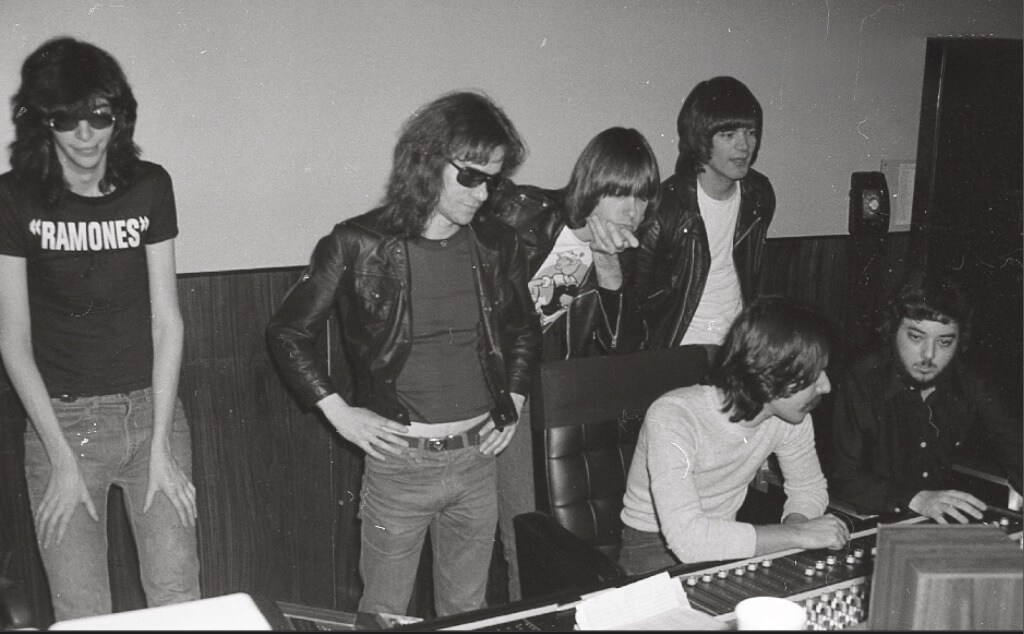
The band had an endless drive to get their first record right, get it done fast, and not dwell on it, but money hung over those sessions like an apparition. Leon had flirted with the concept of making Ramones a one-take-no-breaks album. A quadraphonic version was considered. He placed mics around the band like they were a chamber orchestra, recording them like a classical or jazz ensemble. Leon and the engineers were doing mixing maneuvers while mastering the record. The effects were natural, vocals were double-tracked like “A Hard Day’s Night.” Virtuosity conducted, almost unintentionally, by rock and roll hobbyists… you’d be semi-correct to call it “avant-garde.”
The Ramones did what they could within their capabilities. “John didn’t try to do more than he could, either because he didn’t want to or because he knew he couldn’t compete with people like Jeff Beck and Jimmy Page,” Leigh says. “Why bother trying? I understand his logic about that and, for him, it worked. We grew up listening to the Standells’ “Dirty Water” and simple things, bubblegum songs.” Most of the garage rock the Ramones grew up with was simple. Then Hendrix came along and complicated everything. But it’s not like the Ramones created minimalism. Ramones, however, did revive it. Leigh was studying jazz, music theory, and keyboard composition in college while working nights at a disco, listening to “Fly, Robin, Fly” and “The Hustle.” “And then I heard what the Ramones were doing. It was so refreshing,” he says. “John probably thought I would not like it, because I would do things much more complicated, but I was really sick of the long solos. The whole rock star thing, they were so anti that. I said, ‘This is the best thing I’ve heard in years, man,’ even though I was studying great composers.”
Preparedness and unity colored the sessions, because even though the band was hardly 18 months old, the Ramones had been in lockstep with each other since the late ‘60s. Seven days of recording (three for music, four for vocals) was all it took for the bicentennial’s most important rock album to come unstuck. Leon still has the take sheets, which he keeps in a notebook at his house in England. They’d track a song 16 times in one hour. In fact, Ramones is composed of multiple takes stitched together by Leon and engineer Rob Freeman, but the band was so precise in their recordings that you’d never be able to find the sutures. They wouldn’t even come into the control room for playbacks, because there wasn’t any time for navel gazing. The Ramones rehearsed with a metronome, like classical musicians. If it had been invented, they would have used a click track. You can actually look at their records on WAV files and see that everything’s perfect, and they carried that into their live performances as well. They would do the same BPMs, the same level of intensity from one venue to another. It’s astounding how much the Ramones advanced from 1975 to 1976.
Sure, Ramones was no Sgt. Pepper’s Lonely Hearts Club Band, but the band did incorporate romantic, sophisticated instruments and textures into the mix, like the 12-string guitar, glockenspiel, and tubular bells that paint “I Wanna Be Your Boyfriend.” Plaza Studios had a Wurlitzer pipe organ and the Ramones wanted to capture its “massive sound,” because it was the only instrument that could stand up to the guitar. Leon and the band racked their brains for ideas. A cover of ? and the Mysterians’ “96 Tears” got kicked around for a while until they decided Chris Montez’s “Let’s Dance” would be better. There was debate about who would play the pipe organ. Leon was going to do it, but one of Johnny’s principles was that only Ramones would play on the record. After the producer told Johnny about George Martin playing uncredited on a handful of the Beatles’ records, he conceded.
Leon and Mickey Leigh also provided backup vox, because Leon wanted to add some pseudo-Beach Boys harmonies to “Blitzkrieg Bop” and “I Wanna Be Your Boyfriend,” andDee Dee had no mic technique whatsoever. “And on the things he does sing, it’s like a second lead from Hell,” Leon says, before imitating Dee Dee with a gnarly growl. “The mic was probably unusable after he sang two or three times on it. It was this big blob of sound on the mic, total distortion. More punk than anything on Earth. Unrecordable.” But Dee Dee’s replacements were not originally going to be Leon and Leigh. Leon knew a guy named Elliott Kidd, who sang lead in the Demons—a pub-rock band that played gigs at CBGB and were friendly with the Ramones. Kidd was initially supposed to come in and do backing vocals, but when he couldn’t make it, he sent in a friend of his instead: someone named Michael Bolotin, who agreed to sing on Ramones if Sire gave Leon enough money to hire him.
Michael Bolotin was actually Michael Bolton, the pop-ballad singer who’s been in metal bands, worked with Celine Dion and Ray Charles, and sold 75 million albums. Unfortunately, though, Sire kept its wallet shut and Bolton didn’t sing on Ramones, so the engineers, Leon, and Leigh all did vox themselves. Everything worked out, because Leigh had a great sense of pitch and sounded similar to his brother. That’s what makes the middle part of “Judy Is a Punk” so good. “It would have been a great historical event if Michael Bolton could have been one of those oohs and ahs,” Leon laughs. “It should have happened, but I’m glad he never made it. It would have been totally garbage. But it’s one of the great lost artifacts of rock and roll. His phone number is still on the track sheet.”
In-between song takes, Leigh and Joey would wander around Radio City. Ramones was recorded right after the concert hall’s big Christmas performance, and all the props were still backstage. “We ran into Jesus Christ,” Leigh chuckles. There was something surreal about being in the building. “It was like a dream, them actually achieving that, getting to that level. Within two years, they are in the studio. My brother’s making his first album. You don’t think about it at the time. You just do what you got to do.”
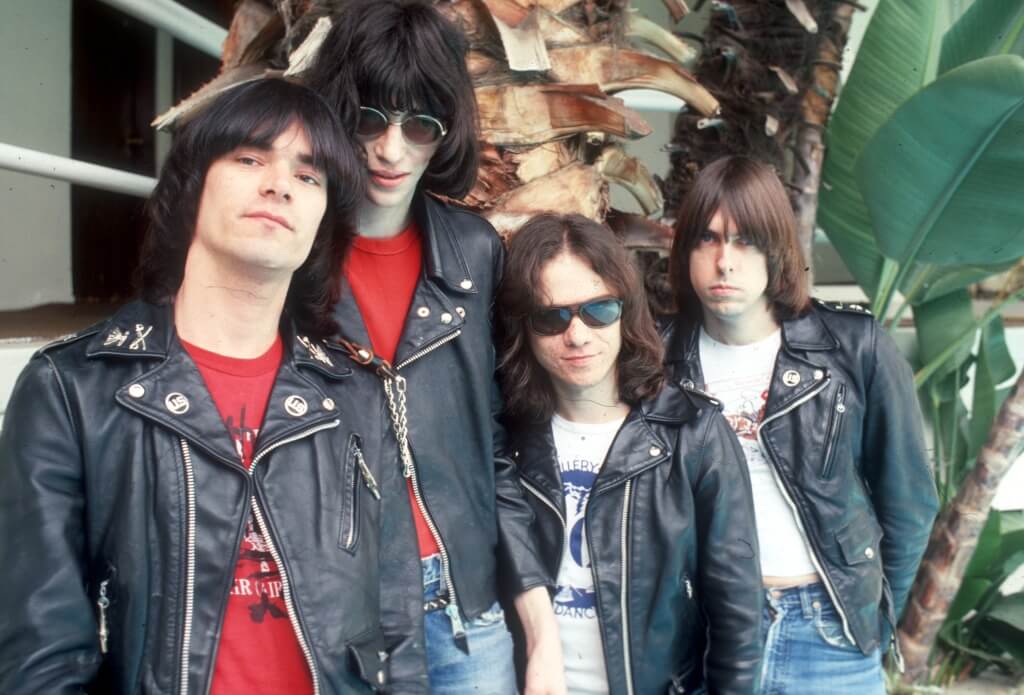
All four members have writing credits on Ramones, even though Dee Dee wrote most of the lyrics. “It was unexpected, man,” Leigh says. “I never thought this guy was going to be such an amazing songwriter who’d write some of my favorite songs.” Tommy wrote “I Wanna Be Your Boyfriend” by himself, and Joey came up with “Beat on the Brat,” but the band wrote most of Ramones in the same room together. “They flourished individually, but they started as a formation and did whatever they could in that way,” Leigh adds. “But then, the individual abilities began to overpower the group effort. And that worked better for them. That’s why they eventually decided they wanted to take credit for writing the songs. It gave them more incentive.”
Near the end of the Plaza Sound sessions, Seymour Stein paid the Ramones a visit. He didn’t like “Today Your Love, Tomorrow the World,” even if it was a parody of Nazi soldiers during World War II. Specifically, he didn’t like one of the song’s original lyrics: “I’m a Nazi, baby, yes I am.” Stein, instead of “taking them out for a cup of coffee or a taco,” as Leon puts it, started harassing the Ramones about it, wanting them to change the line to “I’m a storm trooper in a stupor.”
Leon had heard the Ramones play “Today Your Love, Tomorrow the World” at CBGB and felt attracted to it, even though other ‘70s bands had a “woke mentality” about rock and roll then, as he claims. It’s unclear whether Dee Dee, who lived in Germany when his father served in the U.S. Army, was taking the piss out of German soldiers in the song or being sincere about them (I believe it’s the former, since Tommy’s parents were Holocaust survivors), but Leon thought “it deserved to be heard,” because it was a totally radical point of view. “It wasn’t left-wing like the MC5. It was definitely a totally different social perspective—a warped one— and you can say it’s a joke and laugh, but I think the Ramones, to some extent, actually believed a lot of that stuff. Some of them did. It’s difficult to tell what was put on and what wasn’t.”
But Stein coming to Plaza Sound drove Leon completely batty. “You get people that want to come in and talk marketing concepts from the label while at the same time telling you you don’t have any budget to record,” he says. “There was a long afternoon of conversation of Seymour haranguing the band to change that word and them adamantly not wanting to do it, while the clock was ticking in the studio and I was going bananas, saying: ‘You gave me six days’ worth of time to make a record, and now I have five-and-a-half.’ They wouldn’t shut up with this argument. In retrospect, it was probably an hour and a half. But it seemed like eight hours to me.”
Stein wasn’t trying to impose a political idea on the band, though that was certainly the outcome. His argument was: “You have such little chance to get on the radio to begin with. Why blow your chance by having a lyric like that on the album? You’re close enough with a lot of the other stuff you’ve got to being banned. What about Jewish record programmers, what about politically-minded people that are anti?” Two years ago I ranked “Today Your Love, Tomorrow the World” as the #2 greatest Ramones song ever, and I don’t think it’s coherent enough to warrant such a fuss over semantics. They weren’t Bruce Springsteen, nor were they Bob Dylan. They hated hippies and probably flirted with fascist imagery because they had nothing better to do. But rebellion has a budget and, eventually, Stein got the band to cop to his wishes, and they changed the lyric to “I’m a shock trooper in a stupor, yes I am.”
The basis for the Ramones’ heavy, no-holds-barred sound came from Johnny Ramone, who wanted to emulate big guitar bands. Joey was more influenced by Herman’s Hermits and the Beatles, but all four loved ‘50s mono rock and roll. (In fact, Leon originally planned for Ramones to be released in mono and stereo, but it proved impractical for Sire’s distributor, who’d recently stopped producing mono albums.) Tommy had Marty Thau’s mentality, only stronger. “He was thinking they were going to be a major pop band right off the bat,” Leon says. “I don’t think he was kidding. I think Tommy, left to his own devices, would have made a more over-produced record.”
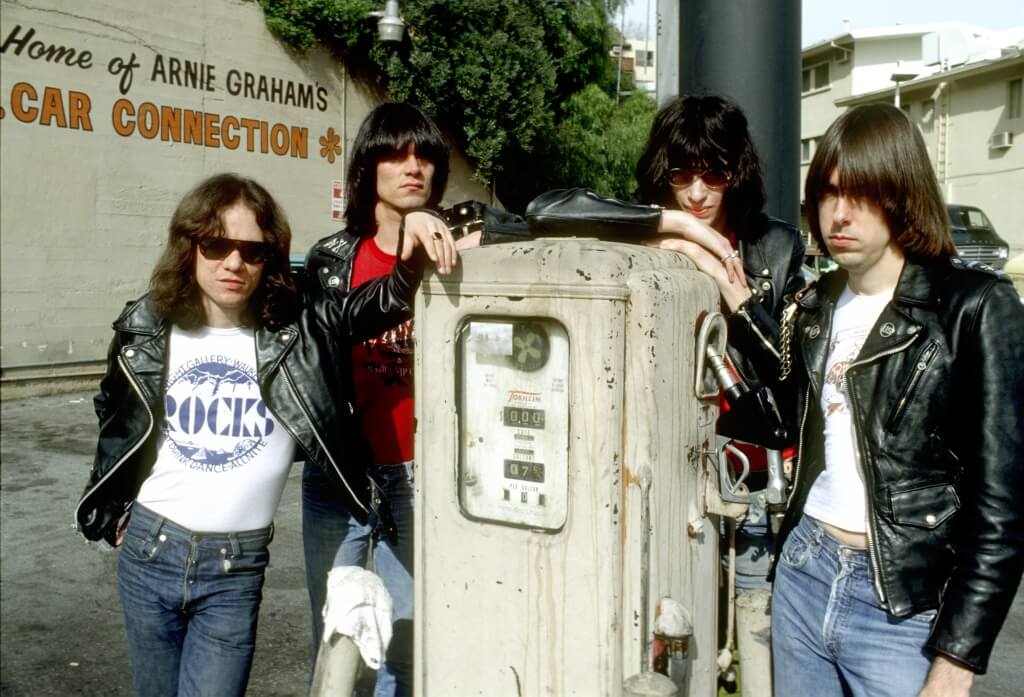
Tommy was trained in the arts, worked at studios, and knew how to articulate the spirit and humor of his bandmates, but he wasn’t much of a producer when Leon found him. He gave Tommy Ramone an “associate producer” credit, mostly because of all that running back and forth between Craig and the band he was doing before the Ramones signed to Sire. “It probably should have been ‘Associate Producers: The Ramones,’ because they all had opinions—different, but valid ones—that made up the sound,” Leon admits. “He talked to the band and they all made decisions together, because he was the only one who could articulate what they were.”
But Leigh goes to bat for Tommy. “You know, I don’t think he gets quite enough credit, really, for making that core what it was. He wrote ‘hey, ho, let’s go.’ Maybe Dee Dee changed it. If you know the story, Tommy originally wrote ‘Blitzkrieg Bop.’ It was ‘Animal Hop,’ and it was about kids going to see a concert, forming a straight line, then the kids are losing their minds. The line in the bridge was not ‘hey, ho, let’s go, shoot him in the back now,’ it was ‘they’re shouting in the back now.’ Dee Dee changed it, but ‘hey, ho, let’s go’ stayed.” And that’s the truth. Marky Ramone may call Tommy the “Pete Best of the Ramones,” but those are Tommy’s guitar solos on Leave Home, Rocket to Russia and Road to Ruins, because Johnny only wanted to do rhythm lines, and that’s his “hey, ho, let’s go” chant, despite Dee Dee’s edits. That’s the Ramones’ most famous line, right? Tommy’s impact prevailed, whether he was in the Ramones or out.
And it should be noted that every record has its flaws. George Martin could have picked out ones on Beatles records that nobody else would ever notice. If it was Tommy’s own druthers, Ramones would have sounded more like Bon Jovi, because he was firmly convinced they were going to have a #1 hit (and because Tommy would eventually co-produce Leave Home and Rocket to Russia with Jon Bon Jovi’s cousin, Tony Bongiovi). “If Ramones had been slicker, the band would have been cut out a lot faster,” Leon says. “Since I was the guy putting my ass on the line to say, ‘These guys can make a record, you should sign them,’ that was the way it was going to be. I’ve been wrong on other things, but I don’t think I was wrong on that one, from how history’s borne it out. I didn’t have any idea that it was going to be that influential, nor did the guys. Even the Beatles thought they were washed up after six years, after all.”
 Keep scrolling for more great stories.