
A band drowned by the flood: The story of Ramones
Tales about New York City, punk rock, and the people who made it, loved it, and wanted it dead.
Photos courtesy of Danny Fields, Tom Hearn, Michael Ochs Archives, Keystone/Hulton Archive, Getty

In 1976, if you wanted to get any kind of alternative radio airplay, you could get it by making a record and then making inroads in a couple of markets. A single wouldn’t get you far, not beyond the local scene. FM radio was getting more popular and would play album cuts in stereo, but it usually took three, even four albums for a label to confidently put promotional money behind an artist’s single. Bruce Springsteen had “Born to Run” around this time, but he was already on his third album—a make-or-break release. The Ramones never followed that pattern. Their later stuff could have been hits, as the indie scene grew, but their debut album was influential in getting bands to come out of the woodwork and put out their own little records. “[Those bands] were able to get their own indie singles on local radio, and then get the attention of the majors,” Leon explains. “But at the time of the Ramones, that couldn’t happen. The audience for this form of music stopped north of 14th street in Manhattan.”
Even so, the band put all their eggs in “Blitzkrieg Bop”’s basket, which at the very least nicked its opening from a Bay City Rollers hit in England. “Maybe we could get something with that,” Leon and the band had said. Trouble was: the Bay City Rollers were relatively larger than the Ramones. “Blitzkrieg Bop” is one of the Ramones’ signature songs now, undoubtedly, but they had other songs that would have been more suitable as singles. “Danny Says” could have made it as an AM record, if it had a slightly different production value. “They refused to release a cover as a single,” John Holmstrom says. “Looking back, I really think ‘Surfin’ Bird’ could have been a novelty hit. ‘Do You Want to Dance?’ could have been a hit. ‘Let’s Dance.’ They did such great covers, and it would have been more approachable if there was a familiarity to the music, for the average radio listener.” The Ramones were only commercial when they were singing other artists’ songs.
Had “Blitzkrieg Bop” been done on the Ramones’ third record, it might have actually been a hit, because people would have been aware of them. But at the time, it was anything but. “The thing about radio back then is it was mainstream. I remember the early coverage the Ramones got on the radio was just terrible,” Holmstrom says. “Those hippie DJs hated them. One guy on WNEW put on the Ramones album and tore it off the turntable after a couple songs, threw it in the garbage, and said, ‘You’re never going to hear that again on this station, I promise.’” Alison Steele, the “Night Bird” of WNEW, even did a news story on how horrible punk rock was.
And it probably didn’t help punk rock’s case that Ramones ends on the Nazi anthem “Today Your Love, Tomorrow the World.” Holmstrom always thought the band had a weird sense of humor. “I never, at the time, took the lyrics seriously. I thought they were goofing on the image of the 1950s greaser.” It was disturbing then, years later, when he found out that the Ramones were serious about songs like “Loudmouth” and “Beat on the Brat.” “I remember I saw a post by a fan who found out that ‘Beat on the Brat’ was inspired by Joey Ramone wanting to hit a screaming child with a baseball bat to shut it up. It’s a horrible thing to write about, but you feel like that. If you’re stuck on a plane and you got some screaming baby behind you won’t shut up, you get that urge.” Most Ramones fans just liked the music, but none of those fans were radio programmers.
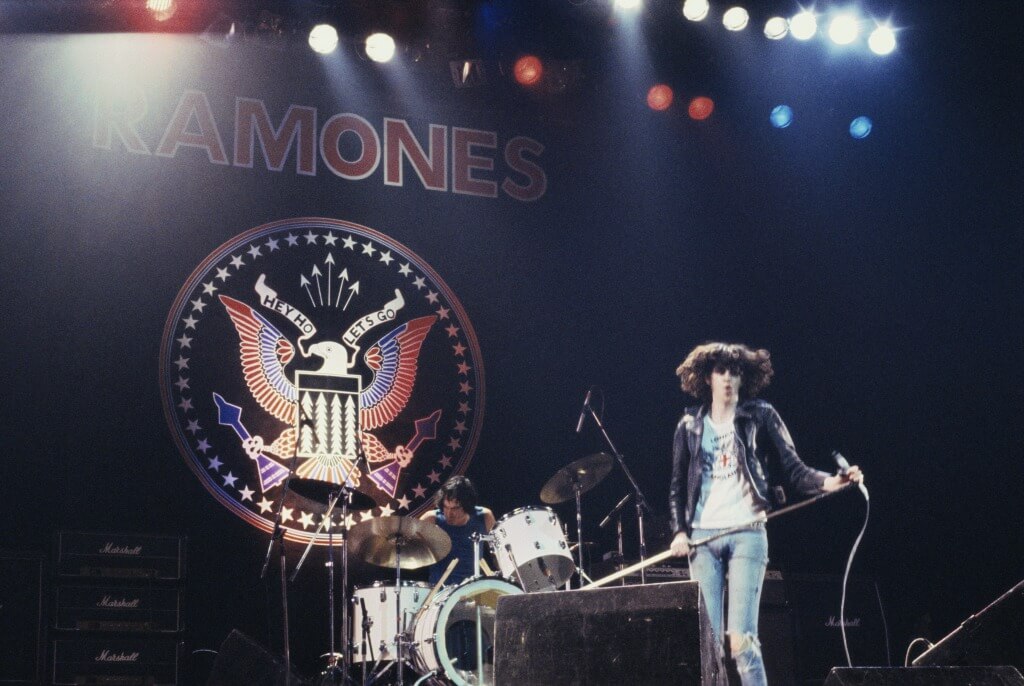
Even without airplay, Ramones put the band on the map—mostly in New York and Los Angeles. After the record came out on April 23rd, 1976, the band started setting attendance records at CBGB. They were outselling Patti Smith. Cover charges at the door went up 50 cents when they were playing. Pretty impressive for an album that cost $6,400 to make. (Three years later, Fleetwood Mac’s studio bill for Tusk would eclipse $1 million.) The Ramones undoubtedly forged the economic model that’s allowed rock music to stay alive now that the record companies are, as Holmstrom lovingly puts it, “dinosaurs.” But the album didn’t actually sell, despite all the uniqueness and controversy and praise around it and the band. Robert Christgau said it “blows everything else off the radio; it’s clean the way the Dolls never were, sprightly the way the Velvets never were, and just plain listenable the way Black Sabbath never was.” Hell, Ramones won over the hippie rags when Rolling Stone critic Paul Nelson called it a proponent of an “exhilarating intensity rock and roll has not experienced since its early days.”
This was when James Wolcott, Ellen Willis, Greil Marcus, Nick Kent, Richard Meltzer, and Lisa Robinson were well-regarded, literary voices in a now-mythical period of music criticism. They bought into the Ramones’ bowl cuts and patched denim jeans. And, crucially, they became fluent in punk rock without losing their fangs, translating the scene for the skeptics and proselytes alike. I think New York Rocker’s Alan Betrock defined it well: “It’s rock and roll the way it was meant to be played, not with boogie or pretense, but just straight freshness and intense energy.” Out of the black and into the blue. Out of the garage and onto the stage. If critics were gods, the Ramones would have made it. If fans like Holmstrom had a say, all music would be held together by three-chord beatdowns. He was shocked when Ramones didn’t move like hotcakes: “It sounds like the Ramones live: nice, simple, primitive. Back then, most of the time when you saw a band, they’d play a guitar solo, play a drum solo. It was all so cookie cutter. The Ramones turned that formula for what a rock band should be on its head.”
Mickey Leigh says the appeal of Ramones boils down to the album’s energy. “You don’t have to even speak English to feel it. It’s organic. The innocence that Craig Leon captured… I don’t think most producers would have let that happen. But Craig did.” Holmstrom, who thinks that punk rock is the “ghetto of pop music,” recalls a New Year’s Eve 1976 party at a musician’s house. He and a buddy said, “Hey, we gotta put on the Ramones!” But nobody was interested. “Every time we went to a party, we wanted to play the Ramones. Play the Ramones. Nobody ever wanted us to play the Ramones. They refused to allow us to put the Ramones record on, even though it was a New York City music event. Put on the Ramones and it was instant hate. Everyone would just say, ‘Well, I like Barry Manilow.’”
The summer after Ramones came out, the band found success overseas. They played two shows with the Flamin’ Groovies in London, at the Roundhouse on July 4th and Dingwalls, the “CBGB of London,” on the 5th. Leigh went because he was the only roadie they could afford to bring along. He was the only roadie anyway. “It was remarkable, because they were doing shows for 30 people and then, all of a sudden, it’s 3,000 people,” he remembers. “In America, we were traveling around lumberjack towns where people were yelling for ‘Free Bird.’ Then we went over to Europe, and people were just so receptive there. It was like the Twilight Zone, man. It was odd. Such a contrast.”
But those “Free Bird” chants inspired the Ramones to go from one song to the next, because they didn’t want anyone else to get a word in. “That wasn’t most of the crowd, though,” Leigh clarifies. “It was odd, because there were those people and then there were the kids in leather jackets, breaking out of the mold of their towns. Sometimes there were clashes between the two. The lumberjack people thought that that was a smart idea. They didn’t know what else to think. They’d never seen anything like it. Eventually, they went somewhere else.”
At Dingwalls, bands had to walk through an alley to get to the venue’s entrance. When the Ramones got there, Englishmen formed a gauntlet for them to go through, as if they were testing the New Yorkers. “These guys looked like they were trying to look tough, all wearing motorcycle jackets,” Leigh recalls. “Somebody said, ‘Oh, you think you’re tough’ to my brother. ‘How would you like a mouthful of hair?’ I said, ‘What flavor?’ You had to find ways to respond to them, to not make them want to beat you up. But once you got past that, they were friendly. The Clash and the Sex Pistols, even.”
Punk had a big influence on getting those crowds into the London shows. In March 1976, Rough Trade came to New York and made a deal with the magazine, air-freighting thousands of copies back to England to sell all over London for 10GBP a copy. In the States, Punk cost 75 cents. Back then, you could get a good beer for a dollar. Pizza was 35 cents a slice. The subway was 35 cents. But the magazine did sell despite the price point, and people like the Damned’s Rat Scabies would read articles about American bands and “try to imagine [what they] sounded like before the records came out.” Punk got so popular in England that Rough Trade couldn’t keep up with the demand, so they bought a photocopy machine and encouraged kids to start their own fanzines. That’s how Ripped and Torn and Sniffing Glue came about.
Nowadays, Hit Parader and Rolling Stone will run you about $13 a piece. The Pistols’ nihilism eventually petered out in a vile cloud of self-destruction. All the ‘70s New York bands that made it out of the decade alive, like Blondie and Talking Heads, chased the tail of commercialism. The Ramones, true AM radio evangelists, wanted a radio hit, but they were never going to go disco or call up Brian Eno. Months after their London trip, the band played in Detroit and met Lester Bangs at the Creem house. At the kitchen table, Bangs and an associate sat in the dark. “What do you guys want to see happen on your next album?” he asked the band. “It should go gold,” they—likely Joey—replied. But Bangs had a suspicious attitude toward the Ramones, Leigh remembers. “Maybe because they weren’t political. Maybe some things threw him. Songs like ‘Loudmouth’ seemed to be condoning violence towards women. Lester was kind of protective in that way. He certainly, I think, admired their originality. But he had more respect for a band like The Clash, who were more political and outright.” British punks were much better at rallying around a cause.
But the band did feud over interpersonal politics for 20 years. Joey represented the anarchy incarnate image the Ramones advertised, while Johnny was an avowed ring-kisser of Ronald Reagan who waited until his bandmate was dead and buried to say “God bless President Bush” during the Ramones’ Rock and Roll Hall of Fame induction in 2002. But politicking on stage or in the press was never the Ramones’ prerogative in 1976. Despite its ideology, American punk wasn’t built on anti-capitalist lifestyles, at least not mainstream punk. It couldn’t have been. The Ramones would have signed to a major label had a major label given a shit about them. Money, I reckon, wouldn’t have inspired them to trade their leather jackets in for three-piece suits. But it’s hard to rebel all the time when you’re dirt poor. As Joey said in New York Rocker: “I’m in it for a little of everything—glamor, glory, and money.”
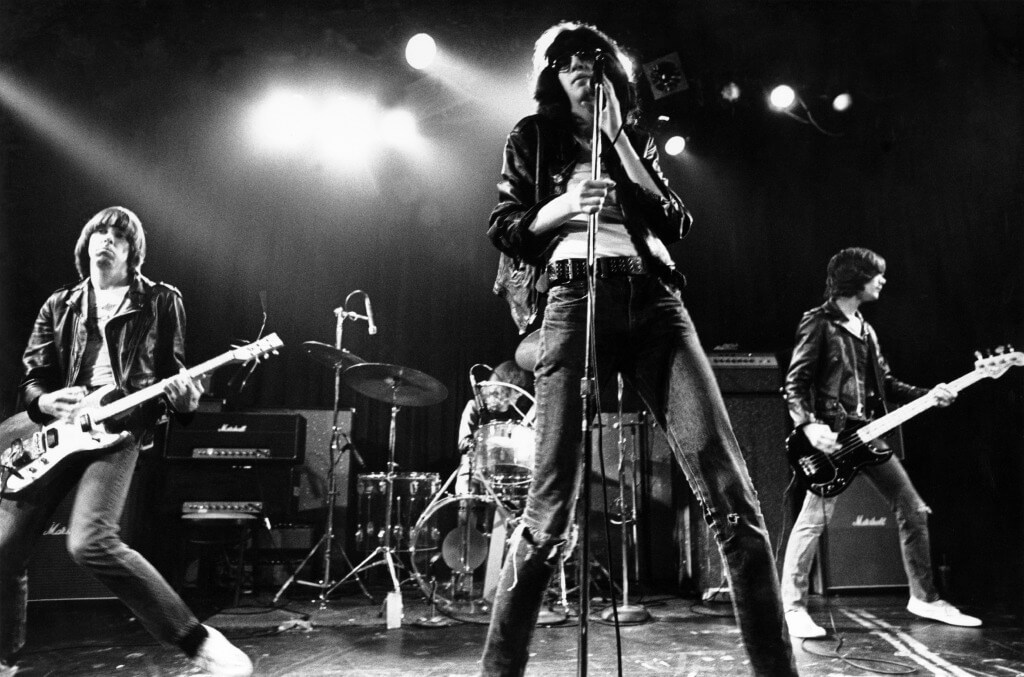
It took Ramones 40 years to go gold, and it never went platinum. A lot of people in New York thought the record was neat, but station programmers boxed the songs out. The Ramones were no more appealing to Americans than the characters in Freaks. They were deformed, depraved, and disaffected, and Ramones is a record that is essentially meaningless—but 50% of my streaming library wouldn’t be here without it. Neil Young, Sonic Youth, Nirvana; they all looted the Ramones’ songbook but rarely cited their work (Aerosmith’s Rocks was Kurt Cobain’s 1976 album of choice).
Joey, who Holmstrom grew close to in the ‘80s, hated just how innocuous the Ramones’ legacy had become: “All he did was bitch and moan and complain about everybody saying punk rock started in England. Joey was the guy in the band who really loved the whole punk thing. He contributed illustrations to the magazine. He wrote a letter for the letters page that we published using a phony name. He came up with the idea for ‘punk of the month.’ He helped write ‘Mutant Monster Beach Party.’ He starred in that photo comic. You can talk to people today who still think punk rock started in England with the Sex Pistols. In some ways, it did, because punk rock had run out of steam after a year in New York. Punk magazine wasn’t selling a lot of copies. Our T-shirts weren’t selling. We were really struggling to stay in business. We didn’t have a corporate sponsor. It was a minor story. But London was so built to create music phenomenons that, once the Pistols went on the Bill Grundy Show, that was it. That’s when punk rock really got off the ground. If not for them, I think it probably would have faded away.”
But I like how Bayley phrases it: “The Ramones opened up the floodgates, but they were still drowned by the flood.” After Kurt Cobain died, rock bands started acknowledging the Ramones and their debut record. But all those thanks didn’t make the Ramones money. They were comfortable but bitter that they never got on the radio. All they wanted to have was a hit record. They hired Phil Spector but even he couldn’t make them a hit record. Nobody could. Johnny Ramone didn’t want to do a disco record, but Joey, desperate as he was, probably would have done a disco record.
Still, the Ramones are present in every punk band that’s put a record on Bandcamp or played a house show or blown all their cash on Xeroxed telephone-pole flyers. They built a mecca of noise for the Clash, Damned, and Buzzcocks by combining the Shangri-Las’ “Leader of the Pack” with the New York Dolls’ “Trash.” By the time they were doing Lollapalooza in the ‘90s, the Ramones were getting respect from the young bands they were sharing stages with: The Offspring, Rancid, Soundgarden. Hell, the Frozen Embryos sang “I Wanna Be Sedated” in My So-Called Life. Even OutKast’s “Hey Ya!” has a touch of “Gabba Gabba Hey” to it. Time may have taken Joey, Johnny, Dee Dee, and Tommy from us, but it’ll never kill the Ramones. That music is deathless. “Maybe the business wasn’t treating them that way, but their contemporaries were,” Leigh says. “They knew they’d made their mark. And my brother knew that they were going to be inducted into the Rock and Roll Hall of Fame before he died. At least he got to know that.”
Johnny Ramone once said that, when the Ramones played in England for the first time, all the British punk bands said, “Whoa, well, we have a band, but we’re not good enough to play.” And Johnny told them, “Well, come on, we’re shit. Just go up there and do it! We don’t play well. What’s the problem?” And that’s what all those bands did; that was the whole idea of punk. That’s Roberta Bayley’s definition of punk: “Don’t wait for somebody to give you permission to do something, don’t wait until you’re proficient. Don’t wait till you’re a virtuoso. Just do it and see what happens. What’s the worst that can happen? Nobody’s going to kill you. That’s what the Ramones did. Before they were ready, they started playing.”
Bands in 2026 still form because of the Ramones. Craig Leon used to listen to demo tape submissions from artists all over the world, and even when they were 18-year-olds who sounded nothing like Joey, Johnny, Dee Dee, and Tommy, the Ramones’ influence was latent beneath the sound. “They would be making the weirdest electronic music you ever heard, trying to emulate their own ethnic instruments through a fuzz tone, and I’d go, ‘Well, why are you sending this tape to England to be judged?’ They’d say, ‘Well, the Ramones really got us going.’” And that’s the point of the Ramones.
“You’re not going to find too many Joey Ramones and Dee Dee Ramones anymore,” Bayley says.
“I hope not, said with love,” Leigh responds.
Bayley chuckles. “Long Live Dee Dee.”
Ramones is an important record to all four of these people. Not many people knew that Mickey Leigh sang that middle part on “Judy Is a Punk,” but he’s proud of it. John Holmstrom thinks that Punk magazine created the image of punk rock but “the Ramones provided the sound.” Craig Leon’s production captured the folk music of downtown New York in 1976. “Every borough of New York City and every neighborhood had a different folk scene back then. From the Bronx down to southern Brooklyn,” he says. “I thought I did a decent job capturing the best known proponents, what were to become the best known symbols of the mentality of that CBGB scene down there. That was my goal, and that’s where it sits. I hope there’s a redeeming value in every record I’ve done, and there’s a lot of redeeming values in Ramones.”
An IOU gig for Punk #3 made Roberta Bayley’s picture of four make-believe brothers from Queens one of the most recognizable images in rock and roll history. Eight years ago, she traveled to South America to host an exhibition of her Ramones photographs, including the 12th frame on roll three. The people there treated her like a deity, following her through the streets and asking for an autograph. When Joey, Johnny, and Dee Dee were still touring together, they sold out stadiums in Brazil. Finally, they had become the Beatles, even if only in South America. And that love there, it’s been passed down through generations. Fathers and sons head-bob to “Blitzkrieg Bop.” The sounds of Ramones waft from one house to the next. Being big in South America isn’t the same as being big in the United States, Bayley says, “but at least they got to be big somewhere.”
Matt Mitchell is the editor of Paste. They live in Los Angeles.
 Keep scrolling for more great stories.