
A band drowned by the flood: The story of Ramones
Tales about New York City, punk rock, and the people who made it, loved it, and wanted it dead.
Photos courtesy of Danny Fields, Tom Hearn, Michael Ochs Archives, Keystone/Hulton Archive, Getty

Back in August 1975, eight months before Ramones came out, a 21-year-old John Holmstrom picked up a copy of the Village Voice and saw an ad about the Ramones while flipping through. He thought they sounded like a band he’d really like, so on a Sunday night in August, he arrived at CBGB for his first Ramones set. There were 20, maybe 30 people in the club. The band played a hair over 20 minutes, but Holmstrom felt satisfied. “They were a great 20 minutes. It was like seeing the Beatles at the Cavern Club. I really thought they were going to be huge. The music was so good. I dreamt of the day I could start a magazine, because they were the perfect punk rock band.” He founded Punk Magazine with Legs McNeil and Ged Dunn two months later.
Village Voice was hardly the only publication to take notice of the Ramones. British rock mags wanted to be on top of what was happening, so they started to draw their image of punk, too. England had three weekly newspapers devoted to music—Melody Maker, Sounds, and New Musical Express—all of which had been writing about the CBGB scene before it was cool. “Melody Maker would send Chris Charlesworth over,” Bayley says. “They were writing about the New York Dolls early on, covering that scene before people had any records.”
After BBC Radio 1 host John Peel talked about the Ramones in the UK, Nick Kent, a critic for NME, came to New York specifically to find them, even though there was no recorded music yet. All the better; he could cross the pond to hear the making of Ramones. “I invited him to the mastering session, and there were these big speakers on either side of the console,” Leon remembers. “And Greg [Calvi], who had just started as a mastering engineer, was working on this really expensive console and I was standing next to the speakers. The pedal tone came in at the start of the first track, and I slammed the speaker and knocked it off its stool. It was a really expensive B&W speaker. Greg said, ‘Oh, my God, what’s happening?’ I said, ‘Look, this band is so powerful that you can’t even play their music back.’ And Nick Kent wrote it all down.
There are disputes over when the phrase “punk rock” was born. Bayley doesn’t think anyone in 1975 was using it. Holmstrom notes that, on the cover of Creem in 1974, Alice Cooper was named “Punk of the Year.” But, actually, Creem was using “punk” as a description as early as 1970, when Lester Bangs called Iggy Pop a punk in his review of Fun House. Alan Vega wrote “punk” on Suicide flyers around the same time. Holmstrom thinks that bands like Brownsville Station were even doing a form of punk rock in the runoff of glam, before Joey, Johnny, Dee Dee, and Tommy demoed a single track. Dave Marsh called ? and the Mysterians “punk-rock” in a 1971 issue of Creem. But the layman’s consensus is that Ramones was the first punk album.
Maybe the Dolls were getting something going post-Stooges, but the Ramones were, as Kid Congo Powers wrote, “faster, funnier, smarter, and dumber than anything I could have ever imagined.” During our conversations, Holmstrom channels Metal Mike Saunders by bemoaning the term “proto-punk,” preferring how the Ramones’ style was never deliberately bad or unmusical like the no wave acts that eventually took over CBGB. “Not many punk rock bands do love songs like the Ramones,” he says. “Not many punk rock bands do harmonies the way the Ramones do harmonies.” It should be noted that the Ramones really didn’t write love songs, because they didn’t have any girls to write about, as Johnny later put it.
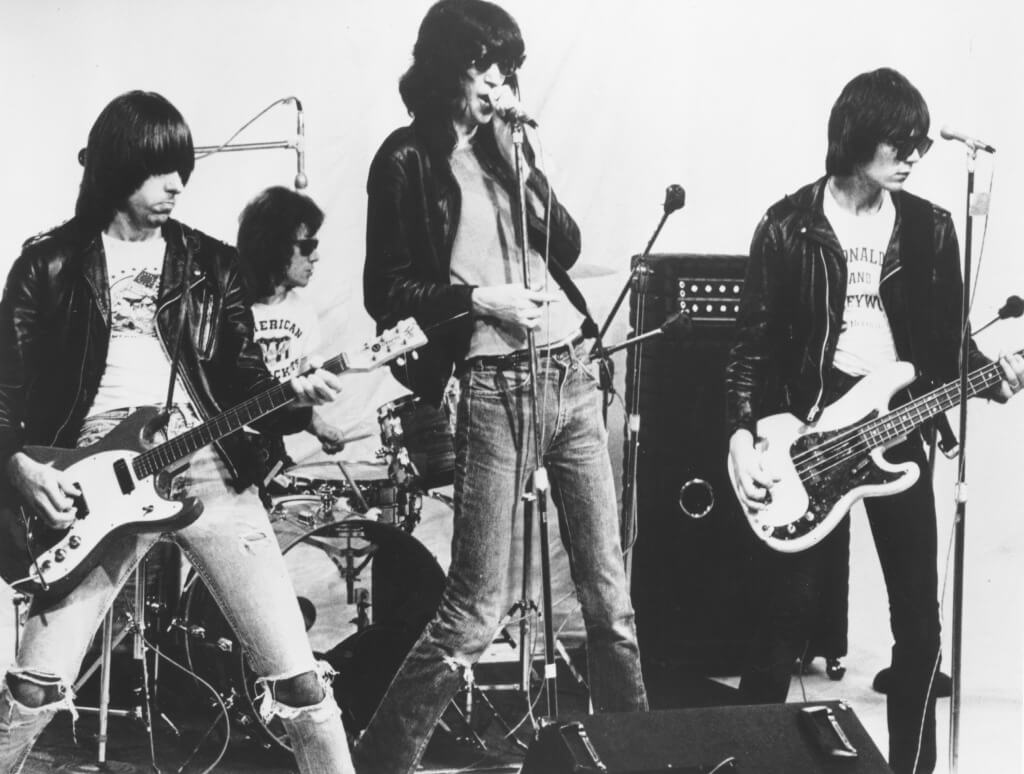
But Bayley will tell you that “punk” wasn’t a genre until Punk magazine came out in 1976 and started affixing the label onto a bunch of New York bands. “Music writers always need to label things,” she miffs. “But the word ‘punk’ was used a lot from way before rock and roll. It was used in the ‘40s for gangsters. Punk rock wasn’t used in print. Even when Alice Cooper got on the cover of Creem, it wasn’t called punk rock. Punk rock was not born overnight.” The Ramones, for their part, wanted to save rock and roll music by doing Herman’s Hermits-type pop tropes fast and loud. The descriptions, to them, played second-fiddle.
Not everyone saw “punk” as an affectionate term, however. The Ramones didn’t call themselves “punk rock” until 1981 or 1982, because they wanted to be thought of as a rock and roll band instead, especially when fans began spitting on the Sex Pistols. “Nobody wanted to put up with that crap,” Holmstrom says. “Sometimes I wonder if the bands would have been better off if Punk magazine never came out, because people hated ‘punk’ with a passion. They probably would have hated the Ramones anyhow. Look at what became popular: Boston is the opposite of the Ramones.” Miles Copeland III, who was managing a prog-rock band called Renaissance in 1975, threatened to yank them from Sire if the label signed the Ramones. “But then, of course, he called me begging to call Blondie and get his newfound band the Police a slot at CBGBs opening up for Debbie Harry,” Craig Leon laughs. “That’s the record business. Your old prog rocker turns into a disco DJ very quickly, if there’s money involved.”
Work for Punk #1 began in the fall of 1975. The Ramones were interviewed for the issue at CBGB in late November, just after Thanksgiving. When Punk found out the band had been signed to Sire, they wanted to put them on the cover for issue three. Holmstrom conducted the interview in Vega’s loft, and Bayley took some pictures up there. By then, the loft was the Ramones’ headquarters. Bayley shot two rolls of film in the loft, but the photos weren’t looking good. She was new to photography and her camera was even newer. Vega suggested they try the playground down the street, so they all hiked down there and continued the shoot. Holmstrom sometimes directed the Ramones on where to stand, but it was “pretty impossible to get those guys to cooperate,” he says. “They hated photoshoots.” Bayley normally shot on Kodak Tri-X film but had switched to Plus-X for the Ramones shoot, thinking it would be indoors, not outside in the bright daytime.
The playground Vega suggested was deserted, derelict. There was a basketball hoop and some blacktop, but not much else. Four brick walls surrounded the lot; it was the west wall that was captured on the third roll of film. For a few frames, everybody’s laughing, because Dee Dee stepped in dog shit. He’s looking at the bottom of his shoe and then, for about four or five frames, it looks like his bandmates are making fun of him. “Dee Dee takes a stick and he puts it into the dog shit,” Bayley remembers. “And then, in the frame after that, everybody has run out of sight and it’s just Dee Dee standing there by himself, waving the stick with a maniacal look on his face, as Dee Dee often put on.” There’s even an outtake from the shoot where the word “HACK” is written on the wall behind the Ramones.
Everyone goofed around during the shoot because they all knew each other from CBGB. “They were trying to be serious for the pictures, but there was a camaraderie between me and the Ramones and John and Legs and Arturo, which is what relaxed the band,” Bayley says. “A lot of the pictures on roll three are quite good, because they weren’t so uptight thinking, ‘Oh, this is important. We have to pose.’ That contributed to the quality of the photos.” Most of the pictures Bayley took in her brief career were of people she was friends with—people who weren’t intimidated by her and vice-versa. That made her photographs more intimate and casual. She and the Ramones were the same age, from the same scene. She captured them as they were. “Quite frankly, the third roll is the best roll of film in the entire session,” Bayley says. “There are a lot of good, usable frames on that. It wasn’t a photo session with Annie Leibovitz with hair and makeup people, but there were a lot of good, usable frames on that.
“Roberta, when you did that cover, were you consciously aware of the New York history of bands against a wall, like the first Fugs album?” Craig Leon asks.
“No, not at all,” she says. “I was obviously a big record fan and music fan my whole life, but I wasn’t particularly a photographer, except for very amateurish things. On the day of the shoot, Johnny actually said, ‘Why are you getting Roberta? She’s the door person at CBGBs. Why don’t you get a real photographer?’ And John was like, ‘No, Roberta is our photographer. We’re going to use Roberta.’”
“The two ideas that I talked to Toni Wadler about were Meet the Ramones, to channel the Ramones bringing back early rock and roll, or to have them stand up against the wall like the Fugs’ first album,” Leon adds. “When your photo came in, it was like, ‘Okay, somebody got this in the ether. This is amazing.’”
“The band looks reasonably symmetrical,.” Bayley says. “Tommy is standing on a brick behind him, stretching himself out so his whole stomach is exposed. Joey is slumping down, so he doesn’t stick out like a giraffe, with his middle finger up. They’re all somewhat evenly standing, and the picture was a rectangle but, because the two sides are just bricks, it lent itself very well to cutting off the two sides to make it a 12-inch square for the cover. In retrospect, it was the perfect picture. I certainly did not know that when I took it.”
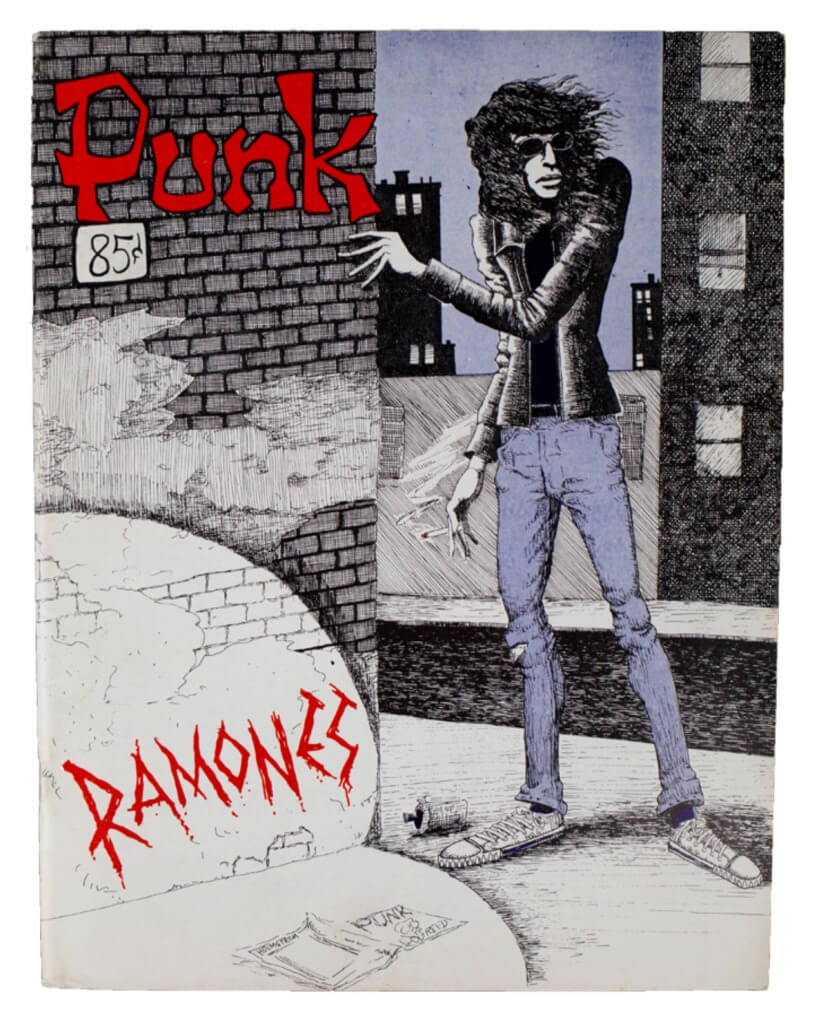
The cover of Punk #3 featured Holmstrom’s drawing of Joey, and inside the zine were hand-lettered interviews and several of Bayley’s pictures. Holmstrom and McNeil drove to The Place in Dover, New Jersey, where the Ramones had a gig, to present them with the issue. Blondie was the opening act and, at one point, the room was empty. When the band saw the cover, they were pissed off. Their tour manager, Monte Melnick said, “Why did you put Joey on the cover? Why didn’t you put all four of them on there?” Holmstrom told him, “There’s a thing in magazines: a single image sells better than four. If you put four faces on the cover, it just doesn’t work. You want eye contact. There’s all these little rules.” Holmstrom was young, but he knew the rules because he was obsessed with magazines. “And, I wanted to see what Joey looked like without his sunglasses,” he adds. “I got him to take off his sunglasses. I did a life-modeling thing at the loft with him. I was fresh out of art school, so that’s how I drew people, instead of using photos for reference. You couldn’t find any photos of them back then, not like that.”
Perhaps because of that lack of photos, Sire Records hired a professional photographer to shoot the Ramones cover. They liked Leon and Wadler’s idea to recreate Meet the Beatles. The Fab Four’s image was shot by Robert Freeman in black-and-white, lit from the side. George, John, and Paul were at the top, Ringo below them. It’s just their heads, because they’re all wearing black turtleneck sweaters. The image is dramatic, especially for the Beatles. And the British cover is much nicer than the American cover, because the Beatles hadn’t broken in America yet. “BEATLES” is written much bigger. But distracting text aside, both images were elegant. But the close-ups of the Ramones, Leon remembers, were made to look hideous. When the pictures came back, nobody liked them. Wadler, the album’s art director, was mortified. “They were gargoyles, real ugly medieval things. I thought it was hysterical,” Leon says. “Toni wouldn’t have it, so she called somebody who knew about you doing the photo, because the record was imminent to come out. We had to deliver something, and Meet the Ramones could have buried them.” [Editor’s note: Paste reached out to Rhino Records in regards to the whereabouts of the “lost” Meet the Ramones cover, but the label was unable to locate the image.]
But Sire didn’t have a replacement for the photographs, so they started desperately calling different photographers. They called Bob Gruen. They called Danny Fields, who had taken a lot of pictures of the band at that point. Before Bayley even had a chance to process the film, she and Holmstrom heard from Danny Fields. “He called me at the office, desperate,” Holmstrom remembers. “‘John, we can’t find any images. We’re calling every photographer who has pictures of the Ramones, to see if we can get a record cover, because the session we did didn’t pan out.’” Sire called Bayley, and she provided them with the contact sheets. Wadler went over to Leon and said, “I think this is the one.” They chose the 12th frame on the third roll for the cover. Another frame was grabbed to use for publicity. “We did a mockup, she sent it off to get it printed as a proof, she gave me a proof with all the edges still on it, and we put it together with tape,” Leon recalls. “I still have it, it’s an ultra-oversized version of the picture you did, Roberta. It was like, ‘Wow, this is what I envisioned the album cover should be.’”
Sire paid Bayley $125 total for both images. “There was no ability to really make a counteroffer, although I don’t know if I would have had the confidence or chutzpah to say, ‘Well, no, I need more money than that.’ I think I was probably, at that point, flattered enough to just say, ‘Sure.’” Holmstrom gave them permission to use the images, since they were shot for Punk. He didn’t even see the picture until the record came out in April 1976. “We got the test pressing way before that, but those are always in a white cardboard cover. I wish I’d kept mine.” Bayley got every cent for the photos, because Holmstrom was against work-for-hire contracts. “I always thought artists and photographers should own the rights to their work,” he tells me. “I feel privileged that I was able to work with such great photographers. I think it really is our legacy, we have the best photos of punk rock.”
And, if you look at the back cover of Ramones, it says “COURTESY OF PUNK MAGAZINE.” Holmstrom tells me that those four words were the greatest thing to ever happen to his career. “The dream came true.” Millions of people have read that acknowledgement. No else got a special thanks from the Ramones. Mickey Leigh, Joey Ramone’s own brother, didn’t even get credited for his singing parts until Craig Leon added him into the liner notes for the album’s 40th anniversary. “That was the bad part of the Ramones,” Holmstrom says. “They were so damn cheap. People know all about Johnny. I got along with him personally, but it would have been nice if he threw me a few bucks for all the T-shirts they made with my work on it. That’s my worst memory of them.”
The second image chosen by Sire wound up used in a publicity advertisement on the back cover of Trouser Press. In it, the band is smiling and there’s a phrase below them: “THEY’RE SO PUNK, YOU’RE GOING TO LOVE THEM.” Bayley thinks it was the record label’s attempt to “soften” the album cover picture, because they “looked threatening to some people.” People in England thought the Ramones were gang members, so Sire wanted to portray them as more accessible and friendly, like Bay City Rollers. They tried to release the smiling picture for PR, and immediately the band, probably Johnny, said, “No, we’re not using that picture. We’re never using that picture again, and we’re never smiling again.” Johnny credited Danny Fields for being the first to say “no smiling.” And the Ramones stayed true to their no-smiling dictum, 14 studio albums, two-dozen music videos, and 2,263 shows later. Not wanting to smile was common for rock and roll bands, but it was an especially strong dictum for the Ramones.
 Keep scrolling for more great stories.