
Who’s afraid of the Khia Asylum?
Some of the most inventive and personality-rich records of 2026 are coming from pop's middle class.
Photos by Monica Schipper & Frazer Harrison/Getty Images
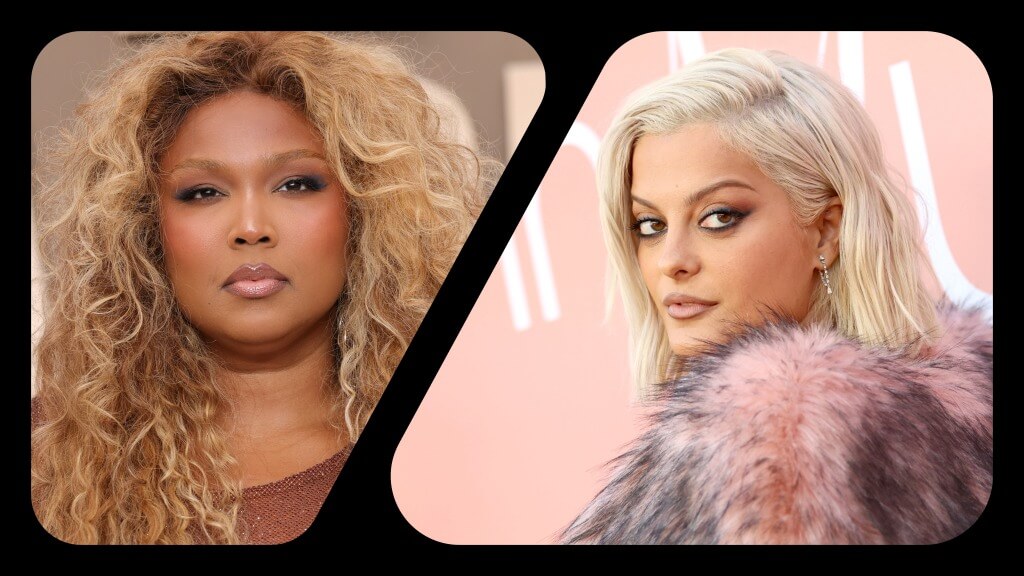
There’s no dancing around it: Lizzo’s latest album flopped. The singer, rapper, and flutist admitted as much herself, taking to social media to discuss the lackluster commercial and critical response to BITCH. What was primed to be Lizzo’s big comeback record sold less than three thousand copies in its first week, and sales have remained slow since. While her 2022 album, Special, debuted on the Billboard 200 at #2 and surged to #1 hit thanks to its lead single “About Damn Time,” BITCH failed to chart at all. Perhaps because of the album itself, or because of Lizzo’s public reaction to its failure to meet the success standards set by her previous releases, the pop star soon found herself on the receiving end of that most vitriolic of stan insults: Khia.
For the uninitiated: Khia, in the most literal sense, refers to rapper Khia Simone Finch, who had a hit single with “My Neck, My Back (Lick It)” in 2002 before fading into relative obscurity. More than a decade after the release of “My Neck, My Back,” a response to a post on X (then Twitter) went viral; a fan shared a photo of herself in tears while meeting the rapper, and another user posted the photo with the caption “This gotta be photoshopped. Ain’t nobody crying when they meet Khia in 2014.” In the 2020s, “Khia” has become synonymous with irrelevance or failure. A Khia is a nobody.
What makes someone a Khia in 2026 is mostly arbitrary. A Khia can be a pop star who has failed to reach mainstream success or ubiquity. A Khia can also be an artist who once dominated the mainstream—either momentarily with one career-defining hit or for a few consecutive years or album cycles—but has failed to maintain their place in the zeitgeist. Sometimes, Khia is used as a stand-in for terms like “one-hit wonder” or “has-been.” Even objective A-Listers can be deemed Khias at a rival fandom’s discretion. Exhibit A: Olivia Rodrigo is in the middle of 2026’s biggest album rollout—in terms of sales, streaming numbers, critical performance, and sheer exposure—yet she’s still been dubbed “Khialivia” by a subset of Swifties who view Rodrigo’s every career move as a slight to Taylor Swift (the two are rumored to have had a falling out over songwriting credits on Rodrigo’s debut album Sour). To be fair, according to Swiftie Logic, any artist who isn’t as ubiquitous as Taylor Swift (so basically, every artist), even if they’re selling out stadiums, might as well be performing to no one in a parking lot.
The term “Khia Asylum” was coined by X user @PopAteeMyHeart, who shared a now-outdated chart depicting the hierarchy of pop stars in spring 2024. The Khia Asylum can look like a series of mid-sized venues or undersold arenas. Sometimes an artist’s stay in the Khia Asylum is short—they’ll manage to bounce back after one lackluster album. Other artists spend their entire careers there. In the world of the Khia Asylum, there is no “alternative,” no “underground,” no “indie.” It operates under the assumption that all Khia Asylum residents (and all artists making anything resembling pop music) are making music with the goal of mainstream domination, and have failed to achieve the wide, almost monocultural reach that they’re presumably aiming for—that all of the Khia Asylum’s patients have been involuntarily committed.
In recent years, the term “Khia” has broached stan Twitter containment and steadily made its way to mainstream vernacular, rising in tandem with a wave of Khia Asylum jailbreaks. Summer 2024 was a full-on Khia Asylum prison riot. Charli XCX, who’d had a few mainstream hits in the early 2010s but had otherwise remained firmly in the alt-pop realm, rose through the ranks of pop stardom with Brat, an album largely made up of meta-commentary about whether or not niche fame was enough. That same summer, Sabrina Carpenter, who’d occupied a similar level of fame as Charli, enjoyed a mainstream breakthrough with her hit single “Espresso,” its accompanying album Short n’ Sweet, and a support slot on Taylor Swift’s Eras Tour, culminating in her newfound A-list pop star status.
Perhaps the most meteoric rise of all was that of Chappell Roan, who’d been dropped by Atlantic Records a few years before, but whose historic sets at Lollapalooza and Coachella, breakout standalone single “Good Luck Babe!,” and sleeper-hit 2023 album The Rise and Fall of a Midwest Princess made her world-famous almost overnight. Since then, artists like Olivia Dean, Zara Larsson, and Slayyyter have had successful Khia Asylum escape attempts of their own.
Now, halfway through 2026, the Khia Asylum discourse has reached a fever pitch, to the point that it’s become common for artists themselves to reference it. Bebe Rexha has incorporated Khia Asylum jokes into her current promotional cycle, sharing a voice note titled “Khia asylum day 3051,” in which she namechecked “Sabrina, Charli, and Zara” as former Khias who got out, and joked that the operators of the Khia Asylum “make us run on the treadmill every day with heels on.” Three days later, she shared a TikTok of herself doing just that. A recent cover shoot of Rexha for PAPER Magazine, accompanying a feature titled “Bebe Rexha Burns Down the Asylum,” showed her bound by wires and restrained by white-coated orderlies, really hammering home the inpatient imagery and Rexha’s desperation to break free.
Unfortunately, desperation is what the entire promotional cycle reeks of, and Rexha’s music has lacked the intrigue that made notable Khia Asylum breakout records like Brat and WOR$T GIRL IN AMERICA so compelling. Self-referential songs like “Sympathy is a knife” and “I’M ACTUALLY KINDA FAMOU$” elevated Charli’s and Slayyyter’s respective commentaries on their own stardom above just self-deprecation and a telltale wink at being in on the joke. Rexha’s heavy-handed references to her own Khia status feel forced and lack artistic substance beyond a blatant admission that she, too, would like to be more famous than she currently is. It’s an unfortunate side effect of an artist becoming too tapped into stan culture, to the point that the promo feels like pandering. The marketing overshadows the music itself, and for what it’s worth, I’m pretty sure that the Khia Asylum’s namesake pronounces it like “kye-uh,” not “kee-uh.”
Charli XCX made a joke about the Khia Asylum at a screening of her self-satirizing film The Moment—a fictionalized account of her own Khia Asylum escape—saying: “The doors to the asylum, I hear they keep them open.” Lizzo has learned that the hard way, although she’s rebuffed the Khia accusations. As the inaugural guest on Zachary “Swiftologist” Hourihane’s new podcast, Proto Pop, Lizzo cited her Grammys, #1 hits, and Diamond-certified record as armor against getting committed to the Asylum.
Both Hourihane and Lizzo rightfully pointed out that male artists rarely get hit with Khia accusations, and that the term highlights how female pop stars are expected to constantly reinvent themselves—and reinvent pop music. For female pop stars, shouldering the burden of embodying or rebelling against culture’s norms, ideals, and aesthetics at any given time is the expectation, not the exception. “There are plenty of men that are in the Khia Asylum that exist permanently in the Khia Asylum,” Hourihane said. “And they don’t get this obsessive focus on them flopping that women get.”
Lizzo mentioned that this kind of pressure tends to be particularly detrimental to Black female artists, and that it’s no coincidence that a Black woman’s name has become a shorthand for failure. She called out the racism, misogyny, and hypocrisy inherent to invoking an “extremely talented, incredible pillar in the Black community and in Black rap music” as the pinnacle of irrelevance. At its worst, the term “Khia Asylum” reveals an ugly truth about who gets credit for influencing pop culture.
There are a number of legitimate explanations for why Lizzo’s latest album failed to perform at the level of her previous releases—between album cycles, the singer was accused by her backup dancers of sexual harassment, racial profiling, bodyshaming, and hostile working conditions; Lizzo’s brand of “you go girl” empowerment pop captivated audiences in the latter half of the 2010s but feels glaringly dated and stale in the present day pop landscape, especially in light of the not-so-positive allegations that have soured her feel-good persona. But Lizzo’s point about the Khia Asylum’s racist and sexist implications still stands. It’s a tale as old as the music industry itself: of Black and/or female artists’ contributions going unappreciated, and of predominantly white audiences and industry gatekeepers being the arbiters of what is and isn’t relevant.
There’s another way of looking at non-mainstream pop stardom—one that acknowledges that the Khia Asylum isn’t always the worst place to be. In a New York Times piece from three years ago, cultural critic Shaad D’Souza coined the term “pop’s middle class,” a nuanced re-framing of Khia-dom that accounts for the myriad ways to be a pop star. Charli XCX recently joked that she might like to go back to the Khia Asylum to “visit all [her] cool friends” who are still there. Pre-Brat, Charli was one of the definitive members of pop’s middle class. She had a few mainstream hits here and there and a steadfast cult fanbase, but was largely unknown to the general public. To those in the know—music critics, gay guys and their hags—she was regarded as an unsung architect, always a few steps ahead of the mainstream pop trends. A lot of her peers and collaborators still occupy a similar niche. Artists like Robyn, Caroline Polachek, and Tinashe have sustained longevity and critical acclaim not through fleeting, buzzy hype moments but through steadily influential careers that play to their own strengths and gradually cultivate fan bases rather than make desperate attempts to break through to the mainstream.
Arguably the most quintessential example of pop’s middle class, Carly Rae Jepsen, has begun rolling out a new record, kicking off the latest round of “Is Carly Rae Jepsen underrated?” discourse, which returns like clockwork during every one of her album cycles. But is being known colloquially as “the ‘Call Me Maybe’ girl” the worst thing in the world when the mainstream success of “Call Me Maybe” (and not much else) has given Jepsen the creative freedom to pursue her passion projects on her own terms, sans Taylor Swift-level scrutiny? Does an artist getting their flowers always have to take the form of Top 40 radio play, streaming numbers in the hundreds of millions, or a level of fame where a trip to the grocery store becomes a pap walk?
If you want to find the best pop music offerings of 2026, you don’t have to look much further than the middle class, where the critically acclaimed but not-quite-mainstream experimentalists—like bedroom pop’s People’s Princess Grace Ives, ex-PC Music dancefloor diva Namasenda, and the figurative and literal mother of pop’s middle class Robyn—are all putting out some of the most inventive and personality-rich records of the year. Alt-pop freakshows like Gelli Haha and Magdalena Bay are extending the shelf lives of their excellent albums from previous years with follow-up singles and high-concept visual projects that expand their respective musical universes. Idiosyncratic art pop auteurs like Rosalía and FKA twigs are selling out stadiums. In the midst of the year’s highest-profile album rollout, Olivia Rodrigo is using her status and acclaim to shine a light on the fringes of the mainstream, whether that’s by covering CMAT or featuring up-and-coming stars like Quiet Light, Rachel Chinouriri, and Eli (as well as longtime left-of-center pop innovators like Santigold and Mitski) on her music festival lineup. Slayyyter is about to open for a hardcore band turned Grammy-winning arena rock act. There’s no standardized formula to this shit.
One of this year’s biggest breakout stars, underscores, has released a record that could easily go toe-to-toe with any blockbuster pop release of recent years. But during the press cycle of her pop star reintroduction, underscores (April Harper Grey) embraced her middle-class status, telling Vogue that she’s “super down to be C-list for the rest of [her] life.” Grey is about to embark on a tour with one of the Khia Asylum’s most notable escapees, but she’s in no rush to leave the Asylum herself. “I definitely feel like a pop star, but I don’t necessarily have aspirations for Madison Square Garden or something,” Grey says. “I really like the size of my shows right now. I like being able to go outside and not get recognized at all. There are things that I really value about the life I’m living currently.” She understands the time-honored and pluralistic truths of pop’s middle class: that a successful music career can look a million different ways, and that sometimes, the Khia Asylum is just the hottest club you haven’t checked out yet.
Grace Robins-Somerville is a writer from Brooklyn. Her work has appeared in Pitchfork, Stereogum, The Alternative, ANTICS, Marvin, Swim Into The Sound, and her “mostly about music” newsletter, Our Band Could Be Your Wife.
 Keep scrolling for more great stories.