
A Place To Always Go Back To: Andrew Haigh and Charlie Plummer Talk Lean on Pete
Photos: Chris J Ratcliffe/Getty Images for BFI / Andreas Rentz/Getty Images
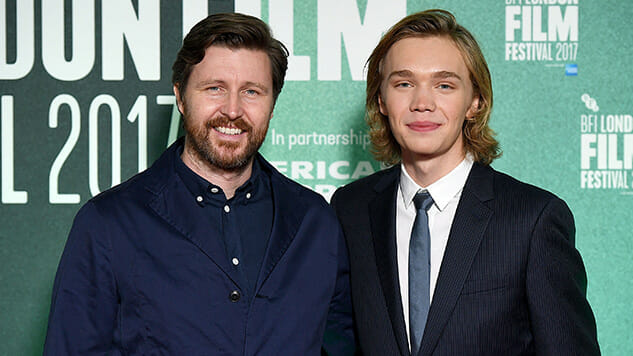
Andrew Haigh thinks a lot about the little things. Like how texts can transform a casual encounter into a dialectic on gay identity. How a letter can unearth the past. How an ad on a forum can shape one’s relationship to work. How a hat can be both shield and sword. How a common verb can be recontextualized, politically and erotically, depending on who’s saying it. But Haigh uses those small details to map out entire psychological and emotional landscapes, as in his nonfiction film Greek Pete, his queer breakout hit Weekend, his Academy Award nominated naturalist ghost story 45 Years and the HBO drama (on which he served as executive producer and occasional writer/director) Looking.
Haigh returns to the screen, for the first time setting his story in the United States, with Lean on Pete, based on the novel by Willy Vlautin. It would be easy to assume that the film is a dramatic departure from the director’s previous work, in style and content, but that would be inaccurate: It carefully and tenderly explores how 15-year-old Charley, played by a devastating Charlie Plummer, conceives of himself in relation to both the landscape around him and his class status.
Paste spoke with the film’s director and star about class, masculinity and what it’s like to build intimacy with a horse.
Paste Magazine: So, Andrew, in your previous work, you’ve used space a lot in terms of how it shapes who you are, and Weekend takes place in the English midlands, right? In Looking: San Francisco. I was wondering if you could talk about space, how the landscape of Lean on Pete shapes Charley’s character.
Andrew Haigh: Interesting. I don’t think we spoke about it necessarily, but for me, like, space and environment and your surroundings, not just in a physical sense, but a temporal sense as well, has such a fundamental effect on who we are, how we act, our frame of mind, our tone, everything. So [space] always was going to be part of this film, especially because it started in kind of a domestic setting, and it is about this kind of family, and in the very beginning it expands outwards into something larger and more isolating and sort of more terrifying.
Paste: In terms of the domestic aspect, I think your films have a very interesting relationship with class. Weekend and Greek Pete are two of the greatest films about queer male sexuality and class. And 45 Years is also a really great film about kind of middle class people. But this is one of the first films of yours where your character occupies different class statuses within the same film. Did you two talk about that at all?
Haigh: I don’t know if we did. [To Charlie Plummer:] We probably didn’t, did we? I mean, class is so fascinating to me. Coming from the UK, which is unpleasantly class-ridden to a really, I think hugely detrimental way to society—like in the UK you can tell someone’s class, however you want to say that means, just by how they talk, where they come from, what they’re dressed in, what part of the country they’re living in. It can be a really disruptive thing. So I’m always interested in how that affects the story, how that affects character. So it was always, again, the heart of this story, but I think we always knew obviously that it’s about someone struggling economically and socially within the story, and we talked a lot about that.
Charlie Plummer: Yeah, and I think too in the character, that is so much a part of his life and I think there’s always that in the background a little bit, the knowledge of that: He doesn’t have a lot of money, he’s living in the [shack in Portland] at the beginning of the film because of that and because his father doesn’t have a lot of money and because he doesn’t know his mother, and I think that that’s always there—but I don’t know if it was ever the focal point. And then, even towards the end of the film, where I think he really has to confront [his class] head on, it’s still something that, at least for me in my interpretation of the character, did have an effect on him, but there was of course a lot of other things going on that I think in his mind were much more important.
Paste: Charlie, I’m not sure if you’re a process kind of performer, but what did you do to build intimacy with the horse?
Plummer: I tried to be as open to the horse as I possibly could be, and I think I was so thrilled to get an opportunity to work with an animal, especially one as intelligent and kind as Starsky, who played Pete, was, because I basically just left myself open to whatever he felt compelled to do in that moment, and just followed his lead. We worked for about two weeks before we started filming and I worked with the horse a lot. So I felt confident in being able to walk him around, feed him, and stuff like that. Just being open. And I feel that way with any actor I work with: Being open to who they are as a human being, and what they’re bringing to this relationship and the character and this environment and what effect they have on that, and then just playing with that. So it didn’t really change that much with the horse.
Paste: Charley is a really interesting character because of the way that he mediates how internal he is. You have a really interesting physicality to your performance, Charlie. And that’s juxtaposed against your use of a lot of long lenses and a lot of zoom lenses, Andrew. Did you talk about how you would use that physicality regarding cinematography and aesthetic?
Haigh: I think we didn’t talk about it, probably. Personally I don’t like to talk too much to the actors about the camera choices, because I feel like the way I want them to perform is as if it feels very rooted in the real world, and that I’m essentially stepping back and just watching and hoping they feel safe with me watching. And then I work out how to watch them in the way that I think makes sense for the film. So I used a lot of zoom lenses and long lenses in the past, especially in this one, and I really like it because I feel like for an actor you can give them physical distance, so I’m not, like, “I’ve got a camera here,” [and] they can feel that I’m still watching them. That’s what I love about the zoom lens. You can find your way into the scene or out of the scene in a way that physically you’re not actually close to the performer.
Paste: Do you find that there was some sort of turning point in your aesthetic trajectory in your career?
Haigh: I think it’s developed. I think I try to do it [based on] what makes the most sense for the story. It’s something like when I did Greek Pete—it’s like this is just me with a camera, so what can I do? And I don’t know how to use a camera or lights, so I’m going to do it in a way that makes sense. And then Weekend was much more handheld. [Lean on Pete] isn’t handheld. There’s all this zoom—actually the first time I’ve used a dolly in my life is on this film. I’ve never used a dolly before, I really enjoyed it actually, especially using it alongside zooms. Especially using the dolly and zoom at the same time. I never cut that much, as I’m sure you can tell, so it’s like your shot choice becomes so important, and your relationship with the blocking of the shot. [To Plummer:] I think the thing I talk to you guys [most] about is about blocking, isn’t it? I always kind of know how I want my characters to move through the space, and we often don’t necessarily need to talk about too much because I trust them to do their performance. So for me it’s usually like, “I need you to walk from there to there and to there, and to do this, and then let’s play with it,” which to me is much better than talking about in-depth motivation behind things.
Paste: Charlie, you have a really interesting kind of elocutionary quality to your line readings. Did you at all talk about the way that Charley would speak?
Plummer: I don’t know if we did. And same with physicality: I certainly had ideas about it. I mean, I always thought [Charley] was a gentle person and a very soft-spoken person in general, but at the same time he could be very strong when he needed to be. And I think in terms of physicality as well. When I first read [the script], my interpretation of it was that he goes through these experiences that really encourage him to shut down in a lot of ways. He does slowly become more interior and more closed off, in his hat or in just the physicality of really crouching and getting so protective over whatever he’s got left. Because so much is taken from him. I don’t know if we did talk. I mean, I didn’t improvise anything. It was all just in the script; I basically just listened to that.
Haigh: It’s all those little choices you make. It’s like, you give someone a hat. They’re going to use the hat in a certain way. [To Plummer:] When you were coming up with all those building blocks of making a film, we did talk a lot about that hat. When does he get that hat, it’s his dad’s hat, when does he wear it, how does he feel when he’s got it on, who is he hiding from, you know? It’s all those things, and you try to do that with lots of different elements within the story, and then I think that guides the performance. For me, I always think about giving little building blocks for an actor that can exist around them, and [even in] conversations off-set, like before or after or walking on to set, rather than there being “I think in this scene you’ve got to do this or do this.” It’s never like that. It’s just like talking around the edges of the story that help you define what the performance is.
Paste: Do you think that hat occupies a similar role as the letter in 45 Years or the texts in Weekend? As kind of the impetus for the film’s plot?
Haigh: This is probably about more plot than I’ve had for one film, but still, my films don’t exist on that level, of [being] action driven, so it’s always [about] finding those small details. I’m becoming quite, like, I’m quite obsessed by those small details. The little elements of our lives define us, not the bigger things, I think. For most of us anyway. So I always just try and make them important in the process.
Paste: What was your adaptation process when you found the book?
Haigh: First thing I did was I went out, of course I got the rights and went out and spent some time with Willy the writer, and he showed me around the track and I met a bunch of jockeys and trainers and kind of people who work in that world, and then me and my partner were driving for three or four months. And we drove all the way to Denver, and then we kind of continued up through Nebraska and the Dakotas and up to Montana, so we spent a good four months on the road and I wrote the first draft of the script while I was doing that trip. I kind of wanted to be in the environment that the story is set, so it just helps me pick up details and feel those details a little bit more. It’s very different out in Idaho or whatever in the desert, in the Oregon desert, than it is in London or Portland even. They’re a bit different.
Paste: Not counting Looking, this is your second adaptation after 45 Years. Was the process any different? Did you feel more confident in terms of the process?
Haigh: I felt like it was different because 45 Years is an adaptation of such a small short story [“In Another Country” by David Constantine] that essentially this was slightly tougher in that it’s a whole novel and I’ve got to choose what not to have. And there’s a reason why people put things in books? There’s a reason for all of the avenues that Willy [Vlautin], the writer, goes down. Like, for example, in the book [Charley] ends up at a children’s home for a while—there are lots of things that happen in the book, you can’t just [include everything], unless I’m making a mini-series of the book. It has to be contained. So a lot of it is trying to work out what is important and what isn’t. And this is quite tricky, because I always want my scenes to feel like they aren’t important necessarily, as they exist. I want you to watch them, feel them, you’re not entirely sure why the scene is there, but it is really important on a more subconscious level that leads to the next thing that leads to the thing after. So sometimes that can be quite tricky to work out. And we did shoot one—
Plummer: There were re-shoots, yeah.
Haigh: With Thomas Mann, the actor. There’s a really lovely sequence, it’s a really nice scene with someone he meets on the road, but it was only in the edit I was like, “Oh, yeah, actually, you take it out and it works better than it does when it’s in, even though the sequence itself was actually very emotional and sweet and lovely,” but those are those hard decisions you have to make.
Paste: Charlie, did you have any familiarity with the source material when you came to this role?
Plummer: No, I mean, my first reaction to it was when I read the script, and I knew of Andrew’s work before but I hadn’t heard of this book at all before that. I read the script and fell in love with it, and then I think I bought the book that night, and before I even found out anything about me doing it or anything like that, and I started reading the book immediately and wrote this letter to Andrew detailing the way I connected with it so much. I was just so engulfed in the character and the journey and I couldn’t believe that there was a movie being made like that with a script like that about a young person. So I was just like, Give it all to me. I love every part of it.
Paste: Andrew, your films can be read as different permutations of masculinity as—even Tom Courtenay’s character is very stoic in 45 Years. Where do you think Lean on Pete fits within that kind of idea?
Haigh: I think all of my male characters, I suppose in all of my films, they’re not necessarily the traditional version of masculinity. It’s the same with Tom Courtenay, it’s certainly a softer, more thoughtful version of what traditional masculinity is, and I’ve never gotten on board with traditional masculinity. I never felt like it made sense to me on a personal level. Growing up, it always felt like an alien thing that I was meant to aspire to and it didn’t make sense. I do think that Lean on Pete continues along that: Here is a really sensitive kid that has almost embraced his loneliness and his aloneness and is trying to work out ways to not be that. But he doesn’t do that in what is a traditionally masculine way. He does like sports and he does play sports, and he is like the quintessential American kid, but he’s certainly not some big, tough jock. There was a difference to him, and that was in the book to be honest as well, and I think that’s what drew me to the book.
I have talked about this with someone, but I think someone asked me why I haven’t done a story with a gay character this time. I said, “Why do you think that Charley isn’t?” Like, there is no reason that Charley is gay or not gay. Nothing is obvious in this story, but I know the writer hadn’t thought of it, that he was or wasn’t. For me, he could be, and I found that interesting actually. This isn’t a story about sex; it’s not a story about someone discovering their sexuality. Charley is a character who needs to have somewhere to live first, and he needs to have food on his table before he can even start coming of age and understanding who he is.
Paste: What do you think has been the most dramatic change with gay culture in the UK since you made Greek Pete? Did you read that interview that Pete did for Butt Magazine?
Haigh: [laughs] I did read that, yeah, a long time ago! I read that a long time ago when it came out. I mean, look, it’s changed dramatically I think, being gay in society. Like you can get married and you can do things that when I was growing up—I’m 45 now, so I grew up in the ’80s—
Paste: 45 years!
Haigh: [laughs] I know, exactly. So in the 80s, I’m like, the notion that you would even be able to be open in [public] with a partner and get married didn’t make any sense to me. I didn’t come out until I was like in my mid-20s. It was quite late. So it’s definitely changed, you can walk down the street and you can feel open. It doesn’t mean that for gay people it’s not still difficult, and I think that anybody that’s gone through something difficult, you have to carry that around with you. I’ve always thought then for kids, the hardest thing is when you’re gay you realize you’re not the same as your parents. And I think for everything else, you usually at least have something that’s the same as your parents. When you’re gay and your parents are assuming you’re heterosexual—which now isn’t necessarily the case either—you’re growing up thinking, “I’m not the same as my parents, and I have to tell them that I’m not the same as them. I think that is something that is always going to continually be tough for kids regardless of how society feels.
Paste: Has that evolution in how you’re watching gay culture in the UK and even in the United States evolve and shape your filmmaking?
Haigh: I suppose it has. I am always interested in making films with gay material, but I’ve always wanted to not just do that kind of thing and I think on a fundamental level I’m very interested in how we define ourselves and how we exist in the world and how we try to struggle through it. So inevitably, a lot of that will be informed by me being gay and living within a world where being gay is not always easy. It always affects me. I mean, the amount of films in the last year that have had gay content that go to the Oscars [is great], but I think there [are] a lot more stories to be told about gay communities and being gay that will never break through the mold and become big hits, and I hope that those films also get made too, alongside the ones that break through.
Paste: Do you think that your understandings or conceptualizations of what “home” is have changed after each film you’ve made and after this particular film that you’ve made?
Plummer: For me, I think certainly. When I read the script, that [sense of home] was something that I particularly connected with, what that means for this character. I was also in my life going through a period where I was really questioning that myself and in my own personal life; I’ve lived in a lot of different places and I never really had that sense of, like, This is my hometown or this is my house or this is my anything. It was always very forward-moving, and I felt like I really connected with the character over that when we first meet him. I think the character is really fighting to go home, and what is home, right? And home I think to him is the people that he loves and whether that be his aunt or Pete or really anyone. That home can always be with you, and I think that was a really important thing for me at the time and still is, especially when you’ve got a job like this where you are moving around a lot and you’re throwing yourself into these other people’s lives. It’s such a valuable thing, especially as a young person, to really have that [structure] be solid, that knowledge that this is the place I can always go back to.
Haigh: And for me home is always about having a place where you feel safe. That to me in its simplest form is somewhere that feels safe, [where] you can be nurtured and you can be loved and you can be accepted. So whether that is your family, that’s great if it is your family. For some people it’s not their family, and for some people it’s a new family that they create, or it’s a group of people or it’s a job or it’s a belief system or whatever it is. It’s something to essentially not feel alone. That becomes your home. So I’ve always found that interesting that it can be numerous different things for different people. Even in this film I felt like everybody sets up a little community. Like whether it’s the race track or whether it’s even the homeless kind of community. It’s like people are all wanting to cling to each other to feel safe, because the world is very, very terrifying and life is full of a lot of suffering.
Editor’s note: This interview has been edited and condensed for clarity.
 Keep scrolling for more great stories.