
The Literary Underground Railroad: Colson Whitehead and Others Reimagine History

Escaped slave-turned-playwright William Wells Brown once claimed, “Slavery never can be represented.” Any attempt to capture the American enslavement experience—fact or fiction, of white or black authorship, apologist, abolitionist or revisionist—will inevitably fall short of representing the whole. So it is with pre-Civil War accounts, slave testimony recorded in the 1930s and the recent flurry of novels and TV series exploring the horrors encountered by those who tried to escape.
The most credible early attempts to write about slavery came in the form of slave narratives—personal memoirs of escaped slaves carefully constructed to document religious conversions, elucidate slavery’s abuses, or both. The first two generations of black authors who attempted to publish these narratives also faced the burden of authentication. Whether first-hand accounts of enslavement, like the narratives of Frederick Douglass and Harriet Jacobs, or comparably apolitical works, like the neoclassical poetry of Phillis Wheatley or the almanacs of Benjamin Banneker, few books by black authors could go to print without a white editor’s inline declaration of authenticity, verifying both its content and authorship.
Books by black authors needed that stamp of authenticity, because they’d face exhaustive efforts to discredit their content upon publication—regardless of their material. Implicitly or explicitly, these works exposed at least one of two interrelated lies that kept America’s peculiar institution humming: that slavery was infinitely more benign than abolitionists claimed, and that black individuals lacked the intellectual capacity to write books or to think for themselves, as Thomas Jefferson claimed in Notes on the State of Virginia.
Even a white author like Harriet Beecher Stowe, who in Uncle Tom’s Cabin (1852) famously inveighed against slavery and the Fugitive Slave Act (which essentially made every free black person a presumed fugitive and conscripted every United States citizen as a slave catcher in the 1850s), endured blistering attacks on her credibility from slavery’s defenders. In response, Stowe published an entire volume (A Key to Uncle Tom’s Cabin, 1853) that enumerated the real-life counterparts or antecedents of nearly every character or event in her book.
Today, it’s no longer prescriptive to identify the sources and historical parallels in any novel that concerns abolitionism. But it’s still instructive, even when those novels’ imaginative flights and thematic involutions take them to their most interesting places.
Colson Whitehead’s Literal Railroad
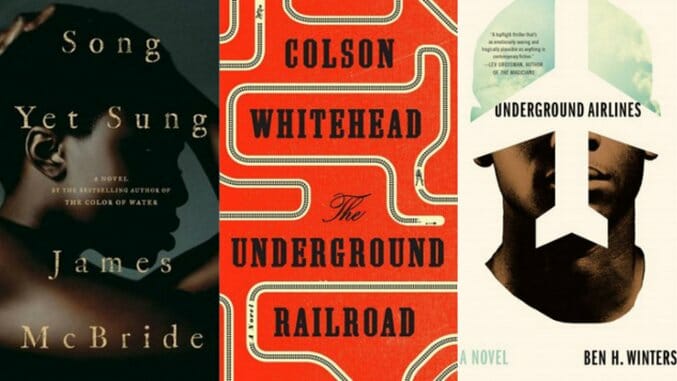
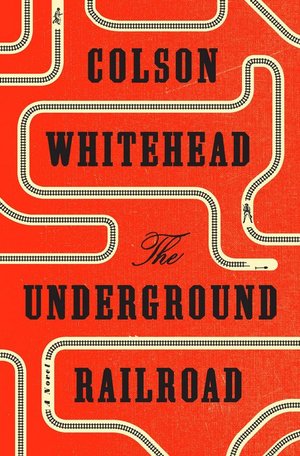 Colson Whitehead’s The Underground Railroad, the much-acclaimed new novel from the author of such piercing works as The Intuitionist and John Henry Days, bears powerful echoes of both pre-Civil War slave narratives and slave testimony gathered for the Works Progress Administration’s Federal Writers Project of the 1930s. As its title suggests, Whitehead’s book delves into the Underground Railroad, the widely mythologized assemblage of “tunnels, disguises, mysterious codes, midnight rides and hairbreadth escapes” (as historian Fergus Bordewich describes) through which legendary conductors like Harriet Tubman helped thousands of slaves escape to freedom. But the magic realist bent of Whitehead’s novel and its unorthodox take on the Underground Railroad make it hard to pin down.
For one thing, Whitehead defies historians’ de rigueur disclaimer: Though so named because of Americans’ incipient fascination with railroads at the turn of the 19th Century, the Underground Railroad was neither underground nor railroad. In Whitehead’s book, the Underground Railroad is quite literally a subway, albeit a desolate and frightfully unpredictable one.
The novel recounts the harrowing journey of a teen named Cora who escapes a Georgia plantation on the Underground Railroad. After multiple journeys, Cora recalls with bitter irony the advice of the first white conductor she encountered:
“If you want to see what this nation is all about, you have to ride the rails. Look outside as you speed through, and you’ll find the true face of America. It was a joke, then, from start. There was only darkness outside the windows on her journeys, and only ever would be darkness.”
By beginning Cora’s odyssey in Georgia, Whitehead immediately departs from the common historical locus of many Underground Railroad accounts. Most fugitives who succeeded in escaping slavery started relatively close to free states—usually in Kentucky or Maryland’s Eastern Shore. Few narratives of the abolitionist era captured life in the slave-labor camps (imbued with false gentility as “plantations”) in the cotton kingdom of the Deep South, because so few fugitives from this region ever made it to freedom.
Whitehead’s departure from a rigorous adherence to history gives him the latitude to explore and expose horrors that wouldn’t fit in a more linear book. Like Harriet Jacobs, author of the essential slave narrative Incidents in the Life of a Slave Girl, Cora flees concubinage on the Randall plantation in Georgia after watching a captured fugitive publicly whipped and roasted over an open fire. Whitehead evokes Jacobs again when the railroad deposits Cora in North Carolina, where whites have “abolished niggers,” trading slavery for genocide. And like Jacobs, who literally spent years in an attic crawl space waiting for an opportune moment to escape, Cora too must hide in an attic. Jacobs’ torture was watching her own children pass by through a tiny “loophole” in the attic wall; Cora’s window on the world reveals minstrel shows and public lynchings.
Another train ride delivers Cora to a free community in South Carolina, where blacks seem to live peacefully alongside whites. This benignly paternalistic environment soon unravels into a sinister scene of scientific experimentation and mass sterilization masked as a public health program. This episode evokes the serial racial abuses of South Carolinian “Father of Gynecology” J. Marion Sims, who experimented on the skull-bone alignment of living slave children and performed operations, without anesthesia, on the vaginas of 10 different enslaved women—one of them as many as 30 times—to test new surgical techniques.
Perhaps the most quietly unsettling part of the South Carolina section involves Cora’s temporary job at a Living History museum of the American experience. Cora rotates between scenes where she plays an African boy employed as a deckhand on a slave ship and a plantation slave tasked with thread-spinning and feeding chickens with imaginary seed. Black actors serve as the only living exhibits in the Living History museum; whites, such as the captain of the slave ship, are portrayed by wax figures. Encouraged to make conversation with the wax figures to add drama for the audience, Cora asks the captain, “What do you say, Skipper John? Is this the truth of our historic encounter?”
This is vintage Whitehead, operating at the seemingly narrow nexus of race, culture and media while illuminating everything around it. That Cora’s story seems far out of sequence and specificity of historical moment becomes utterly irrelevant at this point, as she raises a question plumbing a vexing problem that persists today.
Ben H. Winters’ Alternate History
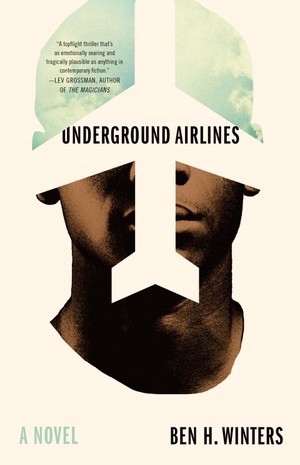
Ben H. Winters, of The Last Policeman trilogy fame, takes a view of the Railroad even more askew than Whitehead’s. Underground Airlines is set in an alternate present where the Civil War never happened and four southern states continue to exploit slave labor in a modernized context. The book’s narrator and central character, Victor, is a slave who’s been enlisted to pose as an agent of an anti-slavery network known as Underground Airlines. And though his ambivalence about his work mounts as he pursues his current target, the tech-savvy and resourceful Victor is exceptionally good at his job.
 Much of Underground Airlines’ fascination comes in the subtle alterations Winters has made in the intervening years since the Civil War that never happened. At one point, an Underground Airlines agent laments the “Mockingbird mentality” of many blacks who expect white folks to save them. Victor hastens to explain to the reader that the agent is “talking about that novel, about the Alabama runner who is discovered hiding in a small Tennessee town, and the courageous white lawyer who saves him from a vicious racist Deputy Marshal who comes to claim him… The hero of the book, the hero and the heart, is that good man lawyer: the white man is the saver, the black man gets saved.” In addition to his twist on Harper Lee’s To Kill a Mockingbird, Winters might also be describing every historical tale about the Underground Railroad in the first 100 years after the Civil War, with the notable exception of the tireless black abolitionist, conductor, testimony-taker and historian William Still.
Even as it ventures into alternate history, Underground Airlines gets many things “right” about the era of the Underground Railroad and the Fugitive Slave Act that, in this context, never ended. Even in a country with only four slave states out of 48, upholding slaveholders’ property rights essentially renders slavery the law of the land nationwide. Thus the idea of the network as an airline “is a figure of speech, the root of a grand extended metaphor… A plane is big and hard to hide, and defending the sovereign air space of the several states is an enumerated responsibility of the National Guard.”
Even more to the point, Winters offers this take on the most common, least reported means of escape: “The other thing to remember, of course, was that most people got no help at all… No planes and no cars, or truck, either. Just some brave sad souls darting across open fields and wading in shallow streams and moving from tree line to tree line. Find the star and follow it, run like runners have done, all the way back to the days of Old Slavery.”
James McBride’s Magical Realism
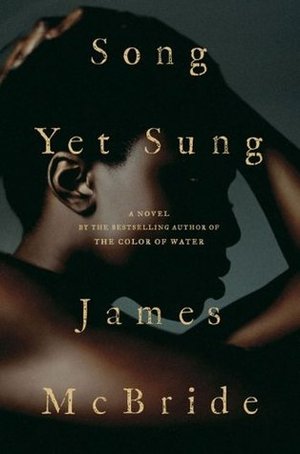 James McBride’s entrancing Song Yet Sung (2008) instead dabbles in a magic realist interpretation of the Underground Railroad, mingling a gritty tale of fugitives and slave catchers in Dorchester County, Maryland with a plunge into the mythology surrounding iconic Underground Railroad conductor Harriet Tubman. Tubman, a Dorchester County native herself, appears in two distinct characters: the spectral presence of “Moses,” a fearless “Gospel Train” conductor reputed to threaten runaways with death if they decide to turn back, and Liz, a “two-headed” escaped slave who experiences vivid dreams during narcoleptic collapses. Tubman herself, bashed in the head by an overseer with a two-pound weight as a young girl, “suffered headaches, seizures and ‘fits of somnolency’” throughout her life, “causing her to fall unconscious for minutes at a time, and pushing a mind already fertilized by evangelical religion into a feverish mysticism that awed those who came into contact with her,” Fergus Bordewich writes in Bound for Canaan: The Underground Railroad and the War for the Soul of America.
At the heart of Song Yet Sung are Liz’s dreams—premonitions of internecine violence within the black population far into the future, and then, with more insistence, a vision of a black preacher addressing a massive integrated crowd at a “big camp meeting” that turns out to be Martin Luther King, Jr. speaking at the March on Washington. In one of the novel’s indelible moments, Liz describes this dream to an old conductor on the Gospel Train, explaining how the preacher’s sermon reaches a climactic moment as he intones, “Free at last, free at last! Thank God Almighty, I’m free at last!” After reflecting for a moment on her vision, the old man asks, “If the preacher you seen in your dream was hollering ’bout being free… well, then, he wasn’t free, now, was he? How long that gonna take?” Liz replies, “I said I would tell you of tomorrow. I didn’t say tomorrow wasn’t gonna hurt.”
The Ancestors of 21st-Century Railroad Narratives
Perhaps the most well-known book to engage with the Underground Railroad since Uncle Tom’s Cabin is Toni Morrison’s Pulitzer Prize-winning Beloved (1987). Though constructed more like an impressionistic prose poem, Beloved takes well-known events in the history of slavery and abolitionism as a jumping-off point. Morrison’s Sethe, a free black woman living in Cincinnati several years after the Civil War, is modeled partly on Margaret Garner, a woman who escaped slavery in Kentucky in 1856 with her four children, her husband and his parents. Discovered by slave catchers in a house on the outskirts of the city, Margaret cut the throat of her two-year-old daughter to keep her from being returned to bondage and nearly killed her 10-month-old daughter before deputies snatched away her weapon.
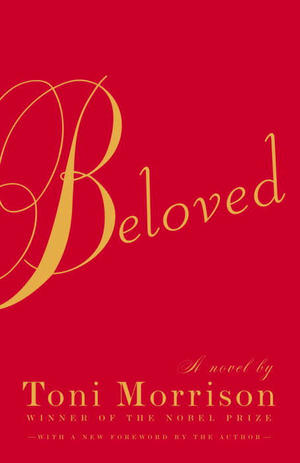 In Beloved, Morrison imagines the aftermath of Garner’s choice, reflecting the real-life ambivalence that her act engendered among a nation more polarized than ever on slavery in general—and the Fugitive Slave Act in particular. Beloved concerns itself with the local reaction among Cincinnati’s black population, rather than the response of abolitionists on a national level. Sethe’s “rough response” to her dilemma draws ostracism from nearly all of the women in town, but Stamp Paid, the Underground Railroad conductor who helped Sethe’s family to freedom, refuses to condemn her.
One might consider Beloved and Uncle Tom’s Cabin the parent and grandparent to contemporary Underground Railroad novels, though only Beloved retains all of its considerable power. Uncle Tom’s Cabin reads somewhat problematically now, too forgiving to mid-Atlantic slave owners, saddled by dated descriptions of “woolly headed boys,” choosing as its hero the nobly accommodationist Uncle Tom. But Stowe’s achievement should not be underestimated. Uncle Tom’s Cabin is best understood as a book calculated to engage white readers at a point of national crisis in 1852 and win their allegiance to the abolitionist cause.
In Uncle Tom’s Cabin’s most riveting scene, an enslaved woman named Eliza manages a daring mid-winter escape across the Ohio River, jumping from one ice floe to another while carrying her four-year-old son. Questioned about the authenticity of this scene, Stowe insisted, in A Key to Uncle Tom’s Cabin, that the real Eliza’s escape happened almost exactly as she told it: “I got the story from the very man that helped her up the bank. I know it is true, for she is now living in Canada.”
Parallels between Uncle Tom’s Cabin and Beloved are few, but if one scene in Beloved might be said to allude to Eliza’s escape, it’s the ineffably lovely scene where Sethe resolves to “lay it all down” and takes her two grown daughters skating on the frozen creek in a fleeting interlude of laughter in their lives. The ice inspires moments of unmitigated joy that are the diametric opposite of Eliza’s abject terror, as if insisting that moments such as these should have awaited every fugitive on the other side of the icy river, though they rarely did.
The Whole Story
In a recent interview with NPR about his research for The Underground Railroad, Whitehead discussed his reliance on slave narratives and remarked, “I actually didn’t research the slave catcher’s point of view. I think the slave catcher’s point of view is probably the default setting on American history.” In the modern-day United States, where the century’s most potent racial justice movement has emerged in response to the aggressive tactics of racial-profiling police, and a real estate mogul and reality TV star has made himself a national populist hero by goading the president of the United States into showing his papers, Whitehead’s point about the prevalence and persistence of the slave catcher’s point of view seems hard to dispute.
So if the definitive novel on the Underground Railroad hasn’t been written yet, maybe that’s because it’s a topic that no single novel can define or fully represent. Or maybe it goes back to the timeless maxim of the keepers of African American oral tradition: “Never tell the whole story to anyone at one time.”
Steve Nathans-Kelly is a writer and editor based in Ithaca, New York.
 Keep scrolling for more great stories.